
Building and Construction in Sydney: What Does it Actually Cost to Build Your Dream Home?
Let’s be honest for a second. You’ve probably spent hours scrolling through Pinterest or Instagram, looking at those pristine, sun-drenched Sydney living rooms, thinking, "I want that." But then you look at your bank account, then back at the housing market, and a familiar knot starts forming in your stomach.
Building a home is arguably the most significant financial and emotional rollercoaster you’ll ever ride. It’s exciting, sure, but it’s also incredibly stressful. You’re hearing horror stories about "budget blowouts," "dodgy builders," and "supply chain nightmares." You just want to know: How much is this actually going to cost me? No fluff, no sales pitch, just the truth.
In the world of building and construction, the "sticker price" is rarely the final price. Between council fees, site prep, and those "small" upgrades that suddenly cost five figures, it’s easy to feel like you’re losing control before the first brick is even laid. If you’re feeling overwhelmed, you’re not alone. We’ve seen this a thousand times.
Let's break down the real costs of building in Sydney and more importantly, where the hidden traps are waiting.
The Foundation: Why Site Costs Are the Ultimate Budget Killer
You’d think the house itself is the expensive part, but often, it’s what’s under the house that breaks the bank. I once saw a couple in Western Sydney who found a "bargain" block, only to realize they needed nearly $80k in additional piering because the soil was essentially play-dough.
The "Nasty" Soil Test Surprise
Before any building and construction begins, a soil report (geotechnical report) is mandatory. If your land has "reactive" clay or is classified as Class P (problematic), your footings need to be deeper and stronger. This isn't just a minor fee; it’s thousands of dollars literally buried in the ground where you’ll never see it.
The Slope Tax
Sydney isn't flat. If your block has a bit of a "character" (read: it's a hill), you’re looking at retaining walls and specialized drainage. Many homeowners look at a slope and see a view; a construction company looks at a slope and sees massive excavation costs.
Hidden Rock and Debris
You never really know what’s under the surface until the digger hits something. Striking "hard rock" can slow down a project by weeks and add daily hire rates for heavy-duty machinery. It's one of those things that makes you want to pull your hair out because you're paying for... well, nothing happening quickly.
Connection and Infrastructure Fees
Getting electricity, water, and sewage to your "perfect spot" isn't free. If your block is at the end of a long driveway or in an older area with outdated mains, the utility companies will charge a premium just to say "hello."
Understanding the numbers is usually the moment where the "dream" meets the "budget." It can be a bit of a reality check, but having these figures upfront is exactly what keeps you from a mid-build panic.
In 2026, the building and construction market in Sydney has stabilized, but the baseline is higher than it used to be. Here is a breakdown of what you can expect to pay per square meter ($/m^2$) and how that translates to a total project.
2026 Sydney Construction Cost Estimates
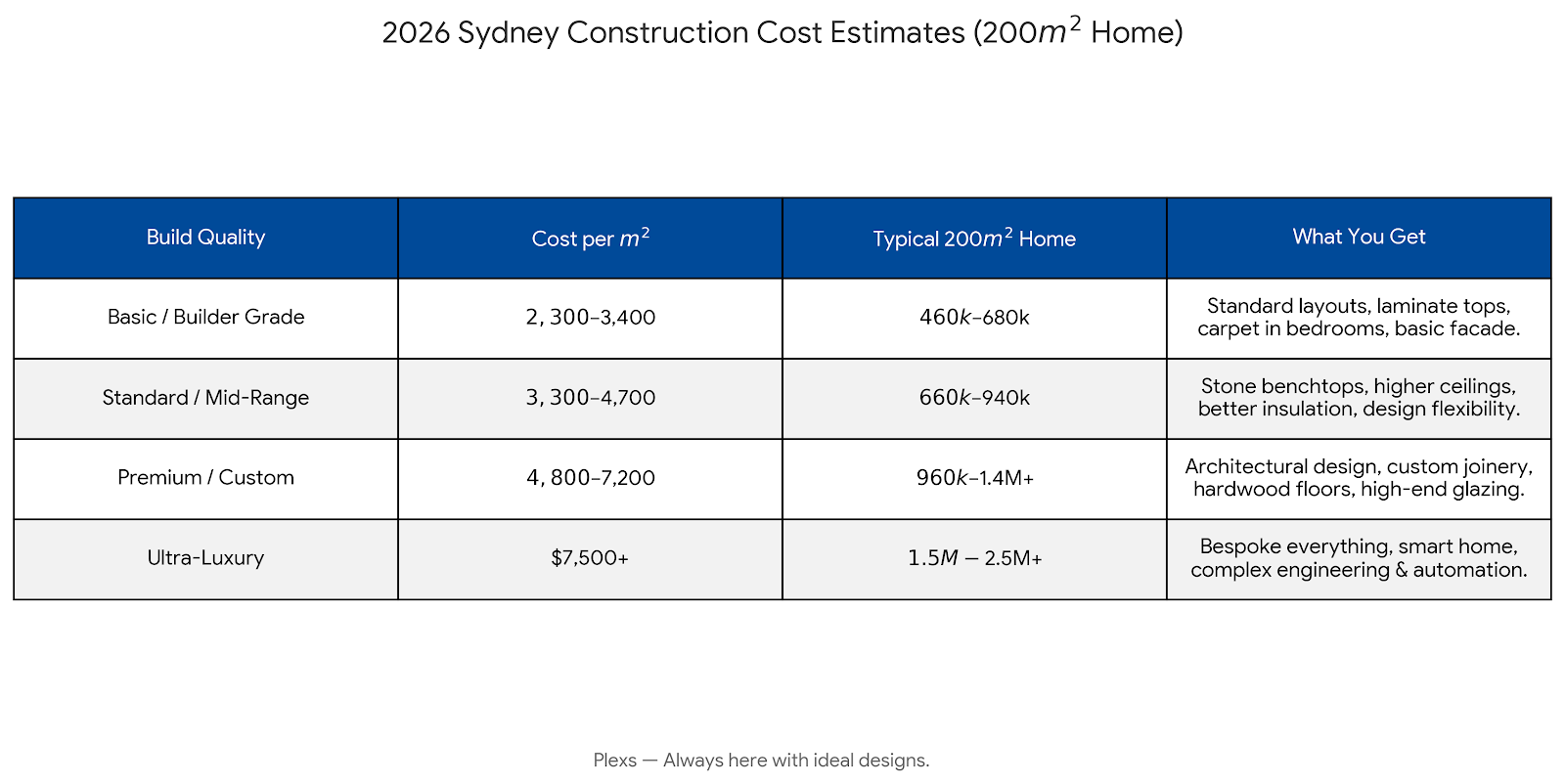
Bespoke everything, complex engineering, smart home automation.
Where Does the Money Actually Go?
If you're looking at a $600,000 build, it’s not just one big lump sum. It’s a million little things that add up. Here is a typical percentage breakdown for building companies in Sydney, NSW:
Structure & Framing (26%): The "bones" of the house.
Fit-out & Finishes (25%): Kitchens, bathrooms, tiling, and painting.
Mechanical & Services (18%): Plumbing, electrical, and HVAC systems.
Site Works & Foundations (13%): Earthworks, slabs, and getting the land ready.
Windows & External Doors (9%): The "envelope" of your home.
Professional Fees (9%): Council permits, engineers, and building certificates.
Hidden "Pre-Build" Expenses
Before a single brick is laid by your construction company, you’ll likely need to account for these "invisible" costs:
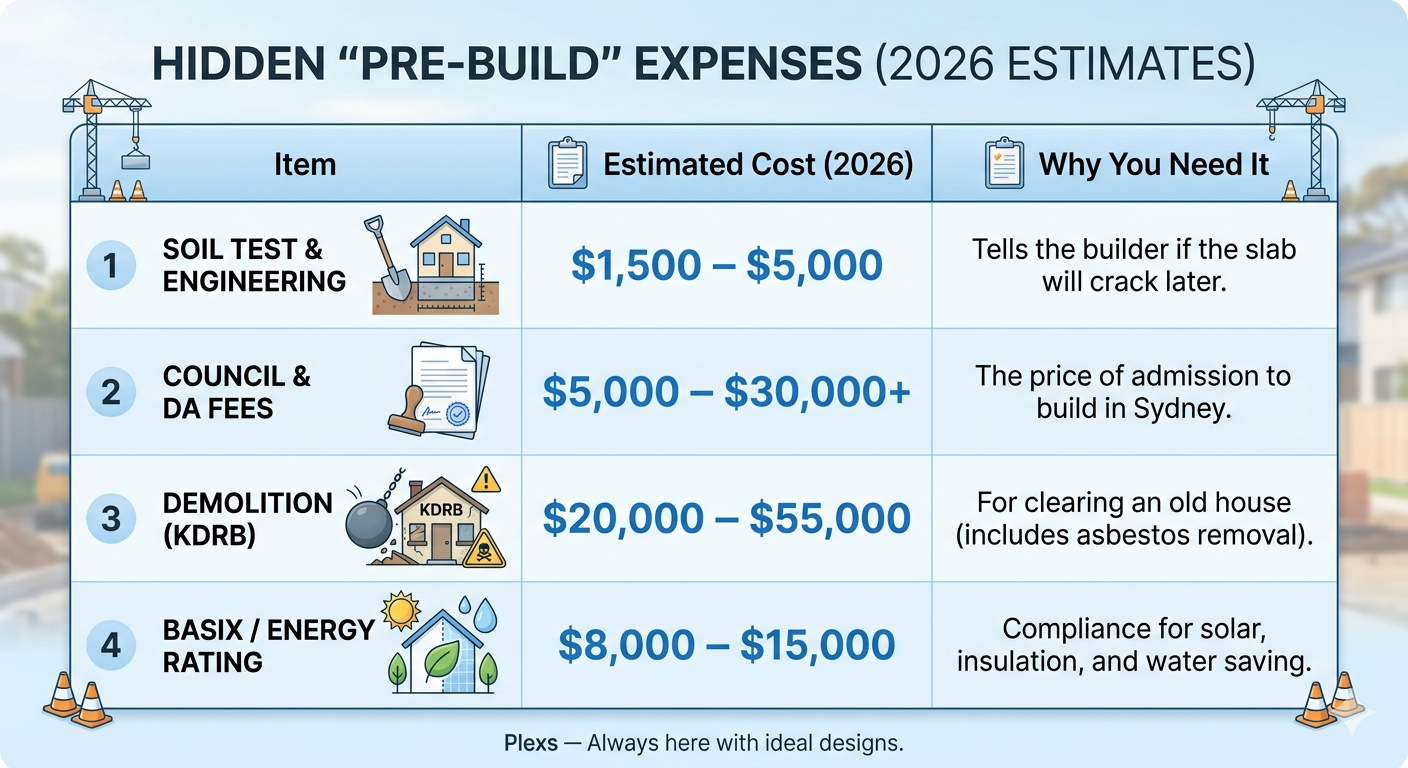
A Quick Human Note: > I always tell people to add a 10-15% contingency buffer. If the digger hits a giant rock or you suddenly decide that the "standard" tile just won't do, that buffer is the only thing standing between you and a very awkward conversation with your bank manager.
The Frame and Shell: Why Material Choices Change Everything
This is where the house starts looking like a house, and where the "per square meter" price starts to fluctuate wildly. People often ask me if they should go with timber or steel. There’s no easy answer, but your choice dictates your long-term maintenance and your immediate debt.
The Timber vs. Steel Debate
Timber is traditional and generally easier to work with, but with Sydney’s humidity and the occasional termite threat, steel is becoming popular. Steel is precise, but it can be noisier and more expensive upfront. I’ve seen homeowners insist on steel for "peace of mind," only to realize they had to cut back on the kitchen to afford it.
Brick Veneer vs. Double Brick
Most building companies in Sydney, NSW default to brick veneer because it’s cost-effective and provides decent insulation. If you’re dreaming of that solid, old-school double-brick feel, be prepared for your labor costs to nearly double. It’s a classic case of aesthetic vs. reality.
Windows: The Invisible Money Pit
We all love those floor-to-ceiling glass walls. But in the building and construction world, glass is heavy, fragile, and requires serious structural support. Plus, if you want energy efficiency (which you definitely do in our summers), double-glazing adds a significant premium.
Roof Selection: Tiles or Colorbond?
Concrete tiles are the budget-friendly standard, but Colorbond is the "cool" Sydney choice. It’s lighter and handles the heat well, but the price tag can be a shock if you haven't budgeted for the specific acoustic insulation needed to keep the rain noise down.
The "Builder Service Sydney" Reality: Labor and Logistics
The people you hire and how they manage the site make or break your budget. It’s not just about the hourly rate; it’s about the "Sydney factor."
The Skills Shortage Squeeze
Right now, finding a reliable builder service in Sydney is like finding a parking spot at Bonnyrigg Plaza on a Saturday morning. Good trades are in high demand. If a quote seems way lower than the others, ask yourself: Why are they so cheap? Usually, it’s because they’re cutting corners or won't show up.
Logistics and Site Access
If you’re building near Lincoln Square or in a tight suburb like Surry Hills, getting a concrete truck or a crane onto the street is a logistical nightmare. Traffic control, council permits for blocking the road these "boring" details add up to thousands before a single nail is driven.
The Role of the Project Manager
You might think you can manage the build yourself to save money. Unless you have a background in civil construction, I’d advise against it. A missed delivery or a trade showing up on the wrong day can cascade into weeks of delays. A professional construction company earns their keep by keeping the gears turning.
Construction Insurance and Compliance
Don't skip the "boring" stuff. Construction insurance is non-negotiable. From Home Building Compensation (HBC) cover to Public Liability, these protections keep you from losing your life savings if something goes wrong. It's a "grudge purchase," sure, but you'll sleep better.
Internal Finishes: Where "Budget" Goes to Die
This is the part where emotions take over. You go to a showroom, see a $4,000 bathtub, and suddenly your $800 budget bathtub looks like a bucket.
The Kitchen "Add-ons"
Everyone wants stone benchtops and soft-close drawers. But "Category 1" stone is very different from "Category 5" marble. I've seen homeowners spend an extra $15k just on a specific shade of white. It's easy to get caught up in the moment, but these are the costs that sneak up on you.
Electrical and Lighting Plans
Standard builds come with a few "batten" lights and a couple of power points per room. But we live in a digital age. Once you add downlights, USB ports, outdoor lighting, and smart home features, you’re looking at a $10k+ electrical bill that wasn't in the initial brochure.
Flooring: The Foundation of Comfort
Hardwood looks stunning but costs a fortune in labor and material. Hybrid or laminate flooring is much more "family-friendly" and easier on the wallet. It’s about deciding where you want to feel the luxury vs. where you need durability.
Joinery and Storage
Built-in wardrobes are often treated as an afterthought. Then you realize you have nowhere to put your shoes. Custom joinery is beautiful, but it requires a specialized builder service in Sydney to execute correctly, and that craftsmanship comes at a price.
Solutions You Can Try (To Save Your Sanity and Your Wallet)
Look, you don't have to be at the mercy of every invoice. Here is how you can actually take some control back.
Step 1: Get a Fixed-Price Contract
Don't settle for "cost-plus" contracts unless you have an infinite budget. A fixed-price contract with a reputable construction company protects you from material price hikes (within reason) and gives you a clear finish line.
Step 2: Choose Standard Designs (with Tweaks)
If you're working with building companies in Sydney, NSW, look at their "off-the-plan" designs. These have been optimized for cost and efficiency. You can usually customize the interiors without redesigning the entire structural frame.
Step 3: DIY the "Easy" Stuff (Maybe)
Only take on DIY tasks that don't require a license. Painting, landscaping, or installing your own deck can save you money but only if you actually have the time and skill. If a pro has to come in and fix your mistake, it’ll cost you double.
Step 4: Prioritize the Envelope
Spend your money on the things you can't change later. Better insulation, high-quality windows, and a solid foundation. You can always upgrade a laminate benchtop to stone in five years, but you can't easily add wall insulation once the plaster is up.
Wrapping It Up
Building a house in Sydney is a marathon, not a sprint. It’s going to be messy, there will be days when you regret the whole thing, and you’ll definitely learn more about plumbing than you ever wanted to know.
But at the end of the day, when you’re sitting in that living room, the one you dreamed about and the Sydney sun is hitting the floor just right, the stress will start to fade. The key is to go in with your eyes open, a realistic budget in hand, and a team you actually trust.
You've got this. Take a breath, do your research, and don't be afraid to ask the "stupid" questions. There are no stupid questions when it’s your house on the line.
Plexs — Always here with ideal designs.
