
AI vs Traditional Construction Management: Why Australian Builders Are Shifting to Construction Software
You know the feeling. It’s 5:30 PM on a Friday. The site is quiet, but your mind is racing. You’re staring at a spreadsheet that doesn’t quite add up, waiting on a subcontractor who hasn't replied to three emails, and wondering how a two-week buffer completely vanished.
At first, it looks harmless, a minor delay on material delivery here, a slight miscommunication with a subbie there. But yeah… this gets expensive fast.
For decades, the Australian building sector has relied on traditional project management. We've used gut instinct, massive paper blueprints, and endless chains of disconnected emails. We convinced ourselves that because we were working hard, we were working efficiently. But most builders don’t realize how broken this system is until it’s too late. The friction between strategic management and project management is real. While the corporate office sets long-term goals, the team on the ground is just trying to survive the day without a budget blowout.
The truth? Relying on outdated methods means you are flying blind. Between fluctuating material costs, labour shortages, and razor-thin margins, managing a site today with yesterday’s tools is a recipe for extreme stress.
But things are shifting. Artificial intelligence isn’t a futuristic concept anymore; it’s rewriting how we build. Let’s look at what is actually happening on modern jobsites, why traditional management is failing your bottom line, and how cutting-edge construction software is bridging the gap to save your sanity.
1. The Broken Promise of the Paper-and-Spreadsheet Era
We’ve all been there. You walk into a site shed and see a massive whiteboard covered in fading marker lines, surrounded by printed schematics that were updated three revisions ago. It feels familiar. It feels like real work.
But honestly? This is where builders lose thousands of dollars every single week.
Traditional project management treats a live, unpredictable jobsite like a static equation. It assumes everything will go according to plan. When you rely on disjointed spreadsheets or basic desktop folders, you aren’t managing a project; you are chasing its ghost. Information is always delayed, and by the time you realize a mistake was made, the concrete is already cured.
The Silo Nightmare Between Office and Site
When your documentation isn't centralized, your office staff and your site managers live in two entirely different worlds. The strategic management and project management goals fall completely out of alignment. The executives are looking at high-level forecasts, while the site supervisor is manually tracking deliveries on the back of a timber offcut.
Without a unified construction management software platform, critical updates get lost in translation. A structural change approved by the engineer stays sitting in an inbox, while the crew on-site continues installing a framing layout that is now obsolete. The result? Frustration, finger-pointing, and thousands of dollars in avoidable rework.
The True Cost of Delayed Field Data
Waiting for weekly paper reports is a massive risk. If you only discover a grading error or a structural conflict five days after it happened, you’ve already paid for the labour, the materials, and the machinery.
Modern projects require modern oversight. Without real-time construction site monitoring software, you are essentially driving down a highway while looking exclusively in your rearview mirror. You see where you’ve been, but you have no idea what you’re about to crash into.
2. Why Your Cash Flow is Bleeding Under Traditional Methods
Let’s talk about the monster that keeps every business owner awake at 2:00 AM: cash flow management in construction. A project can look incredibly successful on paper, stunning architecture, great client relationships, steady progress and still bankrupt the company if the cash timing is off.
Traditional management handles financials retrospectively. You pay the bills, invoice the client, and hope the gap doesn't break you. But when you are balancing multiple major projects across Australia, that guesswork becomes incredibly dangerous.
Balancing the Scales: Opex and Capex
Understanding the fluid balance between opex and capex (operational expenditure and capital expenditure) is vital for long-term survival. Traditional systems lump these costs together into generic buckets. You might purchase a heavy piece of equipment (capital expenditure) without realizing how its ongoing maintenance and transport costs (operational expenditure) are draining your daily liquid cash.
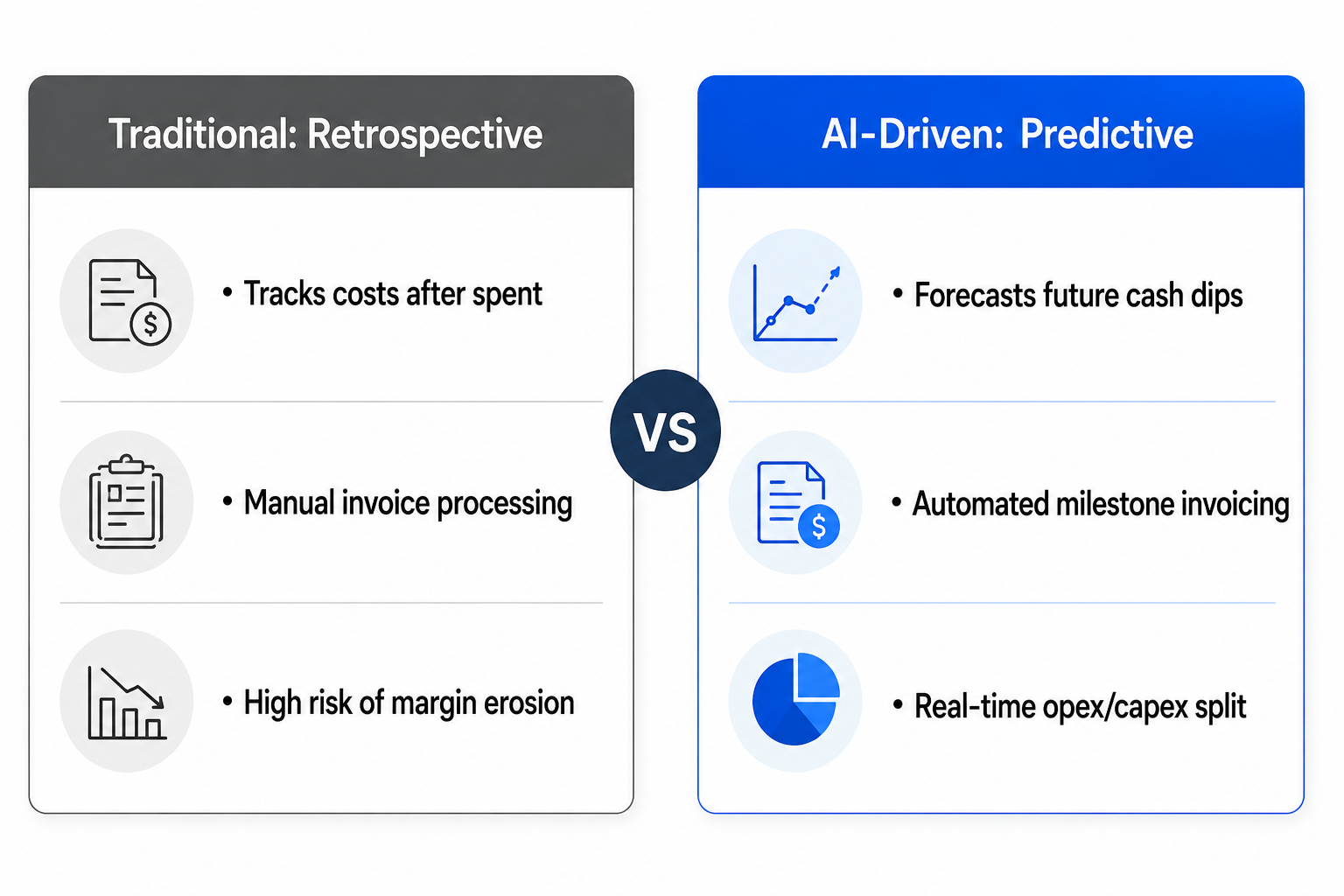
When you integrate dedicated software for construction management, these financial streams are categorized automatically. You get clear visibility into your true operational costs before they threaten your payroll.
The Danger of Inaccurate Estimating and Budgeting
Manual estimating and budgeting is heavily vulnerable to human error. Missing a single line item for regulatory fees or underestimating material inflation by just 4% can completely erase your profit margin.
AI-powered systems don't guess. They analyze historical project data, current market rates across Australia, and subbie availability to generate highly accurate estimates. This keeps your bids competitive without forcing you to swallow unexpected costs down the line.
3. The AI Revolution: Changing How We Track Progress
So, what does an AI-driven project actually look like? It’s not about robots laying bricks. It’s about total visibility, predictive insights, and absolute control over your jobsite.
Instead of wondering if your team is on schedule, modern builders use construction progress monitoring software to capture the exact reality of the site daily. By utilizing camera feeds, drone scans, and mobile updates, the software compares physical progress directly against your digital blueprint.
Predictive Issue Resolution
Imagine an algorithm noticing that your framing team is averaging 12% slower than planned due to site access constraints. Instead of waiting for a milestone delay next month, the platform flags the trend in week one. It alerts your epcm planner (Engineering, Procurement, Construction Management) immediately, allowing you to reallocate resources or adjust subsequent trades before the schedule derails.
The Role of Construction Monitoring Tools
By integrating advanced construction monitoring tools, tracking becomes passive rather than a chore. Site teams simply walk the floor with a 360-degree camera mounted to their hardhats.
The software automatically maps the imagery to your project schedule, updating stakeholders across the country instantly. No more long, descriptive email updates; just objective, visual facts.
4. The Hidden Chaos of Document Control and How to Fix It
If you want to see a project manager break down in tears, ask them to find the structural engineering revision from three months ago that altered the slab thickness.
In traditional environments, files are scattered across personal laptops, WhatsApp threads, and printed folders. It feels chaotic because it is. This is exactly where question marks turn into lawsuits.
What is an EDMS and Why Do You Need One?
To solve this, modern firms rely on a centralized document ecosystem. But what is an EDMS? It stands for an Electronic Document Management System. When deeply embedded within your construction software, it acts as the single source of truth for the entire business.
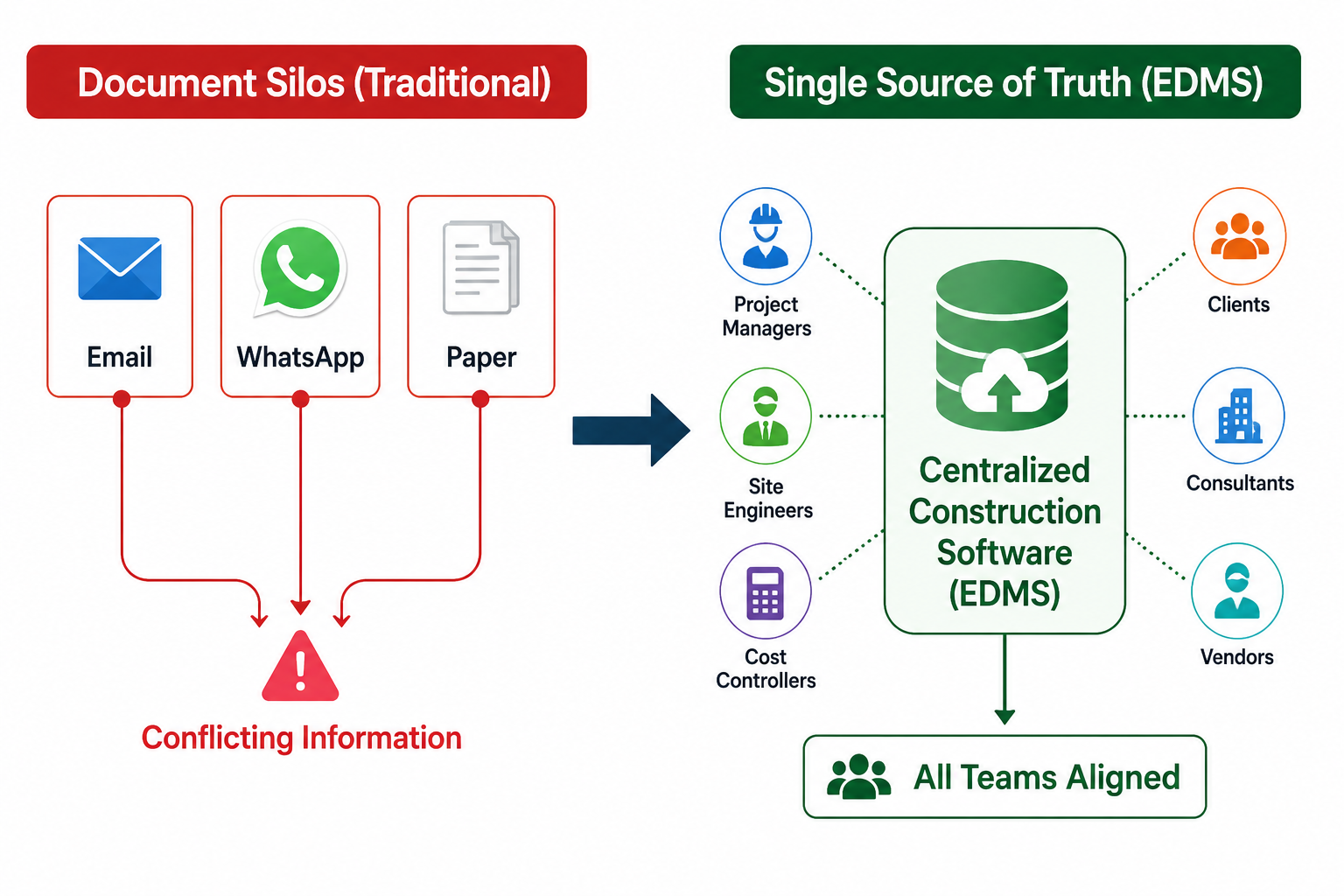
Every RFI, change order, architectural alteration, and safety permit is timestamped, categorized, and linked to the specific asset it impacts.
Streamlining the Architecture Portfolio
For design-build firms, managing an expanding architecture portfolio alongside active construction drawings is a massive headache. If a client requests a change during the design phase, that adjustment must reflect perfectly on-site.
An intelligent EDMS ensures that the moment a plan changes in the design office, the obsolete version is automatically watermarked and archived for the site team. This completely eliminates the nightmare of building from outdated documents.
5. Agile Methodology and Handling the Inevitable Project Changes
"Change is the only constant in construction." Every builder knows this quote intimately. A client changes their mind on finishes, Council imposes a new zoning restriction, or unexpected rock is struck during excavation.
Traditional management treats changes like a major crisis, resulting in paperwork delays, disputes, and halted work. But forward-thinking firms are adopting agile principles borrowed from the technology sector to navigate these pivots smoothly.
Managing Change Without Losing Your Mind
Implementing change management in agile methodology means breaking down a massive, rigid construction timeline into flexible, manageable phases. When a change occurs, the entire system doesn't break down. Instead, the shift is absorbed into the next phase smoothly.
By utilizing dynamic construction project tracking software, the ripple effects of a change order, on material orders, labour schedules, and client budgets, are calculated instantly, letting you secure signed approvals in minutes rather than weeks.
The Power of Agile Change Management
Embracing agile change management keeps your business remarkably resilient. Instead of fighting changes, your project delivery structure adapts around them.
Traditional Change Loop:
Identify Change ──► Manual Estimating ──► Delay Work ──► Dispute ──► Signed Variation
Agile Change Loop:
Identify Change ──► AI Software Impact Model ──► Instant Digital Approval ──► Seamless Shift
This flexibility prevents your team from getting stuck in administrative loops, ensuring that minor adjustments don't turn into major project roadblocks.
6. Blueprint to Reality: Smart Frameworks and Solution Architecture
Building a complex commercial space or custom home requires a massive amount of moving parts. To keep everything organized, high-growth construction companies are hiring specialized technical experts to design their operational systems.
This isn't about hiring another site manager; it’s about treating your entire business infrastructure like a beautifully engineered structure.
Crafting a Flawless Product Breakdown Structure
Before a single shovel touches dirt, you need a crystal-clear understanding of every single deliverable. A product breakdown structure (PBS) decomposes the final asset into its foundational components.
Instead of a vague task like "Build Second Floor," the PBS breaks it down into structural steel elements, concrete decking, fireproofing, rough-in plumbing, and HVAC zones. When this structure is built into your construction software australia platforms, tracking costs and timelines becomes completely transparent.
The Role of a Solution Architecture Specialist
Many mid-to-large building companies now rely on a certified system architect or a solution architecture consultant to tie their technology systems together. These professionals look at how your field data interacts with your accounting software, estimating tools, and client portals.
They ensure that your information flows seamlessly across departments without manual data entry. This level of organization allows management to maintain precise monitoring controlling over multiple complex projects simultaneously, preventing small budget leaks from becoming major structural losses.
7. Elevating Your Management Strategy for Long-Term Growth
To scale a construction company in today's cutthroat market, leaders must transition away from everyday firefighting. You can't grow a business if you spend your entire week driving between sites to settle basic communication disputes.
True growth requires an investment in your people and a deep commitment to modern management frameworks.
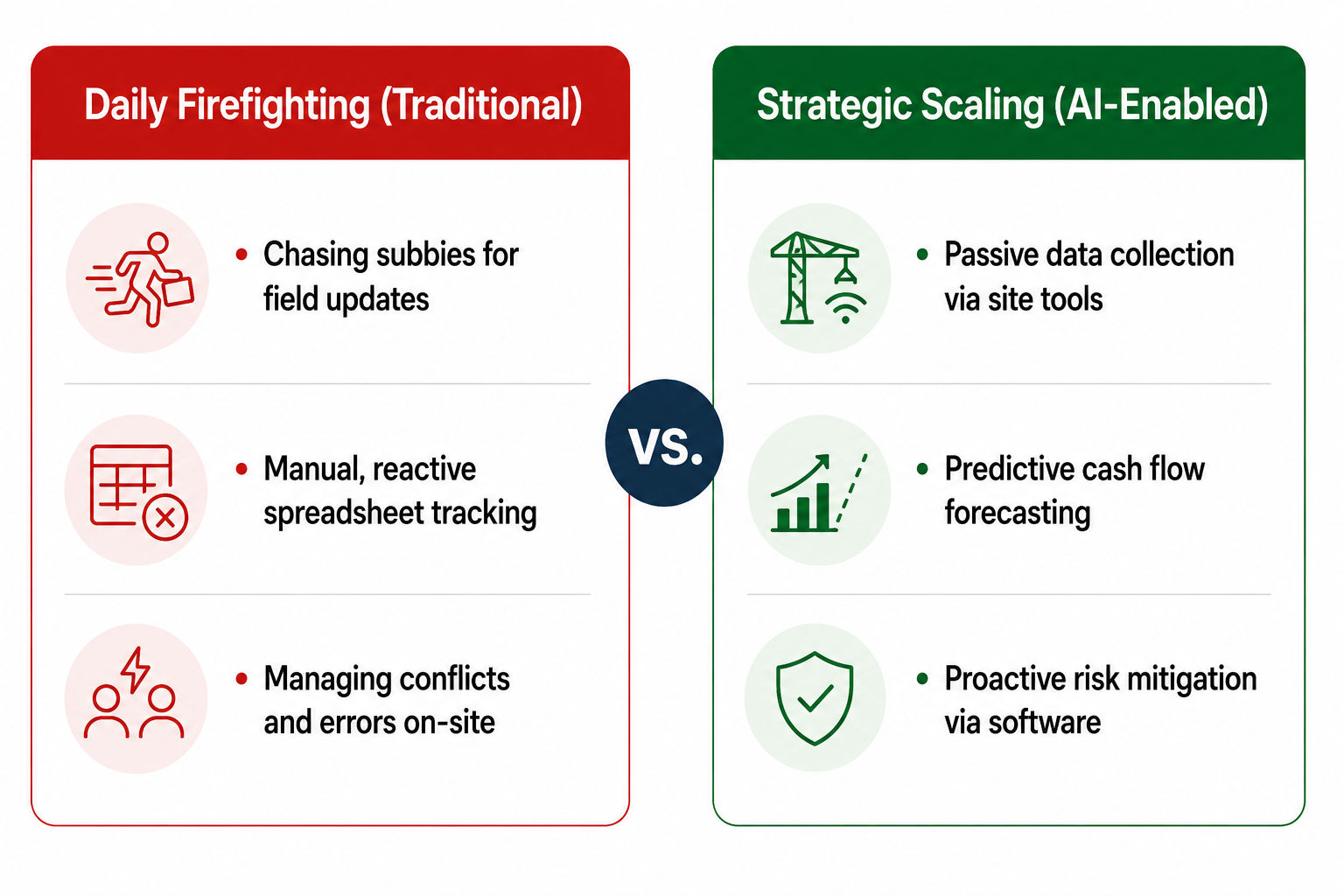
Bridging Strategy and Execution
The core challenge in our industry has always been linking strategic management in project management contexts. High-level business choices, like expanding into commercial developments or targeting sustainable builds, must match your field workflows.
Upgrading your operations with advanced construction software lets you easily see if your real-world site performance matches your long-term corporate goals.
Investing in the Future of Your Team
Tools are only as good as the people running them. Progressive construction firms are putting their project leads through modern product management courses that emphasize empathy, problem-solving, and analytical thinking.
By teaching your leadership teams principles like design thinking, they learn to look at site challenges through a collaborative lens. This shifts the culture from blaming subcontractors for errors to proactively designing workflows that eliminate mistakes before they ever happen.
Solutions You Can Try Before Things Get Worse
If your current jobsite feels chaotic, you don't need to completely rebuild your business software stack overnight. Here are highly practical, actionable steps you can implement this week to regain control of your projects, budgets, and cash flow:
1. Centralize Your Documentation Immediately
The Action: Pick a single platform for all project documents, variations, and communications. Ban project discussions on personal WhatsApp or text threads.
The Benefit: Protects your business from costly legal disputes. If a change order isn't recorded in your central system, it didn't happen.
2. Implement a Daily 10-Minute Visual Walkthrough
The Action: Have your site supervisors use a basic 360-degree camera or a dedicated mobile app to capture site progress at the end of every day.
The Benefit: Instantly creates an undeniable record of physical progress. This simplifies disputes with trades and streamlines progress payments with lenders.
3. Conduct a Split Cash Flow Audit
The Action: Review your current active project accounts and explicitly separate your operational costs (opex) from your capital investments (capex).
The Rule: Make sure day-to-day project income directly covers operational run costs without leaning heavily on your capital reserves.
4. Build a Micro Product Breakdown Structure
The Action: For your next major project phase, break the work down into small, measurable parts instead of relying on broad milestones.
The Metric: Never track a phase simply as "50% complete." Track it by specific, objective markers (e.g., "32 of 64 piers poured").
FAQs
-
Yes. While minor hairline cracks in drywall are often just normal house settling, structural cracks wider than 3mm, especially diagonal cracks, steps in brickwork, or cracks above door frames, can indicate significant foundation movement or structural failure that requires professional engineering assessment.
-
Undertaking major renovations without a fully detailed contract, a fixed price, and an independent contingency fund of at least 15-20%. Homeowners frequently request undocumented variations on-site, leading to massive budget blowouts and strained contractor relationships.
-
In 2026, standard kitchen or bathroom renovations across Australia generally run between $25,000 and $60,000+. Full-home structural renovations vary widely based on location and finishes, typically ranging from $1,500 to $3,500+ per square metre.
-
The best construction software in Australia depends on whether you are a residential builder, commercial contractor, or civil construction company. The most widely used construction management software platforms in Australia include:
Procore — best for large commercial construction projects
Plexs
Buildertrend — ideal for custom home builders and residential construction
Autodesk Construction Cloud — strong for BIM, document control, and project collaboration
Buildxact — designed for small Australian builders and tradies
Trimble Construction One — suitable for enterprise construction operations
Monday.com for Construction — flexible project management for growing firms
Modern construction project management software helps builders manage scheduling, budgeting, RFIs, subcontractors, site reporting, compliance, and cost tracking in one platform. Australian builders are increasingly moving away from spreadsheets because integrated construction software improves productivity, reduces delays, and gives real-time project visibility.
-
Remote construction site monitoring works best when you combine cloud-based construction software with mobile field reporting tools.
The most effective construction site tracking methods include:
Real-time site reporting apps
Drone construction monitoring
Mobile daily logs
Cloud-based project dashboards
Live construction cameras
GPS equipment tracking
Digital timesheets
Progress photo management software
Construction monitoring software allows project managers to track labour productivity, delays, completed tasks, safety incidents, and subcontractor activity from anywhere. Site supervisors can upload photos, inspections, and updates directly from mobile devices, while head office teams monitor progress in real time.
Platforms like Procore, Autodesk Construction Cloud, and Buildertrend provide live dashboards for remote construction project management. Many commercial builders also use AI-powered progress tracking and drone mapping to compare actual site progress against schedules.
Construction firms that implement digital project tracking software typically improve communication, reduce reporting delays, and identify project risks earlier.
-
An Electronic Document Management System (EDMS) for construction helps builders organise, store, track, and control all project documents digitally.
Construction EDMS software manages:
Drawings and revisions
RFIs
Contracts
Submittals
Safety documentation
Inspection reports
Site photos
Compliance records
Variations and approvals
The biggest advantage of construction document management software is version control. Site teams always access the latest drawings and specifications, reducing costly mistakes caused by outdated documents.
An EDMS also improves collaboration between project managers, architects, engineers, subcontractors, and clients by creating a central source of truth for project information.
Popular construction document management systems include:
Digital construction document control reduces rework, improves compliance, speeds up approvals, and supports better project accountability.
-
In construction accounting, Capex (capital expenditure) and Opex (operating expenditure) must be tracked separately for accurate budgeting, tax reporting, and financial management.
Capex in Construction
Capital expenditure includes costs related to creating or improving long-term assets, such as:
Building construction
Structural upgrades
Equipment purchases
Infrastructure works
Major renovations
Opex in Construction
Operating expenditure includes day-to-day business costs, such as:
Site utilities
Temporary labour
Equipment maintenance
Fuel
Office administration
Consumables
The best way to separate opex and capex on construction projects is by using construction ERP software or job costing software with cost code structures.
Construction financial management software allows builders to:
Create separate cost categories
Track labour and materials accurately
Allocate expenses correctly
Produce clearer financial reports
Improve tax compliance
Platforms like Premier Construction Software and Trimble Construction One are commonly used for advanced construction accounting and project cost tracking.
-
Agile project management in construction focuses on flexibility, collaboration, and continuous improvement rather than rigid scheduling.
For custom home builders, agile construction management works by:
Breaking projects into smaller stages
Reviewing progress frequently
Adjusting schedules quickly
Improving communication with clients
Responding faster to design changes
Coordinating trades in shorter planning cycles
Agile construction project management is especially useful for custom homes because residential projects often involve:
Client design changes
Material delays
Weather disruptions
Custom finishes
Variation requests
Builders using agile construction software can manage updates in real time through:
Kanban boards
Collaborative scheduling
Mobile progress tracking
Shared client portals
Platforms like Monday.com and Buildertrend support agile workflows for residential construction businesses. Agile systems improve transparency, reduce bottlenecks, and increase customer satisfaction.
