
10 Benefits of Modular Construction for Australian Homeowners
If you have priced up a new build in Australia over the past couple of years, you already know the numbers do not always add up the way they used to. Material costs have climbed, trades are booked out months in advance, and the national housing shortfall now sits above 73,000 homes. That gap is exactly why modular construction has moved from a niche idea to a mainstream option that homeowners from Sydney's Hills District to regional Queensland are seriously considering.
This is not a fringe trend. The Australian modular construction market was valued at roughly 11.8 billion dollars in 2025 and is forecast to grow to somewhere between 16.4 and 17.1 billion dollars by the early 2030s, depending on which industry report you read. That growth is not being driven by hype. It is being driven by homeowners who want a home built faster, priced more predictably, and finished to a consistent standard, without giving up on design or quality.
In this guide we will walk through ten real benefits of modular construction, look at the numbers behind them, be honest about the trade-offs, and give you a practical way to work out whether it is right for your block, budget and location.
What Is Modular Construction, Really?
Modular construction is a building method where sections of a home, called modules, are manufactured in a factory under controlled conditions and then transported to your site for assembly. This is different from a fully site-built home, where every stage happens outdoors, exposed to weather, and different again from a basic kit home, because modular homes are usually built to the same structural and compliance standards as a traditional house.
It sits under the broader banner of off-site construction and prefabricated homes Australia wide, alongside panelised systems and pod construction. The Housing Industry Association and various state planning bodies now recognise modular housing Australia as a legitimate, code-compliant path to home ownership, not a shortcut around building standards.
There are two broad types worth knowing:
Permanent modular construction, designed as a long-term residence, currently makes up around 54 percent of the market and is the category most homeowners are choosing.
Relocatable modular construction, often used for granny flats, site offices or temporary housing, and increasingly popular for rural properties and secondary dwellings.
Why Australian Homeowners Are Turning to Modular Home Builders Australia
Before we get into the ten benefits, it helps to understand why demand has shifted so quickly. A few forces are converging at once.
First, traditional construction productivity has been sliding for decades. Dwellings completed per hour worked have dropped by more than half since the mid-1990s, largely due to skilled labour shortages and fragmented supply chains. Second, government programs including the National Housing Accord and state-based social housing initiatives are actively funding modular and prefabricated projects, which is pushing more builders, tradespeople and material suppliers into the sector. Third, rising material costs (PVC prices alone have jumped around 30 percent) are adding tens of thousands of dollars to traditional builds, which makes the price certainty of a factory-built home more attractive by comparison.
Put simply, modular construction is no longer the alternative. For a growing number of homeowners it is becoming the sensible first option.
1. Faster Home Construction Australia Wide
The single biggest reason people choose modular construction is time. Because your modules are built in a factory while your site is being prepared, footings poured and services connected, two stages of the build happen at once instead of one after another.
Victorian modular projects have reported build times 40 to 50 percent faster than equivalent site builds, and industry data suggests modular projects can shave months off a typical 12 to 18 month traditional build. For a family renting while they wait, or paying two mortgages during a build, that time saving has a real dollar value attached to it, not just a convenience value.
This is one of the clearest advantages of modular homes in Australia, and it explains why councils under pressure to deliver housing quickly, including several in Greater Sydney, have been supportive of fast home construction Australia methods for social and affordable housing programs.
2. Cost-Effective Home Construction and Affordable Modular Homes
Is modular construction cheaper than traditional building? The honest answer is: it depends on the project, but the cost advantages are real and well documented.
Reports on modular projects in Victoria and Queensland put savings in the range of 20 to 30 percent compared to equivalent traditional builds, driven by:
Bulk purchasing of materials by the factory rather than per-project ordering
Less waste, which means less money spent on materials that end up in a skip bin
Fewer weather delays, which in traditional building are one of the most common causes of blown budgets
Reduced on-site labour costs, since a smaller crew is needed for final assembly
Affordable modular homes are also helping first home buyers and downsizers enter the market at price points that would be difficult to reach with a conventional build, particularly on smaller or infill blocks in areas like the City of Canada Bay and Strathfield Council, where land costs already consume a large share of the budget.
3. Sustainable Modular Homes and Reduced Construction Waste
Sustainability is not just a marketing angle for modular builders, it is a structural outcome of how the homes are made. Because modules are built in a factory using precise digital plans, offcuts and material waste are dramatically reduced compared to a site where measurements, cuts and orders can vary from day to day.
Industry estimates suggest off-site manufacturing can cut construction waste significantly compared to traditional methods, while also reducing the number of truck trips and deliveries to your site. For eco-conscious housing buyers in leafy, environmentally engaged council areas such as Ku-ring-gai, Lane Cove, Woollahra and Hunters Hill, this is often just as important as the price tag.
Sustainable building materials, including engineered timber, recycled steel framing and cross-laminated timber, are increasingly used in modular systems, and cross-laminated timber demand in prefabricated construction is forecast to grow strongly through the early 2030s.
4. Energy-Efficient Modular Homes
Because factory conditions allow for tighter tolerances, energy-efficient modular homes tend to have better sealed building envelopes than site-built equivalents, meaning less air leakage around windows, doors and joints. That translates into lower heating and cooling bills over the life of the home, which matters in both the cold winters of the Southern Highlands and the humid summers of coastal New South Wales.
Many modular builders now design to meet or exceed the energy performance targets in the National Construction Code, incorporating:
Higher-rated insulation in walls, floors and roofs
Double glazing as a standard rather than an optional upgrade
Solar-ready wiring and orientation planning
Smart home design features like zoned climate control
For homeowners in council areas with strong sustainability targets, such as the City of Sydney and North Sydney Council, energy-efficient modular homes in Australia are increasingly seen as a straightforward way to meet both personal values and local planning expectations.
5. Custom Modular Homes and Modern Modular Homes
A common misconception is that modular means identical. In reality, custom modular homes have come a long way from the boxy demountable image many people still associate with prefab housing. Builders now offer:
Flexible home designs with adjustable room configurations
A choice of facades, cladding and roof lines to suit heritage overlays in areas like Woollahra and Hunters Hill
Modern modular homes with open-plan living, raked ceilings and floor-to-ceiling glazing
Modular building solutions that can be extended later as a family grows
Custom-designed modular homes in Australia are particularly popular on acreage blocks in the Hills District and Hornsby Shire, where owners want a contemporary look without sacrificing large living spaces or outdoor entertaining areas.
6. Quality Modular Homes Through High-Quality Factory Construction
One of the more surprising benefits of modular construction is that quality control can actually be higher, not lower, than a typical site build. Factory-built homes are constructed indoors, away from rain, wind and temperature swings that can warp timber, delay curing times or compromise workmanship on an open site.
Each module typically passes through multiple inspection points before it ever leaves the factory, and quality modular homes are built to the same Australian building standards as traditional construction, including compliance with the National Construction Code and relevant Australian Standards for structural design, fire safety and energy performance.
This is a point worth raising directly with any builder: ask to see their factory quality assurance process and their certification pathway, because not all providers operate at the same standard, and this is where due diligence really matters.
7. Modular Homes for Rural Australia and Remote Sites
For homeowners on rural or semi-rural blocks, modular construction solves a problem that traditional building often cannot: getting skilled trades and quality materials to a site that is far from major supply chains. Instead of a rotating cast of subcontractors driving hours to your property, most of the labour-intensive work happens in a factory, and only a smaller crew is needed on-site for the final assembly.
Western Australia's mining regions and remote communities across the Northern Territory and outback New South Wales have long used off-site construction for exactly this reason, and the same logic applies just as well to a rural residential build. Modular homes for rural Australia also tend to handle transport better than people expect, since builders plan modules specifically around road and crane access from the design stage.
8. Residential Modular Construction That Meets Australian Building Standards
A fair question homeowners ask is whether modular homes are held to a lower standard than a traditional build. They are not. Residential modular construction in Australia must comply with the same National Construction Code requirements, the same state planning approvals, and the same certification process as a site-built home.
In fact, because modules are inspected at multiple stages of the factory process before transport, some certifiers argue the paper trail on a modular home is more thorough than on a traditional build, where inspections happen at fewer, wider-spaced milestones. If you are building in a council area with strict planning controls, such as the City of Ryde, Burwood Council or Cumberland City Council, it is worth confirming early with your builder which approvals they manage and which fall to you, since this varies between complying development pathways and full development applications.
9. Modular Building Solutions That Adapt as Your Needs Change
Modular building solutions are not just about the first build. Many systems are designed with future flexibility in mind, allowing homeowners to add a module later for a growing family, a home office, or an ageing parent moving in. This kind of staged expansion is far harder to plan for with a traditional build, where extensions often mean demolishing finished work to tie in new structure.
This flexibility is one reason modular housing Australia wide has found a strong audience among:
Multi-generational families who want separate but connected living spaces
Owners of granny flats and secondary dwellings on established blocks in areas like Willoughby City and Lane Cove
Downsizers who want a smaller footprint now with the option to add a studio later
10. The Future of Modular Housing in Australia
The future of modular housing in Australia looks less like a niche category and more like a permanent shift in how homes get built. Government-backed programs are targeting tens of thousands of new social and affordable homes through modular methods, AI-assisted design tools are reducing errors and waste even further, and automation in factories is starting to bring costs down even as material prices for traditional builds keep climbing.
New South Wales and the ACT currently account for around a third of the national modular construction market, driven by Sydney's housing pressure and infrastructure demand, while Perth is forecast to be the fastest-growing city for prefabricated buildings through 2031. If current momentum holds, modular construction is likely to become one of the standard home construction alternatives available to Australian homeowners, not just a workaround for a tight housing market.
Is Modular Construction Cheaper Than Traditional Building? A Straight Comparison
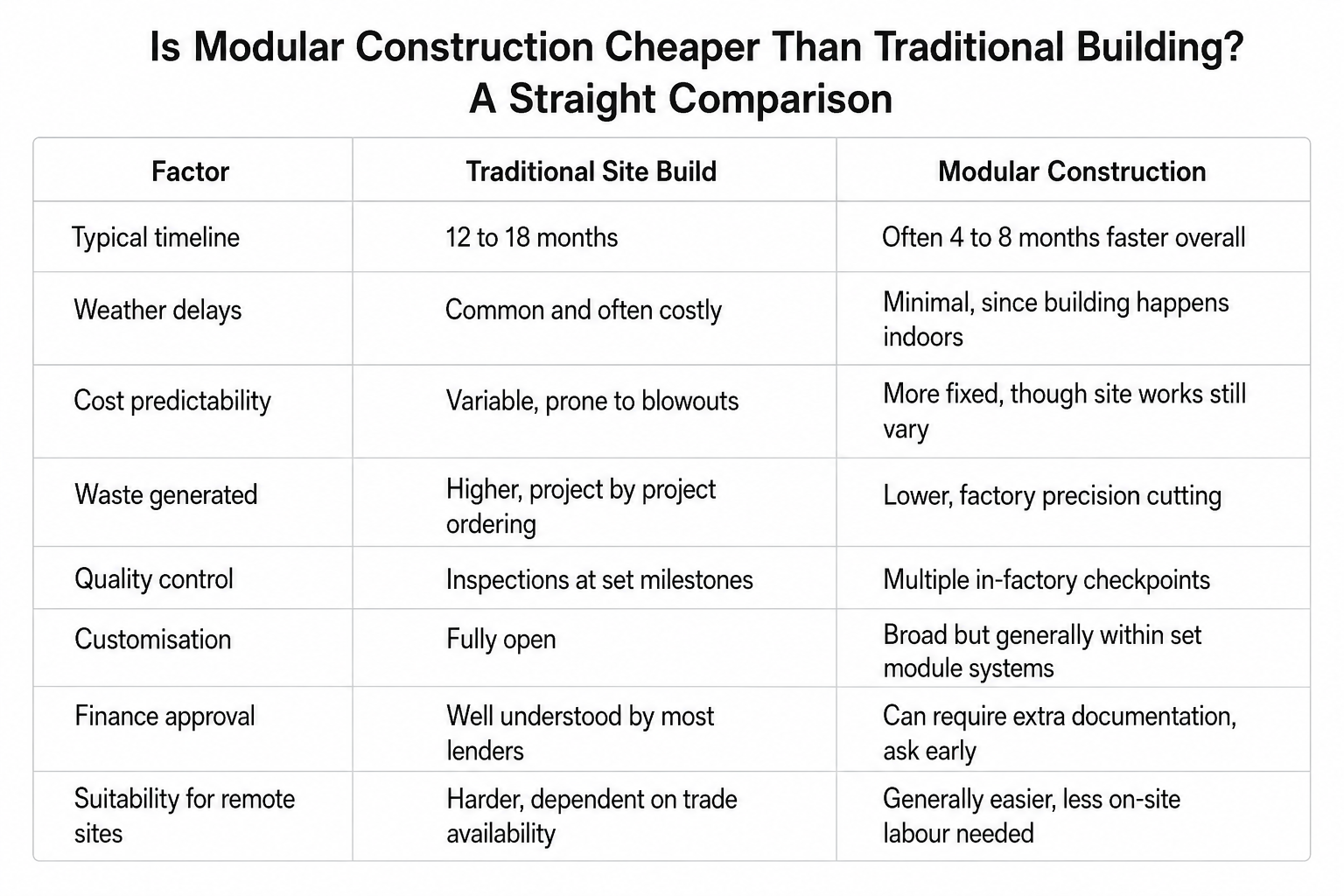
Modular vs traditional construction comparison
The Consequences and Trade-Offs Nobody Mentions Enough
To be fair to homeowners reading this, modular construction is not free of downsides, and any article that only lists benefits is not being straight with you.
Finance can be trickier. Some lenders are still catching up to modular payment structures, which often involve a larger deposit paid before the home leaves the factory. Ask your lender directly about their modular home lending policy before you sign anything.
Perception still lags reality. Some buyers and even some valuers still associate modular homes with lower resale value, even though build quality is often equal to or better than site-built homes. This gap is closing but has not closed entirely.
Transport and access limits design. Very large modules can be restricted by road width, bridge clearances or crane access, which is a real constraint on some rural and inner-city sites alike.
Site costs are not included in the headline price. Advertised modular prices often exclude driveways, retaining walls, connections to power and water, and council fees. Always ask for an itemised, fixed-price site works quote separately.
Not every builder is equal. The quality of modular construction depends heavily on the individual builder's factory processes, certification and after-sales service, so shopping on price alone can backfire.
None of these points are reasons to avoid modular construction. They are reasons to go in with your eyes open and ask the right questions before you commit.
Different Perspectives: What Builders, Buyers and Councils Say
Builders tend to emphasise consistency. A controlled factory environment means the tenth home off the line is built to the same standard as the first, which is harder to guarantee with a rotating crew of subcontractors on a traditional site.
Buyers who have been through the process often say the biggest surprise was how much of the emotional stress of building, weather delays, trade no-shows, budget blowouts, simply did not happen, though several also note that seeing photos of your home in a factory feels very different to walking through a half-built house on your own land.
Councils and planning bodies, particularly those under pressure to deliver housing supply quickly, increasingly view modular and prefabricated homes as a practical tool for meeting targets without compromising on the National Construction Code. Several NSW councils have signalled openness to modular and relocatable homes within complying development pathways, though every application still needs individual assessment.
Taken together, these perspectives point to the same conclusion: modular construction rewards homeowners who do their homework, and it punishes those who assume every builder and every product is the same.
The Modular Home Construction Process, Step by Step
Design and consultation. You choose a floor plan and customise finishes with your builder, similar to choosing a display home but with more flexibility on layout.
Council approval. Your builder or a private certifier lodges the necessary development application or complying development certificate, depending on your council area.
Site preparation. Your block is cleared, footings are poured, and services like power, water and sewer connections are prepared, often while your modules are being built.
Factory construction. Your modules are built indoors, including framing, insulation, wiring, plumbing and often internal finishes like flooring and cabinetry.
Transport to site. Completed modules are transported by truck, sometimes requiring pilot vehicles or road permits for larger builds.
Crane placement and assembly. Modules are lifted into position and joined together, with joints sealed and services connected.
Finishing and handover. Remaining external work, driveways, decks, final connections and inspections are completed before you receive your keys.
Ask any modular home builders in Australia you are considering to walk you through this process for your specific site, since regional and rural blocks may need extra steps for transport approval.
A Quick Way to Check If Modular Construction Suits You
Before committing to any builder, it helps to be honest about your own priorities. Use the interactive checklist above this article (or the printable version below) to score yourself against eight common decision factors, from timeline pressure to sustainability goals to how comfortable you are paying a deposit before you see the finished product on-site. It will not replace a conversation with a licensed builder, but it is a fast way to work out which questions matter most for your situation.
Frequently Asked Questions
-
In many cases, yes. Reported savings range from 20 to 30 percent on comparable projects, mainly from reduced waste, bulk material purchasing and fewer weather delays. Final costs still depend on your site conditions, location and finishes.
-
Modular projects have been reported to finish 40 to 50 percent faster than equivalent traditional builds, since site preparation and factory construction happen at the same time rather than one after the other.
-
Yes. Residential modular construction must comply with the National Construction Code and relevant Australian Standards, the same requirements that apply to traditional site-built homes.
-
Yes, and it is often a better fit than traditional building for rural sites, since less skilled labour needs to travel to the property and most of the work happens in a factory before transport.
-
Modular homes are built in complete or near-complete sections in a factory and assembled on site to full building code standards. Prefabricated is a broader term covering modular and panelised systems. Kit homes typically supply materials and plans for a buyer or builder to construct on site, with less factory-finished work.
-
Most mainstream lenders do finance modular construction, though payment structures can differ from traditional builds, often requiring a larger deposit before the home leaves the factory. It is worth confirming your lender's specific modular home policy early in the process.
-
Timelines vary by builder and complexity, but many modular projects move from design approval to move-in within 4 to 8 months, compared to 12 to 18 months for an equivalent traditional build.
Final Thoughts
Modular construction is not a magic fix for every homeowner's budget or timeline, and anyone who tells you otherwise is selling something. But the underlying case is strong. Faster builds, tighter cost control, reduced waste, better energy performance and consistent quality are not marketing claims, they show up in industry data, in government housing programs, and in the growing number of established, contemporary homes going up across Sydney's suburbs and regional Australia.
If you are weighing up your options, the smartest next step is simple: get quotes from two or three modular home builders in Australia, ask each one the harder questions in this article, particularly around site costs, finance and after-sales support, and compare the answers against a traditional builder's quote for the same block. That comparison, done properly, will tell you far more than any single article can.