
What Is Modular Construction and Why Is Australia Adopting It?
Quick answer: Modular construction is a building method where complete rooms are built inside a factory and then transported to site and craned into place. Australia is adopting it because it can cut build times by up to 50%, reduce construction waste by up to 90%, and help ease a national housing shortage that traditional building simply can't fill fast enough on its own.
Drive through almost any growing pocket of Sydney right now, from the Hills District to the inner west, and there's a decent chance you'll see a crane lowering a finished room onto a set of footings instead of a crew building walls stick by stick. That's Modular Construction Australia in action, and it stopped being a fringe idea for site sheds and mining camps a while ago. It's now one of the main tools state governments, developers and everyday homeowners are reaching for to deal with a housing shortage, a construction labour crunch, and a productivity problem that traditional building has been struggling with for years.
This guide walks through what modular construction actually is, why it's growing so fast across the country, what it really costs compared with a standard build, where it works well, where it doesn't, and what different people inside the industry, from economists to brokers to homeowners, actually think about it. There's a comparison table, a practical checklist and a set of quick-answer FAQs near the end too.
What Is Modular Construction? A Look at Prefab Construction Australia
Modular construction is a building method where complete three-dimensional sections of a building, known as modules, are built inside a factory and then transported to the site and craned into their final position. Each module usually arrives close to finished, with wiring, plumbing, insulation, cabinetry, tiling and sometimes even paint already done, so the on-site work becomes more like assembly than construction from scratch.
Prefab Construction Australia is actually a broader umbrella term. It covers modular building along with panelised systems (wall and roof frames built off-site but assembled flat), kit homes, precast concrete, and prefabricated bathroom pods. Modular is the most complete form of prefabrication because entire rooms travel to site as finished volumetric units, not just flat panels waiting to be fitted out later.
How Offsite Construction Works, From Factory to Foundation
So how are modular homes built, step by step? Offsite Construction, sometimes called offsite manufacturing, runs two jobs in parallel instead of queuing them one after the other. While a factory team builds and fits out modules under cover, a separate crew prepares the site: pouring the slab or footings, running services to the boundary, and sorting out council approvals. Because these steps overlap rather than wait for each other, the whole project wraps up much sooner, which is really the core of the reduced construction time modular offers.
For a typical Australian home, the process generally looks like this:
Design and engineering: 4 to 8 weeks, usually running alongside site planning
Factory manufacturing: 8 to 10 weeks for a standard home
Site preparation: slab, footings and services, happening at the same time as manufacturing
Delivery and crane installation: anywhere from 1 day to a few weeks depending on module count
Site connection and finishing touches: another 6 to 8 weeks
All up, most Australian modular homes are ready in 14 to 20 weeks from order to move-in, compared with 12 to 18 months for an equivalent traditional build. Larger commercial projects follow the same logic at a bigger scale. A modular scheme of up to 30 modules typically has a 4 to 6 month critical path, against 9 to 14 months for the traditional equivalent.
Modular Homes Australia vs Other Prefabricated Buildings
Not every project under the Prefabricated Buildings umbrella is modular, and this distinction matters when you're comparing quotes. Panelised homes still need internal fit-out on site. Kit homes arrive as a pack of materials assembled locally. Modular Homes Australia providers deliver rooms that are already 80 to 95% complete, which is why modular usually wins on speed even against other offsite methods, though it can be less flexible for very unusual architectural shapes.
Modular Construction Australia by the Numbers
It helps to see the scale of what's happening before getting into the how and why. Analysts don't all agree on the exact figures, which is normal in any fast-growing sector, but the direction is the same everywhere you look.
IMARC Group puts Australia's modular construction market at around USD 11.8 billion in 2025, growing to about USD 17.1 billion by 2034 at roughly 4% a year. Expert Market Research puts the current figure even higher, at close to AUD 16.9 billion in 2025, expanding at closer to 6.4% a year. The narrower prefabricated construction segment, tracked separately by Mordor Intelligence, was worth about USD 9 billion in 2026 and is forecast to grow at almost double the rate of the construction sector overall.
Despite that growth, prefabAUS, the industry's peak body, estimates its roughly 1,190 member companies across the supply chain still make up only about 8% of total residential and commercial construction activity in Australia, though its director has suggested that figure could climb to around 30% by 2033 if current momentum holds. In other words, Modular Construction Australia is still a small slice of a very large pie, which is exactly why it has so much room left to grow.
Two forces are driving that growth more than anything else: a housing shortage that traditional building can't fill fast enough, and a construction workforce that keeps shrinking relative to demand.
Why Australia Is Embracing Modern Construction Methods
Modern Construction Methods are getting attention in Australia because the old playbook is under real strain. The Australian Bureau of Statistics projects the population will reach 30 million sometime between 2029 and 2033, and housing supply hasn't kept pace.
Pressure on the Australian Construction Industry
The Australian Construction Industry is dealing with a genuine productivity problem. Dwellings completed per hour worked have fallen by 53% since the mid-1990s, according to Mordor Intelligence's analysis of the sector. The National Housing Accord set a target of 1.2 million new homes by mid-2029, but approvals have consistently missed the mark. By late 2024, roughly 89,734 homes had been approved since the Accord's midpoint, well short of the 120,000 needed to stay on track.
Labour shortages compound the problem. In South East Queensland alone, the construction sector is short an estimated 18,000 skilled workers a year as the region gears up for the 2032 Olympics build-out. Weather adds another layer of unpredictability. A joint study from the University of South Australia and Aston University found weather delays affect 45% of construction projects worldwide, and Sydney's construction costs have climbed 65% over the past decade partly as a result of these combined pressures.
Government Support Driving Modular Housing Australia
Modular Housing Australia has moved from a fringe interest to an actual policy tool. New South Wales is funding 90 modular dwellings through its Building Homes for NSW program, due before mid-2026, and Wild Modular recently delivered the state's first factory-built social housing in Smithfield. Victoria has reported 40 to 50% faster build times and 60% lower in-process energy use on its modular housing projects. Queensland has committed to a 600-unit modular pledge, and the ACT is actively weighing modular and prefabricated homes as a pathway to its target of 30,000 new dwellings by 2030.
At a federal level, the government has confirmed around $54 million in backing for offsite methods for 2025-26, on top of the broader Housing Australia Future Fund. The Australian Building Codes Board is also consulting on a national voluntary certification scheme for manufacturers of modern methods of construction, a genuine piece of building innovation that should make it easier for banks and buyers to compare quality across builders. Even retail has noticed the shift, with Bunnings entering the market in early 2026 with flat-pack backyard pods starting from about $26,000.
This is where Modular Construction Australia stops being a niche interest and starts looking like actual housing policy.
The Benefits of Modular Construction: What the Data Actually Shows
The Benefits of Modular Construction aren't just marketing lines. They show up consistently across independent research, government reports and industry data.
Faster delivery, with most homes ready in 14 to 20 weeks versus 12 to 18 months
Lower waste thanks to factory-controlled conditions
More predictable costs, since fixed factory pricing avoids the trade shortages and weather delays that blow out traditional budgets
Better quality control, with every module inspected at multiple stages before it leaves the factory
Less reliance on scarce on-site labour for the same finished result
Fast Construction Methods Cut Build Time by Up to 50 Percent
Fast Construction Methods work because manufacturing and site works happen at the same time instead of one after the other. Industry data consistently points to build-time reductions of up to 50%, and because modules are made indoors, there's little exposure to the rain delays and site shutdowns that plague traditional builds, especially along the east coast during storm season.
Sustainable Construction Australia and Waste Reduction
Sustainable Construction Australia is arguably where modular makes its strongest case. The construction and demolition sector generated around 30.4% of the country's 67 million tonnes of total waste in 2017, with roughly a third of it not recycled or reused. A 2021 University of New South Wales study compared modular and conventional builds directly and found modular construction can reduce the overall weight of construction waste by up to 83.2%. Other industry estimates put on-site waste reduction as high as 90%, since factory teams measure digitally before cutting, store materials indoors away from weather damage, and can recycle offcuts across multiple builds instead of sending them straight to landfill. This is really what sustainable modular construction in Australia comes down to: less waste, less embodied carbon, and a smaller footprint before anyone even moves in, which lines up with the broader green building practices the industry is trying to adopt.
There's a bigger climate angle too. The Green Building Council of Australia has noted that a typical all-electric home produces roughly seven times more carbon during construction than it does across six decades of everyday use, which is exactly why cutting waste and emissions during the build phase matters so much, not just after move-in.
Energy-Efficient Homes Australia Built to Code
Energy-Efficient Homes Australia standards apply to modular the same way they apply to any other new build. Permanent modular homes must meet the National Construction Code, including its stricter energy performance requirements, and factory-controlled assembly tends to produce tighter building envelopes with fewer draughts and gaps than a home built outdoors across many weeks of changing weather.
Residential Modular Construction: From Granny Flats to Family Homes
Residential Modular Construction covers everything from a small backyard studio to a full four-bedroom family home, and pricing varies enormously depending on where you land on that spectrum.
Affordable Modular Homes and Factory-Built Homes Australia
When people search for the cost of modular homes in Australia, this is roughly what they find:
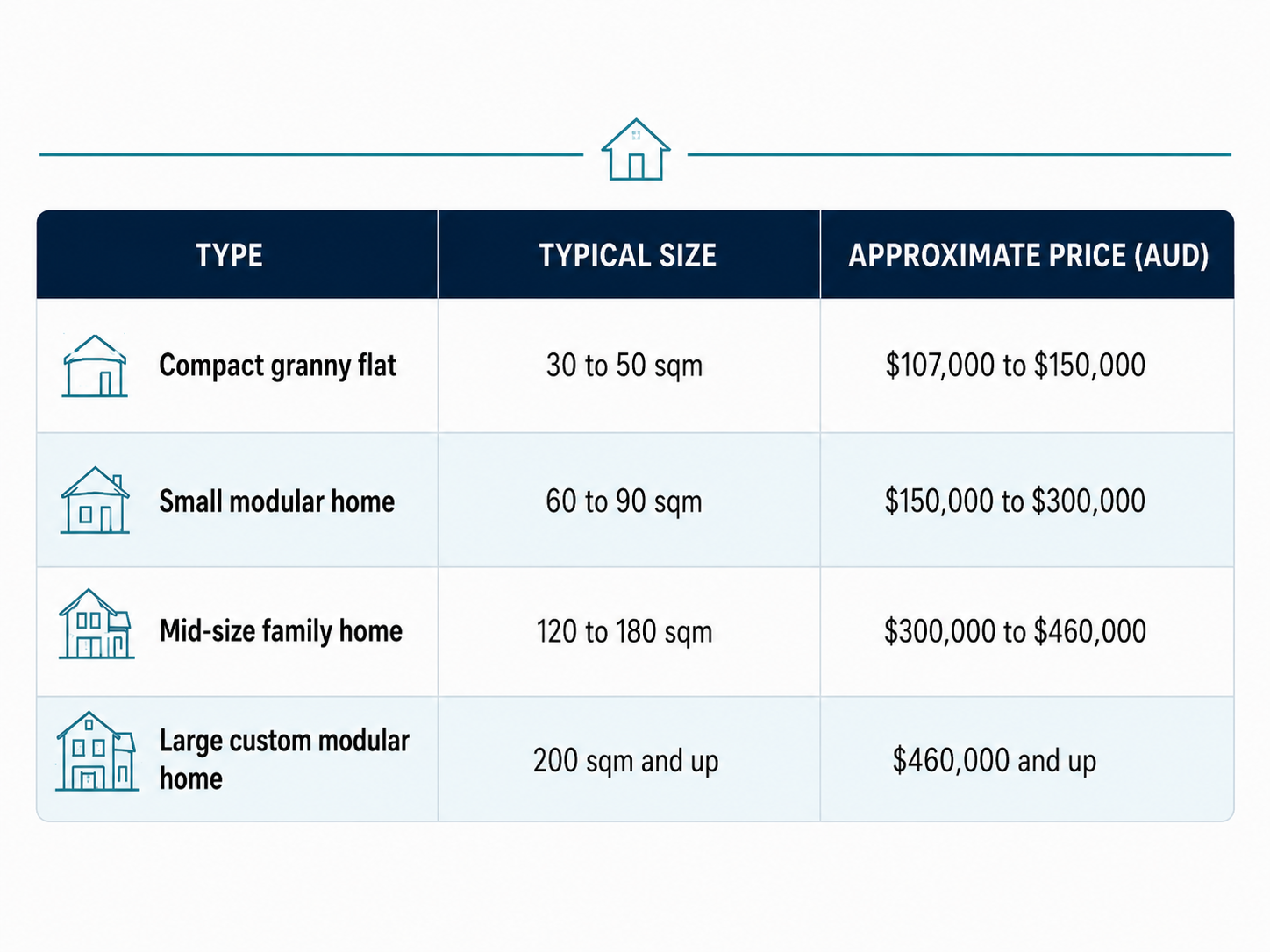
Modular home pricing and size comparison
On a rate basis, most Affordable Modular Homes and Factory-Built Homes Australia builders quote somewhere between $2,000 and $4,600 per square metre depending on finish level, with entry-tier supply pricing on some commercial and volume projects starting from around $2,200 per square metre. Traditional construction generally runs $1,800 to $6,000 per square metre depending on location and specification, with Sydney metro sitting 15 to 20% above Brisbane. Understanding building costs Australia wide like this helps homeowners compare fairly instead of judging a builder on one number alone. The ranges overlap more than people expect. The bigger difference usually isn't the sticker price, it's what you avoid: months of holding costs, trade delays and weather-related blowouts.
Prefabricated Homes Australia Across Sydney's Suburbs
Prefabricated Homes Australia has found a natural home in established Sydney suburbs, where land is tight and renovation disruption matters. Most secondary dwellings (granny flats) can be approved through the state's Complying Development Certificate pathway rather than a full council development application, provided the block is at least 450 square metres and the design stays within an 8.5 metre height limit and a 60 square metre floor area cap under the Housing SEPP 2021. That fast-track pathway can take as little as 10 to 20 business days, compared with 40 to 90 days for a full DA, and it's a big reason "granny flat" has become the most searched property term in Sydney according to Domain, up more than 3% year on year.
Across the Hills District and council areas including Burwood, City of Canada Bay, City of Ryde, City of Sydney, Cumberland, Hunters Hill, Hornsby Shire, Inner West, North Sydney, Strathfield, Willoughby, Woollahra, Ku-ring-gai and Lane Cove, homeowners are turning to modular for similar reasons. Established blocks often have tight side access that makes traditional building slow and expensive. Older housing stock benefits from a faster, less disruptive build. And in several of the harbourside and North Shore council areas, including Woollahra, Hunters Hill, Ku-ring-gai and North Sydney, heritage conservation overlays add planning complexity that makes a shorter on-site construction window genuinely valuable, since less time on site usually means less disruption to a heritage-sensitive streetscape. It's worth noting that heritage listing, flood mapping or high bushfire risk can still push a project from the fast CDC pathway onto the longer DA track regardless of construction method, so an early planning check with the relevant council is worth doing before locking in a design.
Commercial Modular Buildings and Smart Building Solutions
Commercial Modular Buildings aren't limited to housing. Hospitals, clinics, schools and hospitality projects are increasingly built this way because delivery certainty often matters more than anything else to these clients.
Modular Building Solutions for Schools, Health and Hospitality
Modular Building Solutions let a school add classrooms over a single set of holidays instead of disrupting a term, which is exactly how Victoria has been expanding classroom capacity. Healthcare providers use the same approach to add clinical space without shutting down existing operations, since factory work happens well away from a live hospital site. Build-to-rent developers and hospitality operators favour these Smart Building Solutions for the same reason: predictable delivery dates matter more to a revenue-generating asset than shaving a small percentage off the sticker price.
Transportable Buildings Australia for Business and Industry
Transportable Buildings Australia still make up the largest single category of the modular market by volume. Relocatable units dominate because they can be reused across multiple projects: site offices, construction camps, temporary classrooms and remote workforce accommodation all rely on units that can be craned onto a truck and redeployed once a project wraps up. Perth's mining and resources sector in particular leans on this model to house fly-in fly-out workers quickly in remote locations where traditional building simply isn't practical.
Modular Construction vs Traditional Construction: Cost, Time and Quality Compared
Modular construction vs traditional construction usually comes down to three things: how fast you need it, how much price certainty you want, and how unusual your design is. Here's a side-by-side look, based on the ranges reported across the industry data referenced throughout this guide.
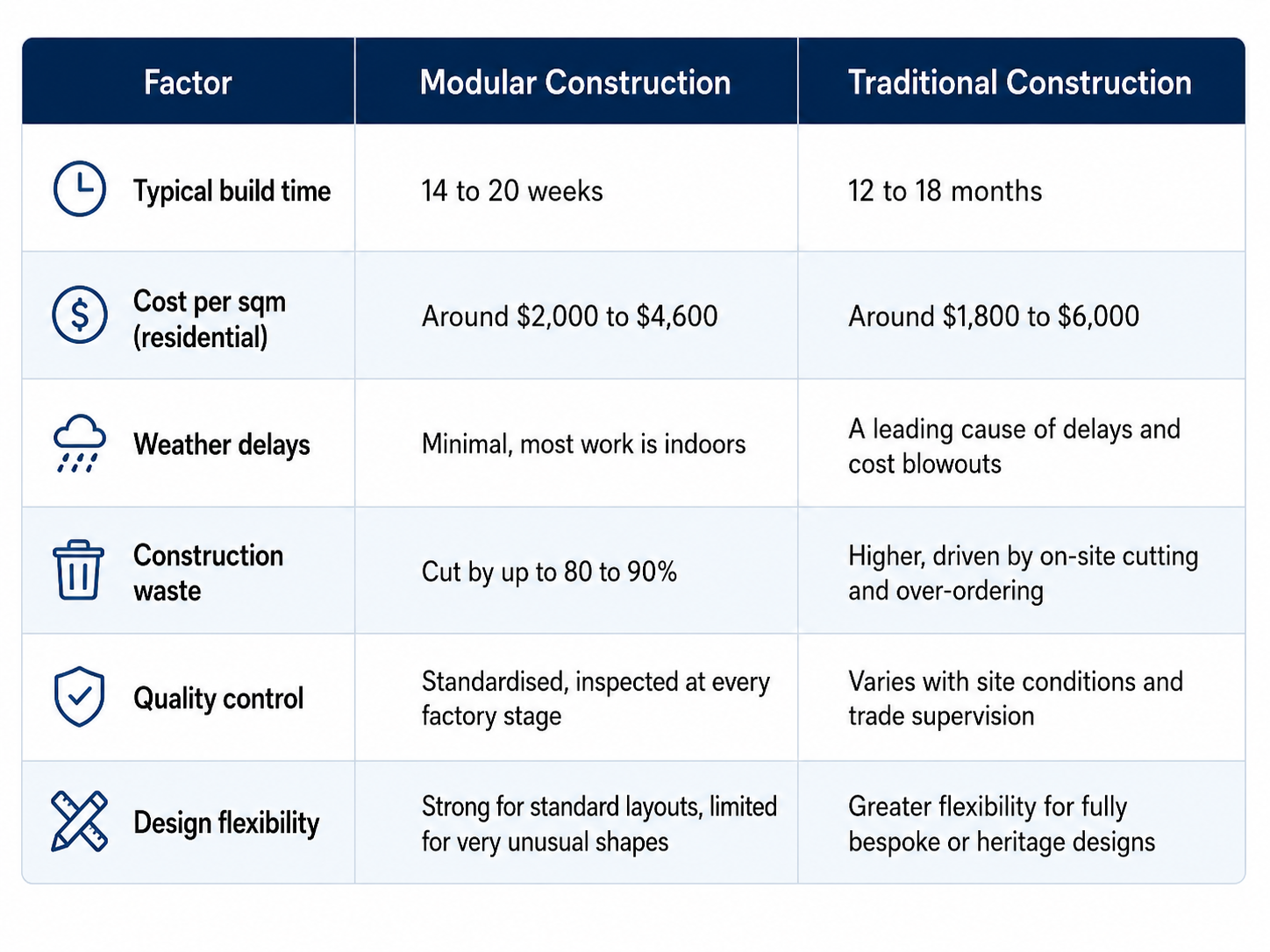
Modular vs traditional construction comparison
The honest takeaway is that cost alone rarely settles the decision. On smaller residential jobs, modular buyers often report savings of 10 to 30%. On larger commercial projects, the capital cost can land within about 5% either way of a traditional build, and the real financial win comes from finishing months earlier and avoiding the interest and holding costs that pile up while a traditional project drags on.
The Other Side: Consequences of Choosing Modular Housing Australia
No building method is perfect, and being upfront about the trade-offs is part of making a good decision.
Financing Gaps and Perception Issues
Modular Housing Australia still runs into a genuine finance bottleneck. Traditional home loans release money in stages tied to on-site inspections, but with modular, most of the value gets created inside a factory before anything reaches the block. One mortgage broker who specialises in this space says she currently works with only two lenders who properly service modular finance, and clients regularly get incorrect information from lenders unfamiliar with the model. The consequence for buyers can be real: some end up self-funding the fabrication phase entirely, using land equity or cash, because the bank won't release funds until the module is fixed to the site.
There's movement in the right direction. Commonwealth Bank now allows progress payments during fabrication for prefab construction loans and is sponsoring a new standard-form contract designed specifically for modern methods of construction. Bankwest has made similar changes in Western Australia. But until this becomes standard across the banking sector, buyers need to ask financing questions early, not after they've already picked a builder.
Perception is the other lingering issue. A stigma around low-quality prefab housing did exist for good reason in the past, tied to real compliance problems. That's changed substantially over the past decade thanks to advances in construction technology, from robotics to digital twins, and skills brought in from the automotive and aerospace industries. Even so, some resale value caution is still worth factoring in, particularly in suburbs where buyers aren't yet used to seeing modular homes on the market.
Design Limits and Transport Risk
Residential Modular Construction has real limits worth knowing before you fall in love with a floor plan. Cantilevered rooms, curved walls and highly unusual layouts can be difficult or expensive to manufacture as modules, since everything still needs to survive a truck journey and a crane lift in one piece. Transport itself carries some risk. Damage during transit is uncommon but not impossible, especially over long distances or on rough regional roads, and any damage typically means delays while repairs are made either at the factory or on site.
There's also a consequence worth flagging on the other side of the ledger. If Australia doesn't keep scaling offsite methods, the housing approval shortfall against the National Housing Accord target is likely to keep widening, and the same weather delays, trade shortages and cost overruns driving up traditional build costs today will keep doing exactly that. Choosing modular isn't risk-free, but neither is sticking exclusively with a building model that's already showing its age.
Different Perspectives: What Experts, Builders and Homeowners Really Say
It's worth hearing from people actually inside this shift, because they don't all agree on the details.
Damien Crough, director of the industry body prefabAUS, argues the old stigma around prefab housing was earned in the past through genuine quality and compliance failures, but says the sector has changed with the arrival of robotics, digital twins and skills transferred from the automotive and aerospace industries. He still cautions that cheap, poorly made prefab products exist alongside well-engineered ones, much like in any other market.
Professor Mathew Aitchison, chief executive of the government co-funded Building 4.0 CRC, sees offsite methods as a genuinely useful tool that Australia underuses, particularly in regional, remote and mining contexts where it already has a strong track record. He's more cautious about metropolitan projects, noting that prefab building in cities can still land more expensive than traditional methods once site-specific challenges are factored in.
Researchers from Western Sydney University, including Dr Ehsan Noroozinejad, have made a sharper point about what's actually holding modular back. In their view, the debate around modular housing has focused too much on speed and not enough on trust, meaning banks, insurers, certifiers and valuers still need a lot more confidence before modular becomes the default rather than the alternative.
Mortgage brokers on the ground back this up with lived experience. Specialists working in the space describe client demand running well ahead of available finance options, and note that misinformation from less experienced lenders remains a genuine hassle for buyers to navigate.
Manufacturers, unsurprisingly, are more bullish. Fleetwood Australia's leadership has pointed to the company's capacity to deliver up to 1,500 new homes a year across seven factories as proof the supply side is ready to scale well beyond current demand.
And then there are the sceptics closer to home. On property forums covering areas like Ku-ring-gai, some homeowners push back on the idea of adding a secondary dwelling at all, arguing it eats into backyard space and appeals to a narrow slice of buyers at the expense of everyone else's resale flexibility. It's a reminder that even where the economics stack up, not every homeowner wants the same thing from their block.
How to Choose Modular Home Builders Australia
If you're comparing the best modular home builders in Australia, a bit of due diligence up front avoids expensive surprises later. Before signing anything:
Ask for a full turnkey quote, not just a base rate per square metre. Site works, transport, crane hire, council fees and utility connections are usually extra.
Confirm the design already meets National Construction Code requirements, and check whether the manufacturer holds ISO 9001 or equivalent accreditation.
Ask which lenders will finance the build, and at what stage they release progress payments, before you fall in love with a specific builder.
Get everything in writing, including what happens if a module is damaged in transit or a delivery is delayed.
Ask to see a completed project in person, ideally one that's been lived in for at least a year, not just a display home.
Check what happens to your deposit if the manufacturer runs into financial difficulty mid-build. This is a real industry risk worth asking about directly.
Confirm the design accounts for your site's specific conditions, including wind rating, bushfire attack level, flood risk or termite zone where relevant.
The Future of Modular Construction Australia
The Future of Modular Construction Australia looks less like a prediction and more like a trend already well underway. Every major forecast points the same direction, even if the exact numbers differ: a market currently worth somewhere in the tens of billions of dollars, expanding at 4 to 8% a year, against a broader construction sector growing closer to 3 to 4%.
Government procurement is likely to keep pulling the sector forward, since states have found that modular delivery timelines line up well with budget and political cycles in a way traditional construction often doesn't. The Australian Building Codes Board's work on a national certification scheme for manufacturers should also make it easier for banks, insurers and everyday buyers to trust a modular home the same way they trust a brick veneer one, which is likely to matter more for mainstream adoption than any further gains in factory speed. Growing support for more sustainable housing across the country will likely keep pushing state governments toward offsite delivery as well.
None of this means modular replaces traditional building outright. It means Australia's toolkit for solving its housing and infrastructure challenges is finally getting bigger, and Modular Construction Australia has earned a permanent place in it.
Is Modular Construction Right for Your Project? Quick Checklist
Use this as a fast gut check:
Do you need to move in or open sooner rather than later?
Is your block on a tight, hard-to-access site?
Are you building in a heritage conservation area or a suburb sensitive to construction disruption?
Do you want a fixed price with less exposure to trade and material cost blowouts?
Is your design relatively standard, without extreme curves, cantilevers or one-off architectural features?
Have you confirmed finance with a lender who actually understands modular progress payments?
If you ticked most of these, modular construction is worth putting on your shortlist. If your heart is set on a fully bespoke architectural design, or you're not yet comfortable navigating the current financing landscape, traditional construction may still be the smoother path for now.
Frequently Asked Questions
-
Modular construction is a building method where complete sections of a home or building, called modules, are manufactured in a factory and then transported to site and craned into place, rather than built piece by piece outdoors.
-
It's growing because of a housing shortage, a shrinking construction workforce, and the fact that modular can cut build times by up to 50% while reducing exposure to weather delays and trade shortages.
-
Sometimes. Smaller residential modular builds are often 10 to 30% cheaper than traditional equivalents, while larger commercial projects tend to land close to cost parity, with the real savings coming from finishing months earlier.
-
Most modular homes take 14 to 20 weeks from order to move-in, compared with 12 to 18 months for a traditional build of the same size.
-
Yes. Permanent modular homes must meet the same National Construction Code standards as traditional homes and go through the same council approval and certification process.
-
Prefab is the broader category covering any offsite-built components, while modular specifically means complete finished rooms or sections are built and transported as whole 3D units.
-
Yes, but options are more limited than for traditional builds. A small number of lenders, including Commonwealth Bank, now offer progress payments during the factory build phase, so it's worth confirming financing before choosing a builder.
-
Prices generally range from around $107,000 for a compact granny flat to $460,000 or more for a large custom family home, with most standard builds costing between $2,000 and $4,600 per square metre.
-
Most NSW councils, including those across the Hills District, Ku-ring-gai, Hornsby, Ryde, North Sydney, Willoughby, Lane Cove, Hunters Hill, Inner West, Strathfield, Burwood, Canada Bay, Cumberland, Woollahra and the City of Sydney, allow secondary dwellings under the state's Housing SEPP 2021, though heritage, flood or bushfire overlays can affect which approval pathway applies.
-
The sector is forecast to keep growing faster than the construction industry overall, supported by government housing programs, improving finance options and a new national certification scheme for manufacturers currently in development.
Final Thoughts
Modular Construction Australia isn't a trend chasing headlines. It's a practical response to a housing shortage, a labour shortage, and a building sector that's been losing productivity for three decades. It won't suit every project or every buyer, especially anyone chasing a fully bespoke design or uncomfortable with today's more limited financing options. But for anyone who values speed, predictable pricing and a lighter environmental footprint, from a family adding a granny flat in Hornsby to a developer delivering social housing in Western Sydney, modular has moved well past proof of concept and into the mainstream.
Sources referenced: IMARC Group, Mordor Intelligence, Expert Market Research, prefabAUS (via Money Magazine), Australian Bureau of Statistics, National Housing Accord data, University of New South Wales (2021 waste study), Green Building Council of Australia, NSW Planning Portal (Housing SEPP 2021), Domain property search data, Broker Daily, Bellrock Advisory, The Policymaker (Western Sydney University), SBS News, Australian Broker News, and Prefab News Australia.