Energy-Saving Homes in Australia: 15 Ways to Cut Power Bills
If you live in Sydney and you opened your last electricity bill, you already know the feeling. That slow dread as you scroll to the total. The quiet calculation you do in your head about what else that money could have paid for.
You are not imagining it. The median Australian household electricity bill hit $2,467 in 2025. In suburbs like Burwood, Strathfield, and Ryde, where older homes with poor insulation are common, many households spend even more. And with the national energy rebates that softened bills in 2024-25 now winding down, households without solar or efficiency upgrades are more exposed than ever to full-price power.
Here is the real kicker: Australians who have already invested in energy-efficient homes and energy-saving solutions are paying as little as $247 per year on electricity. That is not a typo. Solar panels combined with home battery storage can cut bills by up to 90%, according to the Climate Council's 2026 analysis. Meanwhile, more than four million Australian households have rooftop solar and are saving an average of $1,500 per year.
The gap between what you are paying now and what you could be paying is enormous. This guide covers 15 proven ways to close it, with real numbers, local resources for Sydney council areas, and practical steps you can take this week whether you are a homeowner in Ku-ring-gai, a renter in Inner West, or a landlord in Lane Cove.
The Consequences of Ignoring Home Energy Efficiency
Before we get to solutions, it is worth understanding what staying put actually costs you.
Rising energy prices are not a short-term problem. Coal outages in NSW and Queensland in 2025 were equivalent to every unit in those states being offline for more than 80 days, driving severe price spikes. As ageing coal stations are retired, gas generators fill the gap and gas is volatile. Fossil fuel corporations exported nearly $100 billion in extra revenue during the period following the Russia-Ukraine conflict, while Australian families paid more at home for the same resource.
Homes without energy-efficient upgrades face a compounding problem:
Higher bills every quarter as baseline energy costs increase
Greater exposure to price spikes when coal and gas supply is disrupted
Lower property values compared to energy-rated homes in the same street
Physical discomfort during Sydney's increasingly intense summer heat waves
Carbon footprint that is entirely avoidable with existing technology
Residential buildings account for around 24% of overall electricity use and more than 10% of total carbon emissions in Australia. Every energy-saving homes upgrade you make cuts your own costs and reduces that national load.
15 Ways to Create Energy-Saving Homes and Reduce Power Bills
1. Switch Your Energy Plan Before Doing Anything Else
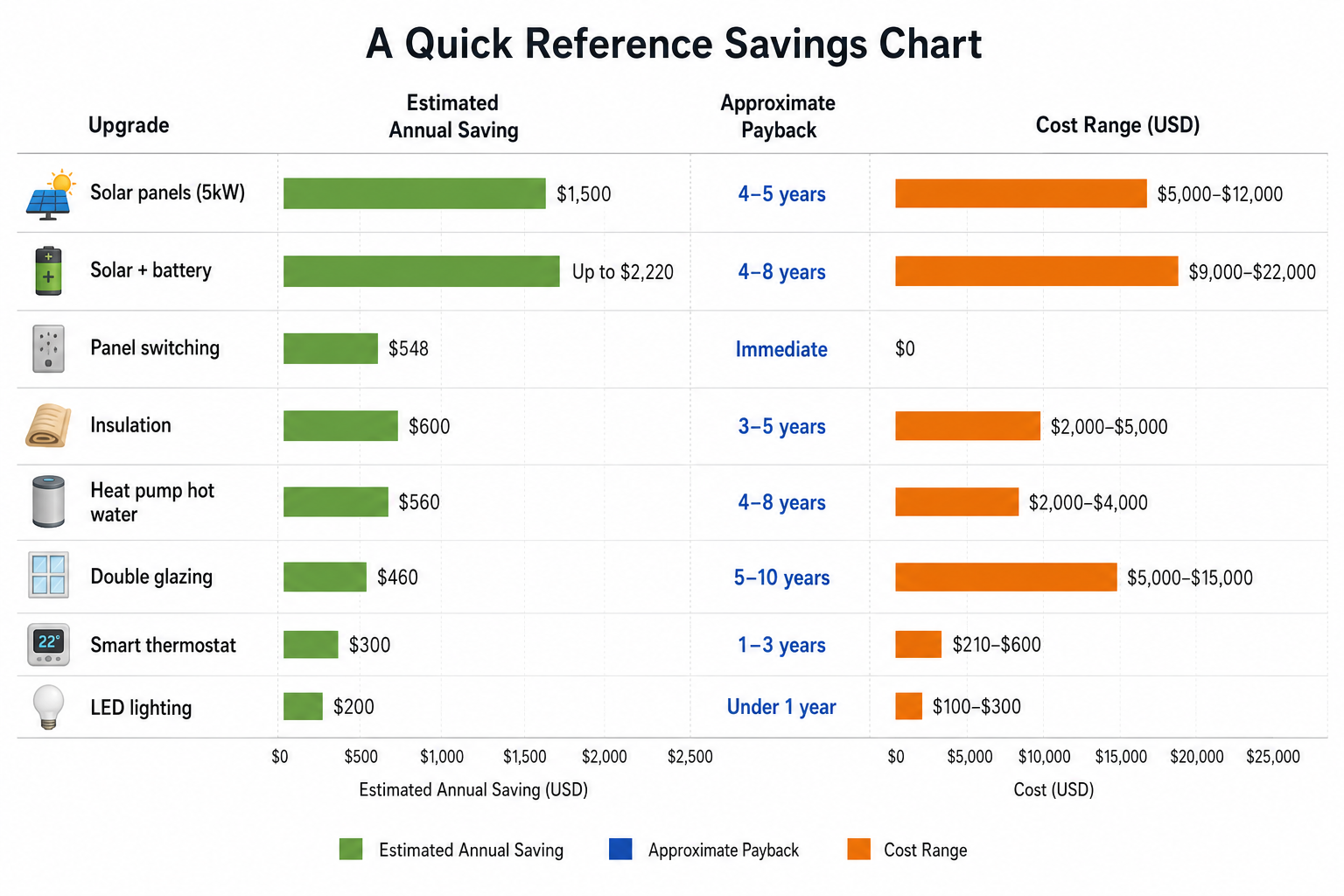
This is the lowest-effort, zero-cost first step that most households skip. According to the Australian Energy Regulator's December 2025 Market Report, NSW households on a flat rate tariff with average energy use in the Ausgrid network could save $548 per year simply by switching from a standing offer to the cheapest available market deal.
The ACCC confirmed in the same period that "customers on older plans pay more than those on newer plans" and that "there continues to be opportunities for customers to save by switching." More than twenty energy retailers offer deals in Sydney. Spend fifteen minutes on Energy Made Easy (the government comparison tool) and you could put $548 back in your pocket without touching a single light switch.
Who this helps most: Homeowners and renters across City of Sydney, Cumberland City Council, Woollahra Municipal Council, and anywhere on the Ausgrid network who have not reviewed their plan in the past two years.
2. Install Solar Panels on Your Roof
Australia has the highest rooftop solar uptake in the world, with over 21% of homes already carrying panels. There is a reason for that. A typical 5kW solar system saves around $1,500 per year on electricity bills, with a payback period of four to eight years according to YourHome data.
The upfront cost is reduced by the Small-scale Renewable Energy Scheme (SRES), which creates Small-scale Technology Certificates (STCs) that your installer typically buys upfront and applies as a direct discount on your quote. This often reduces the cost by several thousand dollars before you spend a cent.
For homeowners in North Sydney, Hunters Hill, Ku-ring-gai, and Lane Cove, where houses sit on full blocks with north-facing roof space, solar is an almost automatic win. Homes in Willoughby City Council and Hornsby Shire areas with high tree coverage may need a site assessment first, but in most cases there is usable roof orientation available.
Action step: Get three quotes from CEC-accredited installers. Do not settle for the first price you see.
3. Add a Home Battery to Maximise Solar Savings
Solar panels generate power during the day. Most household consumption happens in the morning and evening. Without a battery, your excess daytime generation goes back to the grid at low feed-in tariff rates while you buy power back at full price after dark.
A home battery closes that loop. The Australian Government's Cheaper Home Batteries Program, which launched in July 2025, provides around a 30% discount on eligible batteries ranging from 5kWh to 100kWh. Solar paired with battery storage can reduce bills by up to 90%, bringing the average annual bill from $2,467 down to around $247 for households that fully commit to the upgrade.
In suburbs like Strathfield, Burwood, and Canada Bay, where homes often have smaller roof areas but consistent daytime solar generation, a battery makes the most of every kilowatt captured.
4. Insulate Your Ceiling, Walls, and Floors
Heating and cooling account for up to 50% of energy used in Australian homes, depending on the climate zone. The single most effective way to reduce that load is proper insulation. Insulation reduces average heating and cooling costs by around 30% and generally pays for itself within three to five years through reduced energy bills, according to the Insulation Council of Australia and New Zealand (ICANZ).
In older homes common across Inner West Council, Woollahra Municipal Council, and Strathfield Council, ceiling insulation is often completely absent or badly degraded. Up to 35% of heat loss in a poorly insulated home happens through the ceiling alone.
Wall and underfloor insulation extend the benefit further. Once your home's thermal envelope is sealed, you rely far less on your air conditioner and heater to maintain comfort. The work compounds: better insulation means your heat pump or reverse-cycle system runs less, saving even more.
NSW homeowners can access zero-interest loans of up to $15,000 through the NSW Government's energy efficiency loan scheme for eligible upgrades including insulation. Eligibility requires Australian citizenship or permanent residency and a combined household income under $210,000 per year.
5. Upgrade to Double-Glazed Windows
Almost 90% of a home's heat is gained and up to 40% of heating energy is lost through windows, according to energy.gov.au. Single-pane glass is essentially a hole in your insulation strategy.
Double glazing uses two glass panes separated by an insulating air gap, typically filled with gas, that dramatically reduces heat transfer in both directions. You stay cooler in summer without the air conditioner working overtime, and warmer in winter without cranking the heater.
For heritage homes in Hunters Hill Council, Woollahra Municipal Council, and Lane Cove, double glazing is available in period-appropriate frames that satisfy council heritage requirements. Some states also offer rebates for window upgrades, so check your state program before purchasing.
The payback period of five to ten years is longer than some upgrades, but the improvement in daily comfort is immediate and the property value uplift is tangible.
6. Install a Heat Pump Hot Water System
Hot water is the second largest segment of household energy use, making up 15% to 27% of the average Australian household's energy bill depending on location. Traditional gas water heaters are now among the most expensive ways to heat water.
A hot water heat pump uses a refrigeration cycle to extract warmth from the surrounding air to heat water, similar to how a reverse-cycle air conditioner works in reverse. Running costs are approximately one-third of those for a gas system, with a payback period of four to six years according to ACT Government data.
When paired with rooftop solar, a heat pump hot water system can be set to run during peak solar generation hours, meaning you are effectively heating water for free during the day. For households in City of Ryde, Cumberland City Council, and North Sydney with existing gas connections, switching to an electric heat pump eliminates the daily gas supply charge on top of reducing your water heating costs.
7. Switch to a Reverse-Cycle Air Conditioner
If you still have a gas heater, a ducted resistance heater, or a window-mounted unit from fifteen years ago, you are paying far more than you need to for heating and cooling. Modern reverse-cycle split systems are three to five times more efficient than older electric heating systems.
They heat in winter using the same heat-pump principle as hot water systems, drawing warmth from outside air rather than generating it electrically. They cool in summer as standard air conditioners do. A well-sized reverse-cycle unit running at the right settings (23-26°C in summer, 18-21°C in winter) costs significantly less to run than any gas or resistance alternative.
For apartments in City of Sydney, Inner West Council, and Willoughby City Council, a single split system is often all that is needed to cover the main living area. Zoning individual rooms rather than running whole-house systems saves additional energy.
8. Seal Draughts and Air Leaks
This is one of the cheapest interventions available and it delivers results immediately. Gaps around windows, doors, floorboards, and roof penetrations allow heated or cooled air to escape and outdoor air to flood in, forcing your heating and cooling systems to work continuously to compensate.
Door seals, window weather strips, chimney draught stoppers, and gap filler around pipe penetrations cost very little. In many Australian homes, particularly the older federation-style houses common in Inner West Council, Woollahra, Ku-ring-gai, and Strathfield, draughts can account for 15-25% of energy wasted on climate control.
The NSW Government's energy efficiency program lists draught-proofing as an eligible upgrade under its household savings scheme. It is a sensible first step before spending on insulation or glazing, because it ensures the more expensive upgrades perform as intended.
9. Replace Lighting With LED Globes
If any room in your home still has halogen downlights or incandescent globes, you are wasting money every time you turn on a light. LED lighting uses up to 75% less energy than halogen alternatives and lasts significantly longer.
The payback period is typically under one year. The investment is small (often $100 to $500 for a whole home), the installation is simple, and the savings are immediate. For homes in Hornsby Shire Council and Lane Cove where large family homes with many downlights are common, the saving can be surprisingly meaningful over a year.
NSW households can access discounts on LED lighting through the Energy Savings Scheme, making the cost even lower.
10. Install a Smart Thermostat or Timer Controls
Smart thermostats and programmable timers ensure you only heat or cool your home when people are actually in it. They learn your patterns over time, turning the system on before you wake and off after you leave, without you having to manage it manually.
For every degree outside the recommended 23-26°C summer range or 18-21°C winter range, you use 5-10% more energy. A smart thermostat holds these setpoints automatically, preventing the common habit of setting the temperature at an extreme and forgetting to adjust it.
For smart home setups in Sydney suburbs like North Sydney Council, City of Canada Bay, and Willoughby City Council, smart thermostats often integrate with voice assistants and can be controlled remotely via phone when plans change. First-time buyers in new apartments across City of Ryde and Burwood Council can prioritise smart home energy saving as part of setting up their home from day one.
11. Upgrade to Energy-Efficient Appliances
Appliances account for around 30% of home energy use. When an appliance reaches end of life, the energy star rating of its replacement matters enormously for long-term running costs.
The Australian Energy Star Rating Label allows direct comparison between models. A refrigerator, washing machine, or dishwasher with one or two extra stars can save $30 to $80 per year in running costs over its lifetime. Across multiple appliances that adds up.
For pool owners across Ku-ring-gai Council, Hunters Hill, and Hornsby Shire, the pool pump is particularly important. For the 1.1 million Australian homes with a swimming pool, the pool pump can be the single largest electricity user after heating and cooling. Variable-speed pool pumps use dramatically less energy than single-speed alternatives and pay for themselves quickly.
The NSW and federal government offer rebates and discounts for upgrading to energy-efficient appliances including refrigerators, washing machines, and air conditioners.
12. Install an Induction Cooktop
Gas cooktops are inefficient. Roughly 65% of the energy from gas combustion is lost as waste heat around the sides of the pan rather than into your food. Induction cooktops use electromagnetic induction to heat pots and pans directly through the metal base, making them approximately three times more energy-efficient than gas.
They also eliminate the ongoing daily gas supply charge on your bill, which in NSW typically adds $300 to $400 per year regardless of how much gas you actually use.
For homes in City of Sydney, Inner West Council, and Canada Bay undertaking kitchen renovations, making the switch to induction during the renovation avoids future retrofitting costs. Pre-wiring for induction during a renovation is a small incremental cost compared to retrofitting later.
13. Consider a Home Energy Assessment
An independent home energy assessment, sometimes called an energy audit, identifies exactly where your home is losing energy and ranks the upgrades by return on investment for your specific property. Rather than guessing which upgrade to prioritise, you receive a ranked action plan based on your home's actual performance.
In older Sydney homes common across Strathfield Council, Woollahra Municipal Council, and Inner West Council, an assessor often discovers unexpected issues like missing roof insulation over a section of the home, single-glazed skylights, or poorly sealed recessed lighting that voids the ceiling insulation below it.
The Home Energy Ratings Disclosure Framework Version 2, released in December 2024, has also established national standards for home energy rating disclosure. NSW commenced a Home Energy Rating trial in September 2025. As these ratings become mainstream at point of sale and lease, knowing your home's current rating gives you a roadmap for maximising its value.
14. Connect to a Virtual Power Plant
If you have solar and a battery, connecting to a Virtual Power Plant (VPP) lets you sell stored energy back to the grid during peak demand periods and earn money in the process. NSW Energy offers VPP participation to eligible households as an additional income stream on top of standard feed-in tariffs.
During price spikes caused by coal outages or peak summer demand, VPP households can export stored battery energy to the grid at premium rates. This converts your home battery from a cost-saving tool into a small revenue-generating asset.
For residents in North Sydney Council, Willoughby City Council, and Ku-ring-gai who have already installed solar and battery systems, VPP enrolment is often a straightforward next step that requires no new hardware.
15. Use Ceiling Fans Before the Air Conditioner
Ceiling fans use approximately three to five cents per hour to run. A split-system air conditioner costs many times that. In Sydney's climate, which includes warm summers but relatively mild shoulder seasons, a ceiling fan can provide comfortable cooling on days that do not reach extreme temperatures.
Running a fan before turning on the air conditioner, and keeping the air conditioner at 26°C rather than 20°C with a fan running, can cut your cooling costs substantially across a full summer. Ceiling fans with winter reverse settings push warm air that collects near the ceiling back down into the room, reducing heating loads in winter as well.
For families in Cumberland City Council, Burwood Council, and City of Ryde where multi-bedroom homes see high cooling costs across long summers, strategic fan use combined with a properly set thermostat is one of the most accessible home energy-saving ideas available.
Quick reference savings chart
Government Programs and Rebates Available Right Now
Australian homeowners and renters have access to multiple funding streams that reduce upfront costs significantly.
Household Energy Upgrades Fund (HEUF): The $1 billion federal fund has now financed over 10,000 energy upgrades across more than 4,100 homes as of December 2025. It provides discounted finance through lenders including Westpac, Commonwealth Bank, Bank Australia, ING, Brighte, Plenti, and Plico for solar, batteries, insulation, double glazing, heat pumps, and induction cooktops. Available to owners with or without a mortgage, renters, and strata properties.
Cheaper Home Batteries Program (CHBP): Launched July 2025, this program provides approximately 30% off eligible home batteries. Note that from May 2026, the per-kWh rebate structure changes, so timing matters for larger battery systems.
Small-scale Renewable Energy Scheme (SRES): STCs reduce the upfront cost of solar panels and solar hot water systems. Your installer typically applies these as a direct invoice discount.
NSW Energy Saving Loans: Zero-interest loans up to $15,000 for eligible NSW homeowners and landlords. Eligible upgrades include insulation, solar, batteries, reverse-cycle air conditioning, ceiling fans, and draught-proofing. Combined income limit of $210,000 per year applies.
National Energy Bill Relief 2025-26: All NSW households and small businesses are eligible for up to $150 in bill relief in the 2025-26 financial year, automatically applied by your retailer.
Local Perspective: Sydney Councils and Energy-Saving Priorities
Each Sydney council area has a slightly different housing stock and therefore a different starting point for energy-efficient home upgrades.
Burwood Council and Strathfield Council have a high proportion of brick veneer and older double brick homes from the 1950s to 1980s. These homes typically lack ceiling insulation and have single-glazed aluminium windows. Insulation and double glazing are the highest-priority upgrades for Australian home energy efficiency in these areas.
City of Canada Bay and Inner West Council are dense with terrace houses and semi-detached dwellings. Roof space can be limited for solar, but ceiling insulation, draught-proofing, and heat pump hot water systems deliver strong returns. Both councils also have active sustainability programs worth checking for local rebate information.
City of Ryde and Hunters Hill Council include a mix of post-war and contemporary homes with good roof access for solar. Ryde in particular has seen strong solar uptake in recent years. Battery storage is a logical next step for Ryde homeowners who already have panels.
North Sydney Council and Willoughby City Council include many large homes with older gas-reliant heating systems. Switching from gas to reverse-cycle heat pumps and induction cooktops represents the biggest bill reduction opportunity, especially as daily gas supply charges add substantially to annual costs.
Hornsby Shire Council and Ku-ring-gai Council have significant tree coverage which can limit solar generation but also naturally shades homes, reducing cooling loads. Insulation and smart thermostats work particularly well here alongside targeted solar on north-facing roof sections clear of shade.
Lane Cove Council and Woollahra Municipal Council include heritage-listed properties where retrofit options need to meet council requirements. Energy-efficient double glazing in period-appropriate frames, LED lighting, and insulation upgrades are generally approvable. Always check with your council's heritage team before undertaking any works on a listed property.
Cumberland City Council covers a geographically diverse area with many large family homes. Pool pump upgrades, solar, and battery storage are strong performers given the house sizes and associated energy loads.
Frequently Asked Questions
-
Switching your energy plan is the single fastest action. NSW households on the Ausgrid network can save up to $548 per year by switching from a standing offer to the best market deal, with no upfront cost and immediate effect from your next bill.
-
A typical 5kW solar system saves around $1,500 per year on electricity bills in Australia. When paired with a home battery system, total savings can reach up to 90% of your electricity bill, reducing the average annual cost from around $2,467 to as little as $247.
-
Key programs in 2025-26 include the federal Household Energy Upgrades Fund (discounted finance for solar, batteries, insulation, and appliances), the Cheaper Home Batteries Program (around 30% discount on batteries), the Small-scale Renewable Energy Scheme (reduces solar upfront costs), and NSW zero-interest loans of up to $15,000 for eligible homeowners. All NSW households also receive up to $150 in energy bill relief automatically.
-
For Australian homes, bulk insulation (glasswool, polyester, or rockwool) with an R-value appropriate for your climate zone is recommended. For Sydney's climate zone, a minimum R3.5 in the ceiling is generally advised. Insulation should comply with AS/NZS 4859.1. The ceiling is the most impactful area to insulate first, as up to 35% of heat loss occurs there.
-
Yes, particularly for homes in Sydney that experience both hot summers and cool winters. Up to 40% of a home's heating energy is lost through single-glazed windows. Double-glazed windows significantly reduce heat transfer, improve comfort, and lower heating and cooling costs. The payback period is typically five to ten years, and the daily comfort improvement is immediate.
-
An energy-saving home in Australia typically has good insulation in the ceiling, walls, and floor; double-glazed windows; solar panels; energy-efficient appliances; LED lighting; and a heat pump for hot water and space conditioning. Such a home uses substantially less energy from the grid, has lower power bills, is more comfortable year-round, and often qualifies for a higher NatHERS energy star rating, which increases property value.
-
Smart thermostats automatically maintain optimal temperature settings of 23-26°C in summer and 18-21°C in winter, avoiding the 5-10% extra energy cost incurred for every degree outside this range. They learn your schedule, turn systems off when you are away, and can be controlled remotely. In Australia, they are particularly effective when integrated with solar systems to pre-cool or pre-heat homes during peak solar generation hours.
-
Renters can switch energy plans for free (saving up to $548/yr in NSW), replace lighting with LEDs, use ceiling fans before the air conditioner, seal draughts with door snakes and window film, and reduce standby power by switching appliances off at the wall. Some states also allow renters to access loan programs for portable appliances. NSW's Household Energy Upgrades Fund is accessible to some renter households.