Home Automation Installation Cost in Australia: Full Breakdown
Most Australians who start researching home automation end up in the same frustrating place: a dozen websites quoting wildly different numbers with no real explanation of what drives the difference. You see figures ranging from $2,000 to $300,000 and you are no closer to knowing what your actual home is going to cost. That is exactly what this guide is here to fix.
Whether you are in Parramatta or Paddington, Fitzroy or Frankston, Newstead or New Farm, Subiaco or South Perth, the core decisions you need to make are the same. The prices just shift slightly depending on where you live and who you hire. By the end of this article, you will know what a real budget looks like at every level, which devices deliver the best return, and how to avoid the mistakes that cost Australian homeowners thousands of extra dollars every year.
Why Home Automation Australia Is Growing Faster Than Ever in 2026
Before we get into the dollars, it is worth understanding why so many Australians are making this investment right now. It is not just about convenience. The financial case has quietly become very strong.
The smart home market in Australia was valued at USD 4.29 billion in 2025 and is projected to reach USD 11.54 billion by 2034, growing at a compound annual rate of 11.64%. That kind of sustained growth does not happen without real reasons.
Three things have aligned at once. Energy prices across NSW, VIC and QLD are still sitting at usage tariffs in the high 30s to mid-40s cents per kilowatt hour, which makes anything that reduces or shifts consumption genuinely valuable. At the same time, the hardware itself has dropped sharply in price over the past four years, and the ecosystems, particularly Matter, Google Home, Apple HomeKit and Amazon Alexa, have matured to the point where devices from different brands actually work together reliably. Add to that the fact that over 4.4 million Australian households now have rooftop solar, and smart home technology shifts from being a lifestyle product to an energy management tool with measurable payback.
The consequence of not acting is real too. Households without automated energy management are paying more than they need to. Properties without smart security systems are statistically at higher risk. Homes that are not wired for automation during a renovation will pay two to three times more to retrofit later. These are not abstract concerns. They are outcomes Australian homeowners experience every week.
What Actually Determines the Cost of Smart Home Technology Australia
The cost of home automation systems Australia can vary from under $1,000 for a basic DIY setup to well over $300,000 for a fully integrated, professionally designed luxury installation. That range is not meaningless. Understanding what drives it is the key to setting a budget that makes sense for your situation.
The four main cost drivers are:
The number and type of devices or systems you want to automate
Whether you want professional installation or are comfortable with DIY
Whether it is a new build (much cheaper to wire) or a retrofit
The brand tier you choose, from consumer-grade to commercial-grade
Let us break each one down with real numbers.
Smart Home Installation Cost Australia 2026: Tier by Tier
Tier 1: DIY Starter Smart Home (Under $3,000)
This is the entry point for home automation guide Australia coverage. You buy individual devices, connect them to an existing Wi-Fi network, and manage them through manufacturer apps or a voice assistant.
What you get at this level:
Smart lighting starter kit (10 smart bulbs and 3 switches): approximately $700
Smart speaker or display for voice control (Google Nest Hub, Amazon Echo Show): $150 to $350
Smart security camera or doorbell (Ring, Arlo, Reolink): $200 to $600
Smart plug pack (4 to 6 plugs for appliance scheduling): $80 to $200
Smart thermostat or AC controller: $150 to $400
Total DIY setup for a 3-bedroom home: roughly $1,300 to $2,500, depending on the brands and number of devices you choose.
The honest limitation of this tier is fragmentation. You end up with four or five different apps, devices that only partially talk to each other, and a system that is clever but not truly automated. It works. It saves some energy. But it is not what most people picture when they think of home automation Australia done properly.
Tier 2: Semi-Professional Smart Home ($3,000 to $15,000)
This is the sweet spot for most Australian families in suburbs like Chatswood, Camberwell, Kenmore, and Karrinyup who want real automation without the price tag of a high-end install. At this level, you typically engage a professional installer to set up a more integrated system, but you are still using consumer-grade brands.
What a typical $8,000 package in this tier might include:
Professionally installed smart lighting throughout a 4-bedroom home with scenes and scheduling
A central smart home hub or control system
Smart locks on the front door and potentially a secondary entry
A multi-camera security system with motion alerts and cloud storage
Smart blinds or curtains in the main living areas
A smart thermostat integrated with climate control
Voice control through Google Home or Amazon Alexa
Professional installation labour in Australia runs between $80 and $150 per hour. A full semi-professional setup across a 4-bedroom home typically takes 2 to 4 days of installation time, adding $1,500 to $4,000 in labour on top of hardware costs.
Cities like Sydney's Inner West and Melbourne's inner north will see labour rates at the higher end of that range. Outer suburbs and regional areas often come in 10 to 20 percent lower.
Tier 3: Fully Integrated Professional Smart Home ($15,000 to $80,000)
This is where home automation systems Australia shifts from convenient gadgets to genuine property infrastructure. At this level, you are typically working with a dedicated smart home integrator, and the system is designed around how your household actually lives rather than what products happen to be on sale.
Platforms at this tier include Control4, Crestron, Savant, and KNX. These are professional-grade systems with a different architecture to consumer products. They are more reliable, more customisable, and they require programming by a certified installer.
For a 3-bedroom home in Sydney, companies like Technified quote a starting range of around $25,000 for a core automation system covering lighting, audio, climate and app control. The figure climbs to $60,000 to $80,000 as you add comprehensive audio throughout the home, motorised blinds, security cameras, smart locks, dedicated wall touchscreens and more sophisticated scene programming.
A note that frequently surprises people: these systems have ongoing support costs. Integrators typically charge $150 to $250 per hour for on-site programming changes and $80 to $150 per hour for remote sessions. Ask about this before you sign any contract.
Tier 4: Luxury Whole-Home Automation ($80,000 to $300,000+)
At the top end of the smart home Australia market, you are looking at properties in areas like Sydney's North Shore, the Eastern Suburbs, Melbourne's Toorak and Brighton, Brisbane's Ascot, and Perth's Dalkeith and Peppermint Grove.
A recent project in Albert Park, Melbourne came in at $333,000 for a full-scope system covering enterprise networking, cameras, intercom, access control, alarm systems, multi-room audio, a $55,000 home cinema, a full KNX lighting and blind control layer, and a dedicated equipment rack installation.
At this level, the Lutron Homeworks QSX platform is often used for lighting, which delivers the most refined dimming control available. AV distribution allows any source to play on any screen in the home. The automation is customised to the specific lifestyle of the household, not a generic template. Hardware at this tier is specified for 15 to 20 years of operational life, compared to 8 to 10 years at the mid-range.
Smart Home Cost Comparison Table
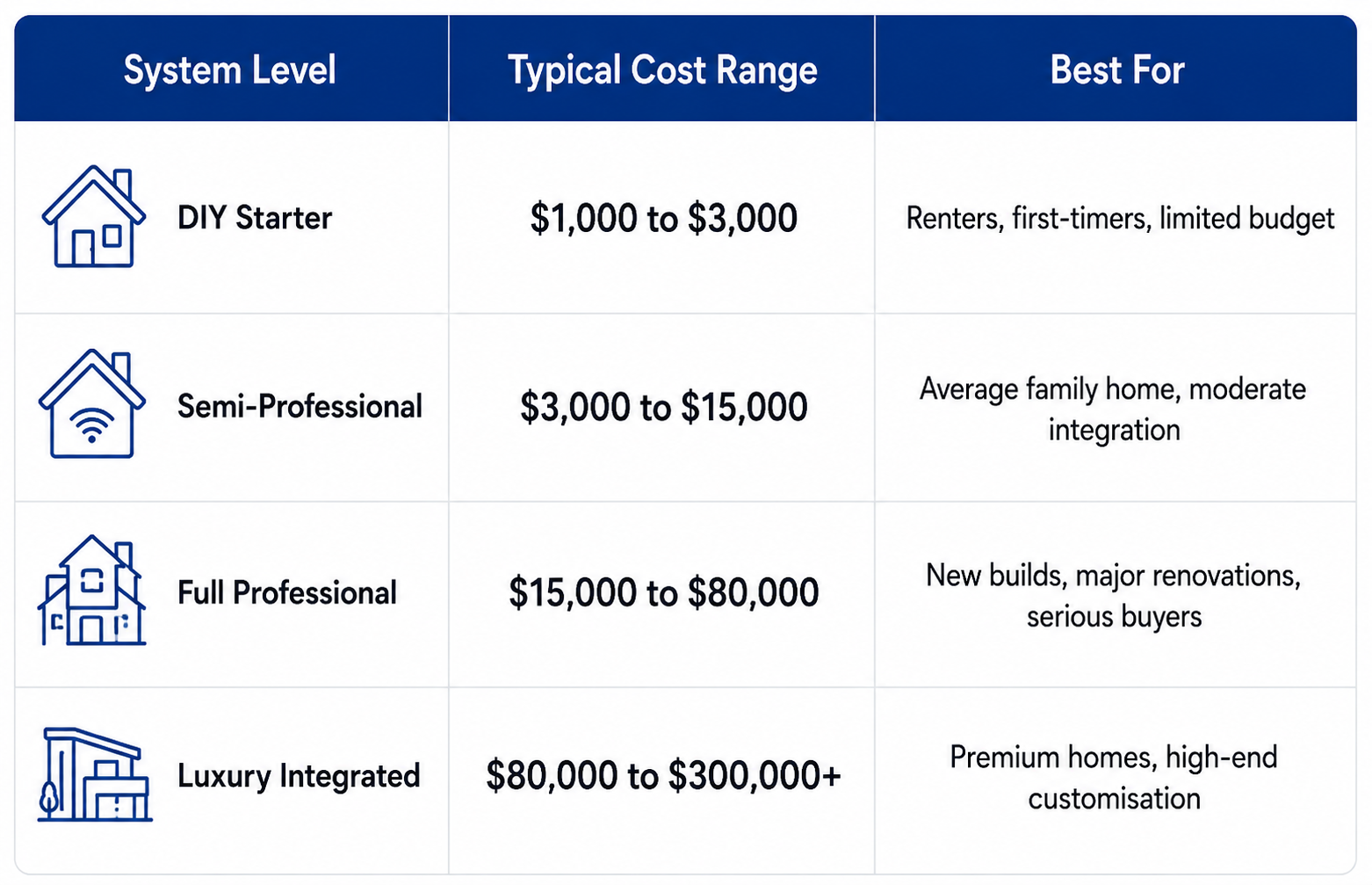
Cost guide for smart home systems
Breaking Down Costs by Smart Home Category
Smart Lighting Systems Australia Homes
Smart lighting is where most people start, and for good reason. It has the most visible daily impact and delivers real energy savings.
DIY path: A smart lighting starter kit covering a 3-bedroom home with 10 bulbs and 3 switches runs roughly $700. Add Philips Hue, LIFX or similar brands and you can extend this system room by room.
Professional path: A whole-home lighting system from brands like Control4, KNX or Lutron runs between $3,000 and $15,000 for hardware and installation. Adding motion sensors, schedules, scenes and voice control integration adds another $2,000 to $5,000.
Smart lighting can reduce lighting energy use by 7 to 27 percent according to ACEEE research, which translates into meaningful savings over the life of the system, especially with time-of-use tariffs that many NSW, VIC and QLD households are now on.
Home Automation Security Systems Australia
Security is one of the strongest value propositions in smart home investment, particularly in Australian cities. A professionally monitored smart security system creates a real deterrent, provides evidence in the event of an incident, and many insurers offer premium discounts for monitored systems.
Entry level (DIY):
Smart video doorbell: $200 to $400
2 to 4 security cameras: $300 to $800
Smart lock: $200 to $500
Total entry level security package: $700 to $1,700
Mid-range (professionally installed):
6 to 8 camera system with NVR: $1,500 to $4,000
Smart locks on all entry points: $800 to $2,000
Motion sensors, door and window sensors: $300 to $800
Alarm system with monitoring: $600 to $2,000
Total mid-range security: $3,200 to $8,800
Professional integrated (security as part of whole-home system): At this level, security integrates with lighting (automatic outdoor lights when motion is detected), access control (who can enter and when), and notifications sent to any device anywhere in the world. Budget $8,000 to $20,000 for a comprehensive professionally integrated security layer in a typical Sydney or Melbourne home.
Voice Controlled Smart Home Australia: Alexa, Google Home and Apple HomeKit
The three major ecosystems operating across Australian homes in 2026 each have different strengths.
Google Home is the most common choice in Australian homes for its tight integration with Android phones, Chromecast devices and Nest products. Google Nest Hub displays start at around $130 and Google Nest Audio speakers at around $100.
Amazon Alexa through the Echo range offers the broadest device compatibility and the most mature skills library. An Echo Dot starts at around $79 and an Echo Show at $230 to $400 depending on screen size.
Apple HomeKit is preferred by iPhone users wanting tight iOS integration. HomeKit devices tend to be slightly more expensive but the privacy architecture is regarded as superior, with processing done locally rather than in the cloud.
In 2026, Matter has changed the equation considerably. Matter is the cross-vendor smart home standard backed by Apple, Google, Amazon and Samsung. A Matter-compatible device works with all four ecosystems simultaneously, which means you are no longer locked to a single brand's app. Buying Matter-compatible devices is now the obviously correct future-proof choice for any new smart home Australia investment.
Energy Saving Smart Home Devices Australia
This category has arguably the strongest financial case of any smart home investment, especially given where Australian electricity prices sit in 2026.
Smart thermostat: $150 to $400. Research shows programmed thermostat control saves approximately $180 per year on heating and cooling. Payback period: 1 to 2 years.
Smart plugs with energy monitoring: $25 to $60 per plug. The real value here is data. Seeing exactly how much your old beer fridge in the garage is costing you per year tends to change behaviour immediately.
Smart hot water system controller: $200 to $600 installed. For homes with rooftop solar, shifting hot water heating to midday when solar production is at its peak delivers significant savings.
Automated energy management system: $2,000 to $8,000 professionally installed. For households with solar and batteries, a coordinated energy management system that pre-cools in the morning when solar is abundant, shifts pool pump operation to midday, and charges EVs when solar output is high rather than automatically after work can save $400 to $800 per year beyond what the solar alone would deliver.
Smart home energy optimisation can reduce overall household energy use by 8 to 10 percent through real-time feedback and automated load control. For an average Australian household spending $2,200 per year on electricity, that translates to $176 to $220 in annual savings from energy management alone.
Australian households are already demonstrating the power of this approach. Climate-smart home upgrades including solar, batteries, insulation and smart energy management are currently saving Australian households an estimated $3 billion per year, with average savings of around $1,500 per year per home.
IoT Home Automation Australia: The Network Foundation
Here is something that most home automation guides bury in the fine print but that professional installers consider the most critical system of all: your network.
Every smart device runs over your home network. Cameras, speakers, sensors, locks, lights, thermostats. The more devices you add, the more your network is carrying. A consumer-grade Wi-Fi router that works fine for laptops and phones will buckle under the load of a properly equipped smart home, particularly as you start adding security cameras that are streaming constantly.
Professional integrators build a wired backbone for the key systems, with Wi-Fi access points spread throughout the property rather than a single router. This costs more upfront but is the difference between a smart home that works reliably and one that needs rebooting every other week.
For a semi-professional setup, budget $500 to $2,000 for a proper mesh Wi-Fi system (Ubiquiti, Eero Pro or Netgear Orbi are popular choices in Australian homes). For a professional integrated system, network infrastructure including a proper rack, switches, firewall and access points is typically $3,000 to $8,000.
How Costs Differ Across Australian Cities and Suburbs
Location affects your home automation budget in two ways: labour rates and property type. Here is a realistic picture of what each major Australian market looks like.
Sydney, NSW
Sydney consistently has the highest home automation installation costs in Australia. Labour rates for smart home integrators in suburbs like Mosman, Balmain, Cronulla, Manly and the Hills District run $120 to $200 per hour. A 3-bedroom home in Sydney's inner suburbs can expect to pay 20 to 30 percent more in labour than the national average.
For a full professionally integrated system, Sydney-based integrators quote $25,000 as the entry point for a genuine whole-home system, with the typical investment for a well-equipped 4-bedroom home in areas like Hunters Hill, Castle Hill or Bondi sitting between $50,000 and $120,000.
Melbourne, VIC
Melbourne's smart home market is mature and competitive. Areas like South Yarra, Richmond, Essendon, Glen Waverley and Doncaster have strong clusters of experienced integrators, which keeps pricing competitive without sacrificing quality.
Labour runs $100 to $180 per hour. A full KNX lighting and blind control layer for a Melbourne renovation in suburbs like Carlton, Brunswick or Hawthorn typically sits at $30,000 to $60,000 for the lighting component alone. Total whole-home systems in premium areas like Toorak or Brighton regularly exceed $200,000.
Brisbane, QLD
Brisbane offers some of the best value for smart home installation in a major Australian city. Labour rates in suburbs like Newstead, New Farm, Paddington, Bulimba and Ascot run $90 to $150 per hour. The tropical climate also makes certain automation categories particularly valuable, including smart air conditioning control, motorised external blinds for sun management, and automated outdoor lighting.
A semi-professional smart home setup in Brisbane typically costs 10 to 15 percent less than an equivalent project in Sydney.
Perth, WA
Perth's smart home market has grown significantly in recent years. Labour rates in suburbs like Subiaco, Cottesloe, Claremont, Mount Lawley and Fremantle are broadly comparable to Brisbane, running $90 to $150 per hour.
One factor specific to Perth: the city has some of the highest rooftop solar penetration in Australia. This makes smart energy management devices particularly valuable, as coordinating solar production with home consumption can deliver exceptional returns.
Other NSW Suburbs and Cities
In areas like Newcastle, Wollongong, the Central Coast, Penrith and Blacktown, the semi-professional smart home market is active and competitive. Labour tends to run $80 to $130 per hour, and you will find many Sydney-based integrators happy to work across the Greater Sydney area including the Blue Mountains and Illawarra region.
AI Powered Home Automation Australia: What Is Actually Here Now
The term AI gets used loosely in smart home marketing, but there are genuine AI applications that are delivering real value in Australian homes right now.
Predictive climate control: Systems like Google Nest learn your schedule and preferences over time and pre-heat or pre-cool before you need it, rather than reacting after you arrive home cold or hot. This reduces energy use while improving comfort.
Anomaly detection in security: AI-powered cameras now distinguish between a person, a vehicle, an animal and a tree moving in the wind. This dramatically reduces false alerts, which was the main reason people turned off their security notifications in older systems.
Energy optimisation with solar: AI-powered energy management systems track solar production forecasts, weather data, occupancy patterns and tariff periods simultaneously, making automatic decisions about when to charge batteries, run appliances and draw from the grid.
Voice assistant improvements: The 2025 and 2026 generations of Google Assistant, Alexa and Siri have meaningfully improved at understanding natural language commands and managing multi-step automations without needing precise phrasing.
The smart home IoT devices Australia 2026 landscape is also being shaped by next generation smart homes Australia concepts around health monitoring, predictive maintenance and integration with electric vehicles. These are not science fiction. They are available today from installers in major Australian cities.
How to Set Up Smart Home Automation in Australia: A Practical Starting Sequence
If you are approaching this for the first time, here is the honest order of operations that experienced installers recommend.
Step 1: Decide on your primary goals. Security, energy saving, convenience, accessibility for elderly or mobility-impaired family members, or entertainment. Your goal determines your priorities.
Step 2: Get your network right first. Do not install $20,000 of smart home gear on a $79 router from Officeworks. A proper mesh network is the foundation everything else depends on.
Step 3: Start with the systems that have the most daily impact. Lighting and audio deliver the highest visible daily return for most families. Security and climate are strong practical additions. Motorised blinds are a luxury that people love once they have them but do not need at the start.
Step 4: If you are doing a renovation or new build, pre-wire even for systems you are not installing yet. Running cable during construction costs a fraction of retrofitting later.
Step 5: Choose a single ecosystem and stick to it. Mixing Google Home, HomeKit and Alexa devices without Matter-compatible hardware creates fragmentation. In 2026, choosing Matter-compatible devices from the start is the cleanest path.
Step 6: Get three quotes from certified integrators. Ask each one for itemised pricing, not just a total. Ask about ongoing support costs, warranty handling and their typical response time for service calls.
What People Get Wrong About Smart Home Australia Costs
Underestimating network infrastructure. The number one cause of smart home failure in Australian homes is inadequate network infrastructure. Budget for it properly from the beginning.
Choosing the cheapest installer. The cheapest quote usually reflects the least planning, the least reliable hardware, and the least programming effort. The system you live with for the next decade is worth spending properly on.
Not asking about ongoing support costs. A professional integrated system will need programming changes, software updates and occasional fault resolution. Budget $500 to $2,000 per year for ongoing support depending on system complexity.
DIY electrical work. In Australia, all mains electrical connections legally require a licensed electrician. DIY electrical work voids your insurance and creates genuine safety risks. This applies without exception.
Buying cheap unbranded devices. Unbranded smart home devices from unknown marketplace sellers often rely on cloud services that shut down, leaving you with hardware that no longer works. Stick to brands with a credible long-term business behind them.
Smart Home Ecosystem Australia: Google, Alexa and Apple HomeKit Compared
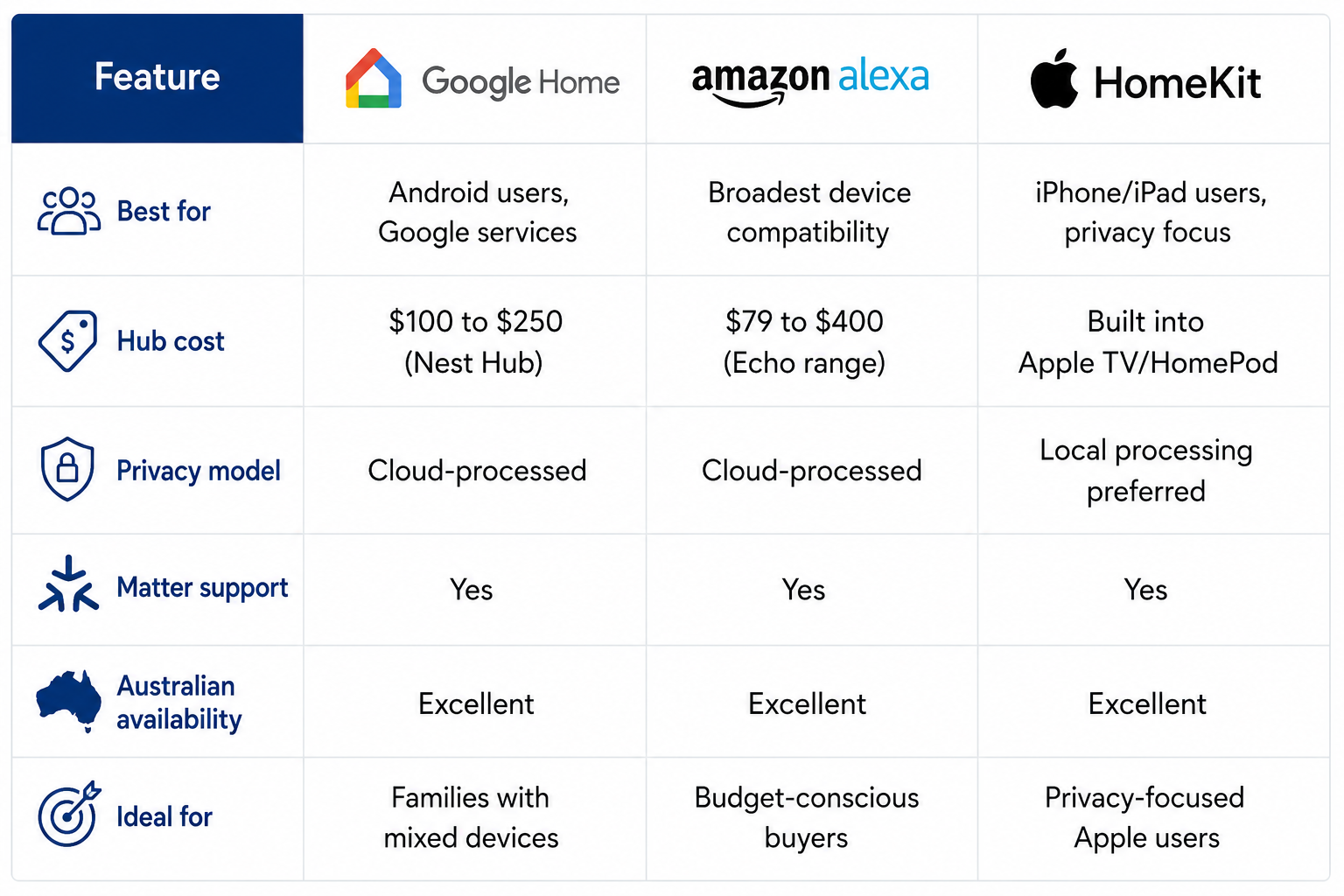
Smart home product comparison chart
The Consequences of Ignoring Smart Home Technology Australia
This section will not be popular with everyone, but it is worth being direct. There are real costs to not upgrading.
Energy costs accumulate. Households without smart energy management in 2026 are paying unnecessary electricity bills. With time-of-use tariffs now common across NSW, VIC and QLD, the difference between a managed home and an unmanaged one is real and recurring.
Property value impact. Buyers in Sydney, Melbourne and Brisbane in 2026 are increasingly factoring smart home capability into purchase decisions. A home wired for automation and pre-fitted with good infrastructure is a more attractive property than one that is not.
Security exposure. A home without remote visibility and smart security is harder to monitor and respond to when something goes wrong. This matters more, not less, as the technology to do something about it has become widely accessible and affordable.
Retrofit premium. Every year you delay adding smart home infrastructure to an existing home is a year closer to a renovation where you will pay the retrofit premium. Running cable during a renovation costs roughly one fifth of what it costs to do it after walls are closed.
Frequently Asked Questions
-
Home automation in Australia ranges from around $1,000 to $3,000 for a DIY starter setup, $3,000 to $15,000 for a semi-professional installation, $15,000 to $80,000 for a fully integrated professional system, and $80,000 to $300,000 or more for a luxury whole-home installation. The right budget depends on the size of your home, the number of systems you want to automate, and whether it is a new build or a retrofit.
-
Yes, for most homeowners. Smart home devices deliver measurable savings on energy bills, reduce security risk, increase property value, and make daily life more convenient. With electricity prices in NSW, VIC and QLD still at 37 to 44 cents per kilowatt hour, automated energy management delivers meaningful returns. Properties with good smart home infrastructure are also increasingly favoured by buyers.
-
For DIY: Google Home or Amazon Alexa ecosystems using Matter-compatible devices give the best flexibility. For professional installation: Control4, KNX, Lutron and Crestron are the most widely installed platforms by Australian certified integrators. The best system is the one designed around how you actually live, not the most technically impressive one on paper.
-
In Sydney, a professionally installed smart home starts at around $25,000 for a core system in a 3-bedroom home. A comprehensive 4-bedroom whole-home system in suburbs like the North Shore, Eastern Suburbs or Hills District typically runs $50,000 to $120,000. Labour rates for integrators in Sydney run $120 to $200 per hour.
-
In Melbourne, professional installation labour runs $100 to $180 per hour. A full whole-home smart system in premium suburbs like Toorak, Brighton, South Yarra or Camberwell typically costs $80,000 to $200,000. Mid-range systems in suburbs like Glen Waverley, Essendon or Doncaster can be delivered for $25,000 to $60,000.
-
Smart thermostats, automated hot water system controllers (especially when shifted to solar hours), smart plugs with energy monitoring, and coordinated battery and solar energy management systems deliver the strongest energy savings in Australian homes. Combined, these can reduce household electricity costs by 8 to 15 percent annually.
-
Yes, for most devices. Smart lights, plugs, cameras, locks and speakers can be installed by any reasonably tech-confident homeowner. The exception is anything that involves mains electrical wiring, which legally requires a licensed electrician in Australia. For a fully integrated system covering all rooms and multiple systems, professional installation produces a dramatically better result.
-
A DIY smart home uses consumer devices managed through individual manufacturer apps and typically costs $1,000 to $3,000. A professional smart home uses integrated platforms like Control4 or KNX, is programmed by certified installers, covers all systems from a single interface, and delivers a more reliable, customised and feature-rich experience. It costs significantly more but the outcome is a fundamentally different product.
-
Yes. Buyers in Sydney, Melbourne, Brisbane and Perth are increasingly factoring in smart home capability when comparing properties. A home with quality integrated automation, pre-wired infrastructure and a reliable security system commands a premium in the current Australian property market, particularly in the $1 million to $3 million price bracket.
-
All three ecosystems have excellent Australian availability in 2026. Google Home suits Android users and those already in the Google ecosystem. Alexa suits buyers wanting the broadest device compatibility and often the lowest hardware entry price. Apple HomeKit suits iPhone users who prioritise local processing and privacy. In 2026, choosing Matter-compatible devices means you are not locked to any single ecosystem, which is the safest long-term strategy.
Final Word
Home automation Australia in 2026 is not a niche product for wealthy tech enthusiasts. It is a mainstream investment with real financial, security and lifestyle returns for ordinary Australian families in suburbs across Sydney, Melbourne, Brisbane and Perth.
The key is to approach it with realistic expectations about budget, a clear priority order for which systems to install first, and enough knowledge to have an informed conversation with professional installers. Start with the network. Define your goals before choosing products. Get itemised quotes and ask about ongoing support. And if you are doing a renovation, pre-wire now even for systems you are not ready to install yet.
The Australian home automation market is growing because the technology has matured, the prices have come down, and the financial case has become impossible to ignore. The households that invest sensibly in smart home technology today will be paying lower energy bills, living more securely, and holding more valuable properties for the next decade and beyond.
All price ranges in this article reflect market data as of mid-2026. Individual quotes will vary based on property size, location, brand selection and installer. Always obtain a minimum of three itemised quotes from certified installers before committing to a project.