
Drone Site Inspection vs Traditional Inspection For Construction: Which is Better?
A straight-talking, data-backed comparison of construction drone inspection services and legacy methods, covering cost, safety, accuracy, and real-world ROI.
QUICK ANSWER: Drone vs traditional inspection for construction: drones win on cost (saving 50-80% per inspection event), safety (reducing on-site hazards by up to 75%), and speed (completing in minutes what takes human crews hours or days). Traditional inspection still holds an edge for certain close-contact structural assessments. For most construction site monitoring, progress tracking, and safety compliance tasks, UAV inspection solutions deliver better data at lower risk and cost.
1. The State of Construction Inspection in 2025
Construction sites have never been more complex, more data-hungry, or more closely watched. Owners demand weekly progress reports. Insurance companies want documented safety audits. Regulators expect detailed records going back months. Meanwhile, project timelines keep shrinking and labor costs keep climbing.
This pressure is forcing a real question that site managers across the industry are now confronting: is the way we have always done inspections actually good enough anymore?
The numbers are striking. The drone building inspection service market was valued at around $4.6 billion in 2026 and is projected to reach $12.1 billion by 2033. That is not a niche trend. That is an industry in the middle of a fundamental shift. And it is being driven not by novelty, but by construction companies doing the math and realizing that drone vs traditional inspection is not even a close contest on most projects.
KEY STATISTICS AT A GLANCE
75% fewer on-site safety hazards when drones replace human inspectors
80% reduction in inspection costs reported by construction teams
70% cut in manual inspection labor through drone automation
93% of construction projects encounter substantial risk events under traditional management
This guide is going to give you a complete, honest comparison. Not a sales pitch for either side. Just a clear look at what each approach actually delivers, what it costs, and where it falls short.
2. What Traditional Construction Safety Inspections Actually Look Like
Before we can compare, it is worth being specific about what traditional construction inspection methods actually involve. Because traditional inspection is often treated like a single thing, when in reality it is a collection of methods that vary enormously in cost, risk, and accuracy.
The Core Methods of Traditional Aerial Site Inspection
A ground-based visual inspection has a human inspector walking the site, climbing scaffolding, and physically reaching areas of concern. For high structures, this means organizing access equipment, observing strict safety protocols, and spending significant time on a site that is already busy and dangerous.
For hard-to-reach areas, companies have historically used:
Scaffolding and rope access systems
Man-lifts and boom cranes
Helicopters or manned aircraft for aerial views
Specialized access teams with extensive safety certifications
Each of these options costs money, takes time, and puts people in environments where the risk of accidents is real.
THE HIDDEN COST OF TRADITIONAL INSPECTION Traditional construction inspections using helicopters, scaffolding, or specialized access equipment often cost $1,000 to $5,000 per inspection event. That means many project managers simply inspect less often to save money, which is exactly when problems go undetected and grow expensive.
The Limitations Nobody Talks About Enough
Traditional construction site surveying comes with genuine constraints that are easy to overlook because they have always been there. Manual inspections rely heavily on individual expertise, meaning two inspectors can look at the same structure and document different findings. That inconsistency creates real problems for quality control and dispute resolution.
Weather windows shrink the inspection calendar. A human inspector cannot safely work on a rooftop in heavy rain or high winds. The documentation from traditional methods, typically photos taken from fixed vantage points and handwritten notes, often fails to meet the increasingly detailed requirements of modern project management software, insurance providers, and litigation.
And then there is the simple problem of human physical limits. A person cannot simultaneously see the entire site. They cannot compare today's concrete pour against last week's with centimeter precision. They cannot detect thermal anomalies invisible to the naked eye. These are not criticisms of individual inspectors. They are just the physical reality of what human beings can and cannot do.
3. Construction Drone Inspection Services: How They Work
Commercial drone inspection for construction is not just a camera on a flying machine. The best construction drone inspection services combine hardware, flight planning software, data processing, and reporting tools into an integrated workflow that produces dramatically more useful information than a traditional walkthrough ever could.
The Hardware Behind UAV Inspection Solutions
Modern drone inspection equipment covers a range of sensor types:
High-resolution visual cameras that capture imagery detailed enough to measure crack widths and check surface finishes
Thermal imaging sensors that detect heat loss, moisture intrusion, and electrical anomalies completely invisible to the human eye
LiDAR sensors that generate precise 3D point clouds measurable to centimeter accuracy, rivaling traditional surveying methods
Enterprise-grade systems like the DJI Matrice 4D carry multiple sensor types simultaneously, have IP55 weather resistance, and can fly for 40-plus minutes per battery cycle. Dock-based autonomous systems can launch, inspect, return, recharge, and upload data without any human involvement, enabling scheduled inspections around the clock.
Drone Mapping for Construction: The Data Pipeline
What happens after the flight is where commercial drone inspection truly separates itself from manual alternatives. Photogrammetry software processes hundreds of overlapping images into georeferenced orthomosaic maps and accurate 3D models. These are not just pretty visuals. They are measurable, comparable data sets that can be loaded into construction monitoring software and overlaid against the original design models.
Construction progress tracking with drones works by running repeat flights on a scheduled basis, then comparing the resulting 3D models to detect exactly what has changed. This automated construction site inspection generates information that would take a ground crew days to compile manually, and does it in hours.
4. Side-by-Side Comparison: Drone vs Traditional Inspection
Here is an honest head-to-head look at drone vs traditional inspection across the metrics that actually matter on a construction project.
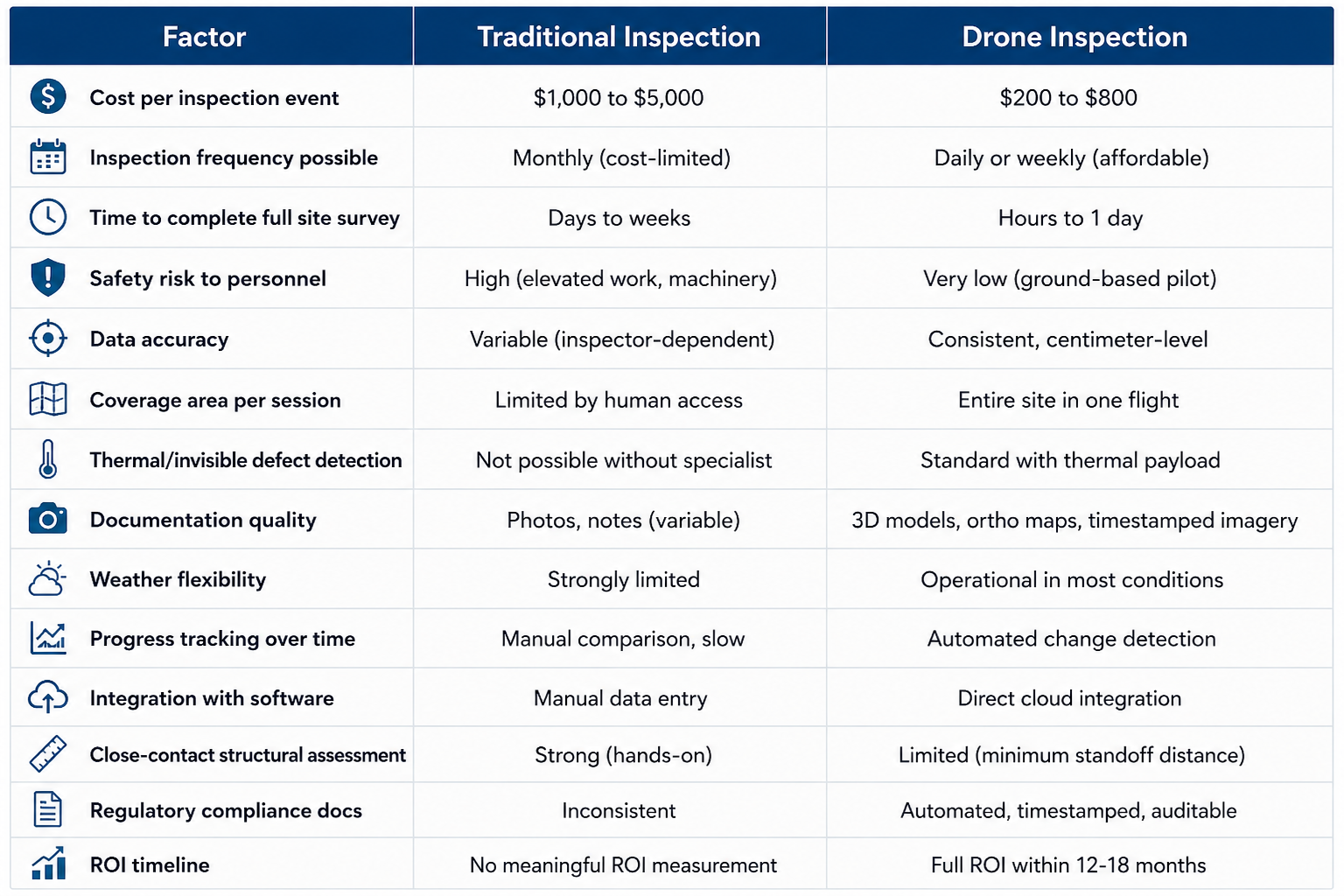
Inspection methods comparison chart
5. Drone Inspection Pricing vs Manual Methods: The Real Cost Comparison
One of the biggest reasons construction teams hesitate to switch to drone inspection services is the assumption that the technology is expensive. When you look at the actual numbers, the opposite tends to be true.
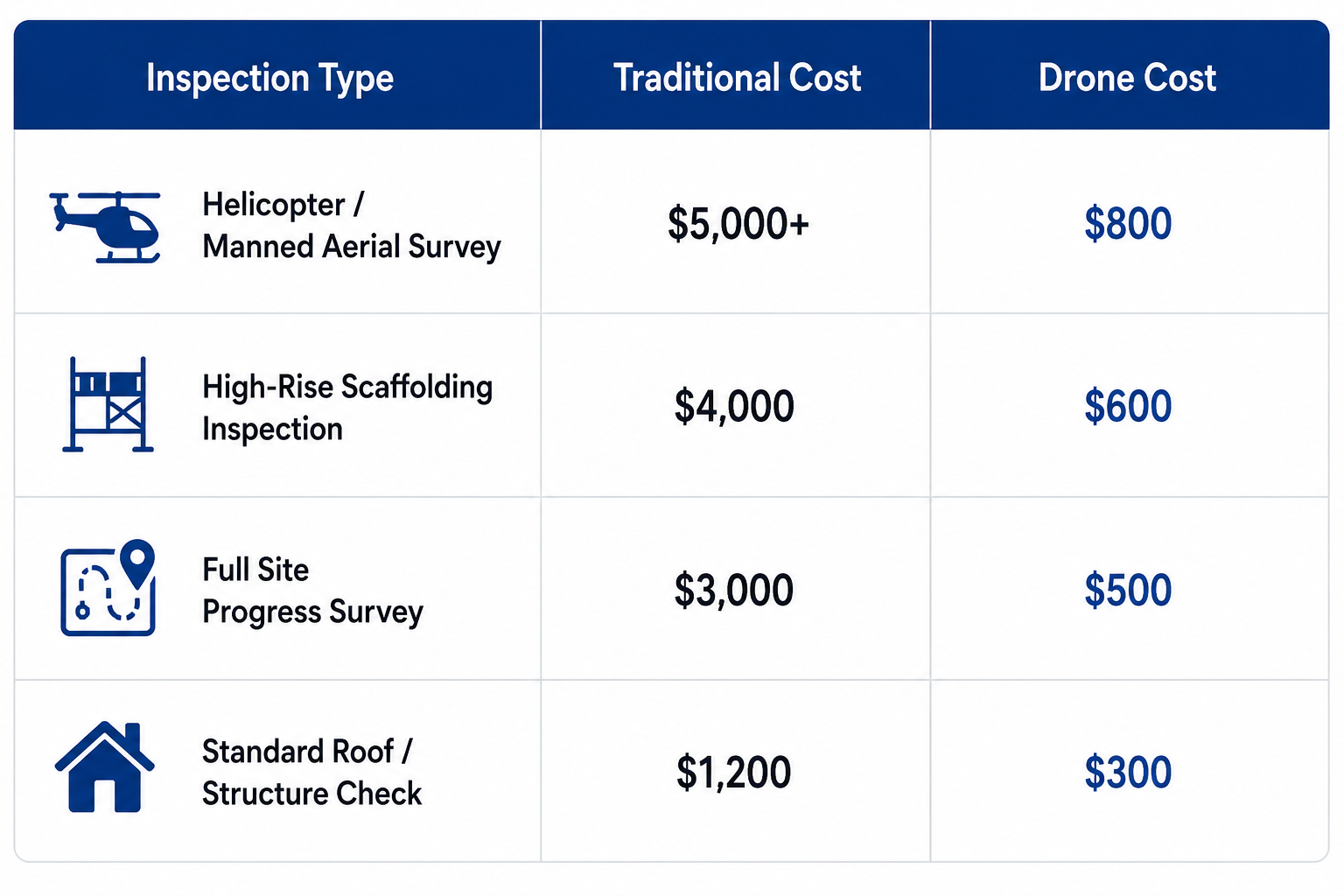
Pricing comparison: traditional vs drone inspection
The Frequency Multiplier: Where the Real Savings Stack Up
The cost comparison above only tells part of the story. Because traditional construction site inspection is expensive per visit, project managers typically schedule monthly inspections at best. That means weeks can pass between documented site conditions, giving problems time to compound before they are caught.
Drone inspection pricing is low enough that weekly, even daily, inspections become economically viable. Construction monitoring software then processes and compares each flight automatically. This shift from periodic snapshots to near-continuous monitoring fundamentally changes what a construction team can catch and when they can catch it.
Most construction companies that implement comprehensive drone inspection programs report full return on investment within 12 to 18 months. The savings come from multiple directions simultaneously: reduced labor costs, earlier problem detection preventing costly rework, better documentation cutting dispute resolution costs, and enhanced safety records leading to lower insurance premiums.
6. Construction Safety Inspections: The Safety Benefits of Drone Technology
Here is a fact that deserves more attention than it usually gets: construction is one of the most dangerous industries in the United States, accounting for approximately 21% of all worker fatalities. A meaningful portion of those deaths happen during or because of inspection activities at elevated heights or in confined spaces.
When companies hire drone inspection services for construction, they are not just buying efficiency. They are actively removing people from dangerous situations.
What the Safety Data Shows
75% fewer on-site safety hazards as a direct result of keeping inspectors on the ground
40% fewer workplace injury incidents linked to UAV inspection solutions adoption
35% of construction sites inspected by thermal drones reveal insulation failures creating fire hazards
OSHA's enforcement guidance increasingly recognizes drones as a preferred method for hazardous area inspections
REAL-WORLD SAFETY IMPACT Thermal imaging drones identify insulation failures that create fire hazards in 35% of construction sites inspected, allowing teams to act before OSHA citations or, worse, incidents occur. OSHA's own enforcement guidance increasingly recognizes drones as a preferred method for hazardous area inspections.
The Insurance Angle
Companies with documented drone safety inspection programs have reported lower general liability premiums directly tied to their improved safety records. Insurance adjusters process claims 40% faster when drone-generated reports are available, because the documentation is precise, comprehensive, and unambiguous. The indirect financial benefit of a safer worksite compounds over years of operation in ways that are hard to put a single number on, but impossible to ignore.
7. Accuracy and Data Quality: UAV Inspection Solutions vs Human Eyes
The comparison between drone inspection for construction sites and traditional methods on data quality is where the gap becomes genuinely stark.
LiDAR-equipped drones generate 3D models with measurement accuracy that rivals traditional surveying standards. Photogrammetry-based drone mapping for construction projects produces georeferenced orthomosaics accurate enough for earthwork volume calculations and grade elevation verification.
Consistency Is the Underrated Advantage
Traditional construction site inspection is inherently inconsistent. What one inspector documents depends on what they see, their training, their fatigue level that day, and where they physically can and cannot go. Two inspectors can walk the same site and produce substantially different reports.
Automated construction site inspection using drone flights with pre-programmed routes eliminates that variability. Every flight captures identical coverage from identical positions, making change detection accurate and defensible. When a dispute arises about what the site looked like on a given date, a timestamped 3D model is a far stronger piece of evidence than a handful of ground-level photos.
"A single drone flight captures more data in 15 minutes than a crew on ladders captures in 3 hours, with zero safety incidents and permanent, shareable documentation."
Thermal Imaging: Seeing What Human Eyes Miss
One capability that traditional inspection simply cannot replicate is thermal detection. FLIR-equipped drones identify overheating electrical systems, moisture trapped in roofing membranes, and compromised structural integrity through heat signature variations in concrete curing and steel connections. These are defects invisible to the naked eye that can only be found with thermal sensors. In construction, finding these issues before a building is occupied can be the difference between a minor repair and a catastrophic failure.
8. Construction Progress Tracking and Drone Surveying Services
One of the most practical applications of construction drone inspection services is routine progress documentation. This is where the frequency advantage of drone inspection pricing becomes most tangible.
When a site is surveyed weekly by drone, project managers can overlay this week's 3D model against last week's and get an automated report showing exactly how much earthwork moved, which structural elements progressed, and where work is behind schedule. Real-time drone construction monitoring lets teams identify schedule slippage while there is still time to recover.
Construction Monitoring Software Integration
Modern drone surveying services do not deliver a folder of images. They integrate directly with construction project management platforms, feeding processed orthomosaic maps, volume measurements, and annotated reports into the tools project teams already use. This digital construction solutions approach eliminates the manual data entry that has traditionally made inspection documentation a time-consuming afterthought.
Automated comparison tools can flag when earthwork volumes deviate from planned quantities, when installed materials do not match design specifications, or when site conditions have changed in ways that might affect schedule or safety. Construction workflow optimization through drone data has been shown to reduce project monitoring costs by up to 55%.
Equipment and Asset Tracking
Beyond structural monitoring, aerial site inspection using drones provides a complete picture of where equipment and materials are positioned across a large site. For construction companies managing multiple cranes, excavators, and material stockpiles, weekly drone flights produce an inventory record that ground-level checks simply cannot match in speed or completeness.
9. When Traditional Inspection Still Makes Sense
This article would not be honest if it pretended drone vs traditional inspection was always a clear victory for drones. There are situations where human inspectors on the ground or in contact with a structure provide something drone technology cannot.
Close-contact structural assessment requiring a physical tap test on concrete, or hands-on evaluation of a weld, demands direct human access that no current drone can replicate.
Indoor inspections of complex interiors, basements, confined mechanical spaces, and GPS-denied environments may require specialized indoor drones or direct human access.
Post-incident forensic investigation sometimes requires a level of interpretive judgment and physical interaction with evidence that a camera, however high-resolution, cannot provide.
Regulatory sign-off in some jurisdictions still requires a licensed human inspector to personally certify a structure, regardless of what the drone data shows.
Extremely tight urban airspace may have restrictions that prevent drone flights entirely, particularly near airports or in dense city centers.
The honest answer is that the most sophisticated construction teams are not choosing between drone and traditional inspection. They are deploying construction drone inspection services for the majority of site monitoring, progress tracking, and safety compliance work, while reserving human inspectors for the specific tasks that genuinely require direct physical access.
10. Different Perspectives: What Contractors, Insurers, and Regulators Think
The drone vs traditional inspection debate looks different depending on who is having it.
The Contractor's Perspective
For project managers and general contractors, the business case for drone inspection for construction sites is increasingly straightforward. Lower cost per inspection means they can inspect more frequently without blowing the budget. Better data means fewer disputes with subcontractors over scope and quality. Fewer site injuries means lower insurance costs and less operational disruption.
The Insurance Industry's View
Insurers are among the most enthusiastic adopters of drone-generated construction data, and for self-interested but rational reasons. Detailed, timestamped aerial documentation makes it dramatically easier to settle claims accurately and quickly. Contractors with comprehensive drone inspection records have been able to reduce their claim dispute rate significantly.
The Regulatory Perspective
Regulatory bodies are moving toward recognizing and sometimes requiring drone-based documentation. The FAA's 2024 Reauthorization Act streamlined drone operations for safety inspections. OSHA's interpretations increasingly encourage drone deployment for hazardous area inspections. In South Korea, regulations have been structured to explicitly integrate drones into construction site management, pointing toward where the regulatory environment globally is heading.
The Traditional Inspector's Perspective
Many experienced construction inspectors see drones as tools that complement rather than replace their expertise. The ability to process and interpret drone data, understand what thermal anomalies actually indicate, and recommend corrective action based on 3D model data still requires deep domain knowledge. The role of the inspector is evolving rather than disappearing, shifting from physical site presence toward data interpretation and expert judgment.
11. The Consequences of Sticking With the Old Way
This is the section most articles avoid because nobody wants to be the one predicting doom. But the consequences of not evaluating the drone vs traditional inspection question are real and quantifiable, and ignoring them does construction professionals a disservice.
The Cost of Missed Defects
Industry data shows that 93% of construction projects encounter substantial risk events, with budget overruns of 5% to 10% being common outcomes. A significant portion of these overruns trace back to defects and deviations that were not caught early. Monthly traditional inspections create 30-day blind spots. Problems that could have been corrected in a day when they were small become multi-week rework jobs when discovered late.
The Documentation Liability Gap
Construction litigation is expensive and increasingly common. When disputes arise about site conditions, structural quality, or safety compliance, the side with comprehensive documented evidence wins. Companies relying on occasional manual inspections with inconsistent documentation are leaving themselves exposed in ways that only become apparent when something goes wrong.
THE COMPETITIVE CONSEQUENCE Construction companies that master drone technology and construction monitoring software are operating at a fundamentally lower cost base than competitors using traditional methods. As drone inspection becomes the market norm rather than the exception, the companies that delay adoption will face a widening gap in both margins and client expectations.
The Safety Record Consequence
A poor safety record is not just a legal and moral problem. It affects bonding rates, insurance premiums, the ability to bid on government contracts, and the company's ability to attract and retain skilled workers. Every preventable injury that happens during a traditional inspection that could have been done by a drone is a consequence of the decision not to modernize.
12. How to Hire Drone Inspection Services: What to Look For
If you have decided to explore commercial drone inspection for your construction operation, the next practical question is what to look for when you hire drone inspection services. Not all drone inspection companies for construction are equal, and choosing the wrong one wastes money and produces data you cannot act on.
Key Criteria for a Drone Inspection Company for Construction
FAA Part 107 certification for all commercial pilots is the minimum legal requirement in the US. Verify this before engaging any provider.
NDAA compliance matters for government projects. Check that your provider uses approved hardware if you are working on public contracts.
Construction-specific experience is critical. A drone pilot who primarily shoots real estate video will not have the photogrammetry expertise your site monitoring needs.
Software integration capabilities should be confirmed before signing a contract. Ask which construction monitoring software platforms their data is compatible with.
Insurance coverage for the drone operator and their equipment should be verified independently.
Reporting turnaround time matters more than most clients ask about upfront. Same-day or next-day processed reports support real-time decision-making.
Thermal imaging capability should be confirmed if you need subsurface defect detection, moisture mapping, or electrical inspection.
Pricing Models to Expect
Drone inspection pricing for construction sites varies by scope and contract structure. Single inspection visits run from $200 to $800 for standard sites. Day rates for larger or more complex sites typically fall between $1,000 and $3,000. Many construction clients find that monthly or quarterly retainer packages offer the best value, providing consistent scheduled flights, predictable costs, and a provider who becomes familiar with the site over time.
Frequently Asked Questions
-
For most construction inspection tasks, yes. Drone vs traditional inspection comes down to the task at hand. Drones outperform traditional methods on cost (saving 50 to 80% per inspection event), safety (reducing on-site hazards by up to 75%), speed (completing in minutes what takes crews hours), and data quality (consistent, georeferenced, measurable outputs). Traditional inspection retains an advantage for hands-on structural assessments that require direct physical contact with materials.
-
Drone inspection pricing for construction sites typically ranges from $200 to $800 per inspection event for standard sites. Larger sites or those requiring specialized sensors may use day rates of $1,000 to $3,000. Subscription retainer packages that include multiple monthly flights often provide better per-inspection value. Compare this to traditional inspection costs of $1,000 to $5,000 per event, and the cost advantage of UAV inspection solutions becomes clear.
-
The main benefits include significantly lower inspection costs, dramatically improved safety by keeping workers off elevated structures, faster data collection allowing more frequent inspections, higher quality and more consistent documentation, thermal imaging that detects defects invisible to the human eye, direct integration with construction monitoring software, and better progress tracking through repeatable drone mapping for construction projects.
-
Drones are used for construction site inspection in several ways: scheduled progress monitoring flights that create weekly or daily 3D models; safety compliance audits that document PPE use and hazard conditions; thermal inspections that identify moisture, heat loss, and electrical anomalies; structural surveys of difficult-to-reach areas like rooftops and facades; earthwork volume measurements; and as-built documentation comparing actual construction against design plans.
-
Yes. LiDAR-equipped UAV inspection solutions produce 3D models with centimeter-level accuracy that meets or exceeds traditional surveying standards. Photogrammetry-based drone mapping for construction projects generates georeferenced orthomosaics accurate enough for earthwork volume calculations and grade elevation verification. The consistency of automated flight paths also eliminates the inspector-to-inspector variability that limits traditional inspection accuracy.
-
Most construction companies report full return on investment from drone inspection programs within 12 to 18 months. ROI comes from multiple sources: reduced inspection labor costs, earlier detection of defects preventing costly rework, better documentation reducing dispute resolution costs, lower insurance premiums from improved safety records, and the ability to increase inspection frequency without proportionally increasing costs.
14. The Verdict
For construction site monitoring, progress tracking, safety inspections, and documentation, drone vs traditional inspection is not a close contest. Drones are faster, safer, cheaper, more consistent, and produce better data. The only tasks that genuinely favor traditional methods are those requiring physical contact with materials or regulatory contexts that still mandate human sign-off. Every other construction inspection function benefits from switching to UAV inspection solutions.
The question the construction industry is moving past is whether drones work for site inspection. That is settled. The question now is how quickly companies will build the capability to get full value from real-time drone construction monitoring, and what they will lose in the meantime if they wait.
Construction drone inspection services have moved from an interesting experiment to a core operational tool in less than a decade. The cost savings are real. The safety improvements are documented. The data quality is measurably better. The companies investing in construction site drone services now are building a lasting competitive advantage over those still debating whether the technology is ready.
It is ready. The better question is whether your operation is.
RECOMMENDED NEXT STEPS If you are evaluating drone inspection for your construction operation, start with a pilot program on a single active project. Run parallel drone and traditional inspections for 60 days, compare the data quality and cost, and let the results make the case. Most teams that run this experiment do not go back.
Sources: FactMR Drone Construction Monitoring Market Report 2025; Birds Eye Aerial Drones safety statistics 2024; FlyByGuys commercial drone inspection cost analysis; DroneBundle drone inspection services guide 2026; Struction Solutions OSHA compliance documentation; ASCE Journal of Construction Engineering and Management; SkyeBrowse ROI analysis; UAV Coach drone services pricing guide 2026; MarketsandMarkets drone inspection market data 2025.