
The Hidden Structural Trap: Why Choosing Between Knockdown Rebuild vs Renovation in Sydney Could Cost You Thousands If You Guess Wrong
It always starts the same way. You’re sitting at your kitchen table in Sydney, staring at a floor plan that doesn’t work anymore, wondering where the budget went. Maybe the kids are growing, the walls feel like they’re closing in, or the draft coming through the old timber windows is finally driving you crazy. You want change. But then the panic sets in.
Should you strip the house down to its bones, or just tear the whole thing down and start over?
If you’ve been losing sleep trying to figure out knockdown rebuild vs renovation, you’re definitely not alone here. It’s the ultimate fork in the road for Sydney property owners. Go one way, and you’re dealing with the unpredictable mess of an old house that keeps hiding its secrets. Go the other, and you’re watching a bulldozer turn your memories into a pile of rubble, praying the council approvals don't take a year.
At first, a cosmetic fix seems easier. But yeah… this gets expensive fast. Most homeowners don’t realize this until it’s too late: an old house can be a financial black hole. On the flip side, building fresh from the ground up sounds terrifyingly permanent.
Let’s pull back the curtain on the real renovation vs rebuild cost, look at what happens behind the scenes with custom home builders and demolition services, and find out which option actually keeps more money in your bank account this year.
1. The Concrete Reality: What Actually Happens to Your Money When You Decide to Renovate or Rebuild House?
Most people think cutting a house in half or extending it out into the backyard is the budget-friendly choice. Sounds logical, right? It isn't. When comparing a major renovation cost to a rebuild house cost, logic is often the first thing to go out the window.
When you tackle a full home renovation cost, you aren't just paying for the things you see, like those beautiful stone countertops or the European oak flooring. You're paying for the privilege of working around what's already there.
The Invisible Money Pit of Old Framing
When building contractors rip back the plasterboard on an older Sydney property, they rarely find perfection. They find sagging joists, termite damage from ten years ago, and electrical wiring that belongs in a museum. Suddenly, your simple wall removal requires massive steel beams and unexpected structural repairs. The budget flips before the plumbing is even touched.
The Linear Efficiency of Slab-Up Construction
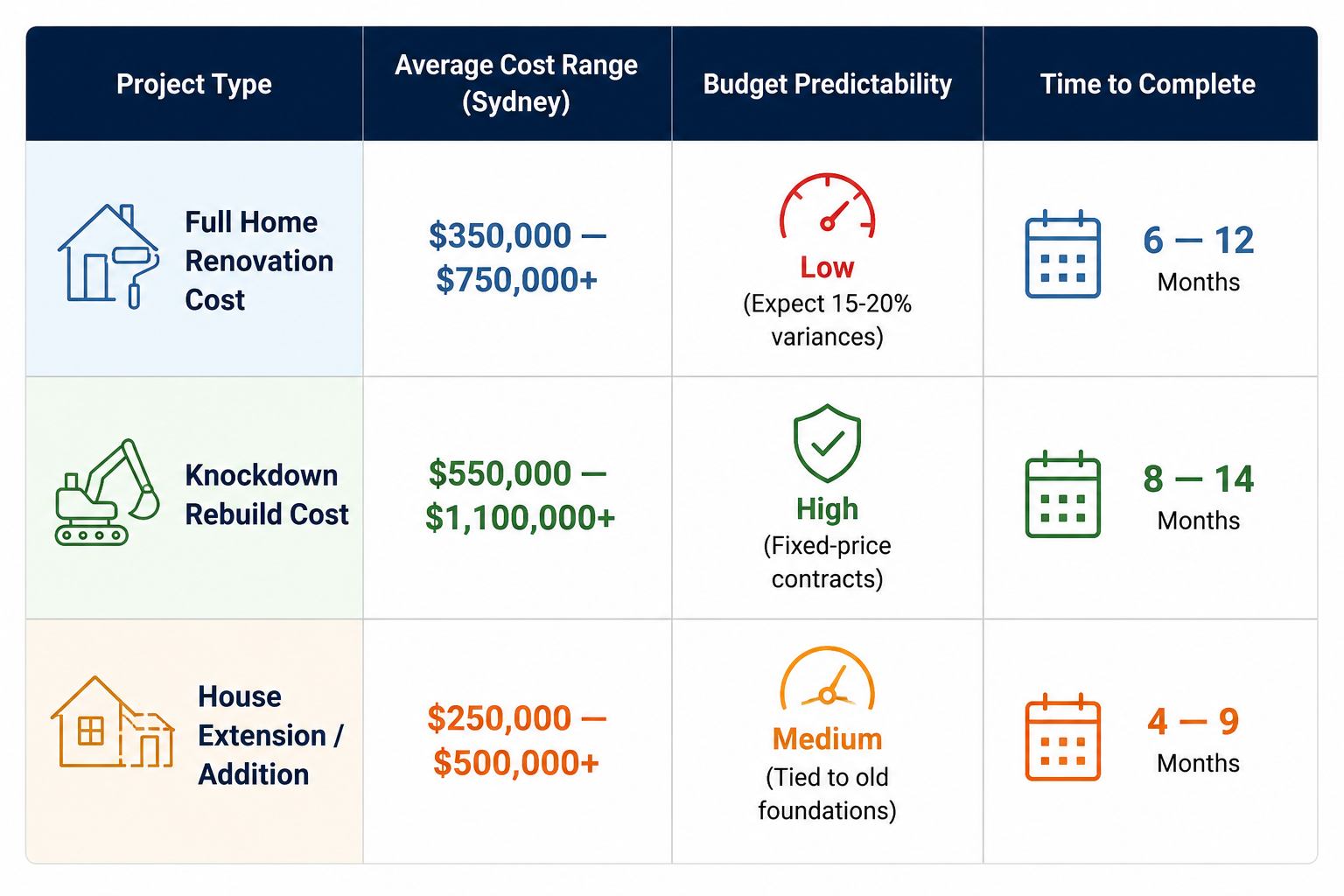
With a knockdown rebuild Sydney project, the financial trajectory is completely different. It’s clean. It’s predictable. Demolition services clear the site in a matter of days, leaving a blank slate. Custom home builders can pour a modern concrete slab, deliver materials in bulk, and run framing without fighting thirty-year-old structural mistakes. You lose the historical charm, but you gain a fixed-price contract that doesn't change every time someone picks up a hammer.
2. Breaking Down the Numbers: The Real-World Renovation vs Rebuild Cost Comparison in Sydney
Let’s talk real numbers, because guessing is it cheaper to renovate or rebuild based on internet forums will get you into trouble. In the current market, construction costs Australia have shifted dramatically, making old assumptions completely obsolete.
Calculating the Cost Per Square Metre to Rebuild a House
If you ask any reputable builder what is the cost per square metre to rebuild a house in Sydney right now, they’ll tell you it generally spans from $1,800 to $3,500+ per square metre for a standard project home, and upwards of $4,500+ for high-end modern home designs.
The kicker? Renovation costs on a square-metre basis are almost always higher than a new build. Why? Because manual labor is expensive, and meticulously modifying an existing structure requires double the hours of building a fresh wall from scratch.
The Sneaky Contingency Trap
When looking at a home renovation cost, you must factor in a massive buffer. If your builder quotes $400,000 for a structural remodel, you need at least $60,000 tucked away for the "oops, look what we found in the ceiling" moments. With a new build, your site costs and structural engineering are locked in before the first shovel hits the dirt.
3. When Is a Knockdown Rebuild Worth It? The Unforgiving Warning Signs of an Unsalvageable House
I’ve seen people ignore major structural issues for months, sinking fifty grand here and thirty grand there into an old property, only to realize they're putting a band-aid on a sinking ship. At some point, you have to ask: should I knock down and rebuild instead of fighting a losing battle?
The Subterranean Disaster: Foundation Failure
If your floors are sloping, your doors won't close properly, and brickwork cracks look like lightning bolts running down the side of your house, you’re looking at serious foundation issues. Fixing a failing foundation with underpinning or extensive structural repairs can easily swallow a six-figure sum before you've even modernized a single bathroom. This is exactly when a knockdown rebuild worth it, when the cost to make the house safe matches the cost to replace it.
Hazardous Materials and Toxic Layouts
Older homes across the inner west and northern suburbs of Sydney are notorious for containing asbestos and lead paint. Safely remediating these materials during a major renovation cost calculation can slow down your timeline and blow out your labor fees.
Furthermore, if your home has low ceilings, a weird orientation that blocks out natural light, or a layout that places the bathroom off the kitchen, a renovation won't fix the underlying flaws. You’re just paying to make an awkward house look slightly prettier.
4. The Architectural Ultimate Battle: Home Extension vs Knockdown Rebuild
If you love your neighborhood but lack space, you’re likely stuck comparing a home extension vs knockdown rebuild. It’s the ultimate battle between expanding outward (or upward) and starting fresh.
The Limitations of Extending the Past
When you hire house extension builders, you are constrained by the past. Your new roofline has to tie into the old roofline. Your plumbing lines have to travel across old foundations. If your current home has poor insulation or thermal performance, your new extension might feel like an incubator while the front of your house remains freezing cold. You’re trying to weld two different eras together, and the seam often shows.
The Absolute Freedom of Modern Home Designs
Choosing to walk away and focus on a knockdown rebuild cost Sydney gives you something money rarely buys in a reno: complete creative freedom. You can optimize the entire footprint for solar orientation, ensuring your living areas face north to drench the home in winter sun. You can build high-performance, energy efficient homes featuring double glazing, continuous insulation, and smart home automation from day one.
Important Note: A new build automatically must comply with the latest BASIX (Building Sustainability Index) requirements in New South Wales. This means your ongoing running costs, heating, cooling, and water, will be significantly lower than an older, draughty renovated home.
5. Navigating the Sydney Red Tape Bureaucracy: Council Approvals, DA, and CDC Explained
Let’s be honest: dealing with local government in Sydney can feel like a full-time job. Whether you choose knockdown rebuild vs renovation Australia, your timeline and budget will live or die based on council approvals.
The Fast-Track Route: Complying Development Certificate (CDC)
One of the biggest reasons homeowners lean toward a knockdown rebuild Sydney is the ability to bypass local council altogether via a CDC. If your land meets specific criteria and your chosen home design fits within the state’s housing code, a private certifier can approve your new build in a matter of weeks. It completely avoids the emotional rollercoaster of a local council assessment.
The Long Road: Development Application (DA)
If your property is heritage-listed, sits within a conservation zone, has significant trees, or if you’re planning a complex, architecturally unique major renovation cost project, you’ll likely need to file a DA with your local council. This process requires patience. It involves neighbor notifications, council planner reviews, and potentially months of back-and-forth negotiations.
If you're wondering when should you renovate instead of rebuild, heritage overlays are the prime answer. If your council prohibits demolition due to historical preservation, a meticulous, respectful renovation is your only path forward.
6. Financial ROI: What Adds More Value, Renovation or Rebuild?
At the end of the day, your home is also your largest financial asset. You need to look at this decision through the cold lens of equity and property value increase. Does the market reward the character of a renovated classic, or the pristine certainty of a brand-new build?
The Premium on "Turn-Key" Perfection
The modern Sydney buyer is busy, tired, and deeply suspicious of hidden defects. When you put a house on the market that has been completely rebuilt by custom home builders, it comes with structural guarantees and a pristine finish. Buyers are willing to pay a premium for a home where they don’t have to lift a finger or worry about historical structural quirks. It’s clean, it’s modern, and it drives higher emotional bidding.
The Ceiling of Renovation Value
There is an invisible ceiling on how much value a renovation can add. If you spend $500,000 renovating a home in an area where the median house price is capped, you run a massive risk of over-capitalizing. It doesn't matter how premium your finishes are; it’s still fundamentally an old house with an old skeleton. A brand-new build resets the depreciation clock for tax purposes and redefines the streetscape, consistently yielding a more predictable return on investment.
Solutions You Can Try Before Things Get Worse
If you're sitting on the fence, overwhelmed by the choice between a knockdown rebuild and a major renovation, don't rush into signing a contract. Take these practical, strategic steps first to figure out exactly what your current property can handle.
1. Get a Definitive Structural Health Check
Before allocating a single dollar to a design or a demolition permit, hire an independent structural engineer.
What to ask for: A comprehensive assessment of your foundations, stumps, load-bearing walls, and roof framing.
Why it matters: If the engineer finds the bones of your house are rotting or shifting, your decision is made for you. Don't waste money planning a renovation on a failing foundation.
2. Map Your Plot Restrictions (The DA vs CDC Check)
Find out exactly what your property is legally allowed to become before talking to sales reps.
Step 1: Request a Section 10.7 Planning Certificate from your local Sydney council.
Step 2: Look for bushfire zones, overland flooding risks, heritage overlays, or easement lines that cut through your yard.
Step 3: If your property has a heritage conservation overlay, cross a complete demolition off your list and start looking for specialized restoration contractors.
3. Run a True Budget Comparison Test
Don't guess the numbers. Run a real-world feasibility test using actual market data.
Action: Reach out to two custom home builders for a rough estimate on a standard footprint rebuild, and concurrently have a building designer quote a structural extension.
The Formula: Take the renovation estimate and add a mandatory 20% contingency fee. Compare that final number directly to the fixed-price new build quote. If the difference is less than 15%, building new is almost always the safer financial bet.
4. Checklist: Are You Ready to Rebuild or Renovate?
Use this rapid-fire checklist to see which way your situation leans:
[ ] Is the layout fundamentally broken? (If yes $\rightarrow$ Lean toward Rebuild)
[ ] Does the home have historic character worth preserving? (If yes $\rightarrow$ Lean toward Renovate)
[ ] Are the ceilings lower than 2.4 meters throughout? (If yes $\rightarrow$ Lean toward Rebuild)
[ ] Is your block slope steep or difficult to access? (If yes $\rightarrow$ Lean toward Renovate to utilize existing footings)
[ ] Do you want a guaranteed move-in date and set price? (If yes $\rightarrow$ Lean toward Rebuild with a fixed contract)
-
In terms of raw cost per square metre, a knockdown rebuild is almost always cheaper than a major renovation. Renovations involve unpredictable labor costs, custom structural engineering, and fixing old problems. However, the total upfront cost of a rebuild is often higher because you are replacing the entire footprint rather than just updating a portion of it.
-
In 2026, a standard knockdown rebuild in Sydney typically ranges from $550,000 to over $1,100,000. This depends heavily on the size of the home, site access issues, council fees, slope variations, and whether you select a premium custom design or a high-volume builder design.
-
A comprehensive, structural full home renovation cost in Sydney generally sits between $350,000 and $750,000. If you are changing layout configurations, adding extensions, or replacing structural plumbing and wiring, costs can quickly climb to meet the price of a completely new build.
-
The most reliable way to spot inflated pricing is to request an itemized cost breakdown rather than a lump-sum quote. Compare this breakdown across three independent builders. If one builder's quote for structural steel or carpentry is significantly higher without explanation, ask for clarification or walk away.
Conclusion
The choice between a knockdown rebuild vs renovation isn't just a matter of design taste; it’s a major financial crossroads that dictates your quality of life for the next decade. If your current Sydney home has historic charm, solid bones, and only needs cosmetic adjustments, a renovation can preserve that magic while giving you the updates you crave. But if you are fighting a broken layout, sloping foundations, and climbing quotes, walking away from the old framework is often the most financially liberating choice you can make.
By clearing the slate, partnering with elite custom home builders, and anchoring your finances to a fixed-price contract, you eliminate the terrifying unknowns that plague old home renovations. You gain spaces drenched in natural light, cutting-edge thermal efficiency, and the immense peace of mind that comes with structural warranties. Trust your instincts, audit your structural realities, and choose the path that protects your peace, your family, and your financial future.
Plexs — Always here with ideal designs.