
Steel and Cement Rates in Australia (Yearly Update): Latest Prices, Market Trends & Forecast
If you have priced a slab, a shed frame or a full house build in the last twelve months, you already know something is different. Quotes expire faster. Suppliers add fuel surcharges that were not there last year. And two materials sit at the centre of almost every conversation with a builder or quantity surveyor: steel and cement.
This guide pulls together the current Steel and Cement Rates across Australia, why they are moving the way they are, and what the next 12 to 18 months are likely to look like. We have used industry pricing reports, supplier price lists and market data from 2025 and 2026 to keep the numbers grounded in reality rather than guesswork. Whether you are a homeowner planning a build, a tradie quoting jobs, or a project manager tracking budgets across Sydney, Melbourne, Brisbane, Perth or Adelaide, this is the reference to bookmark and check back on.
Quick answer: As of mid-2026, structural steel in Australia is running at roughly AUD $1,900 to $2,300 per tonne at the lower end, rebar sits between $1,000 and $1,800 per tonne depending on grade, and ready-mix concrete ranges from around $150 to $490 per cubic metre depending on strength, city and whether the price is ex-plant or fully delivered. Bulk cement pricing has climbed due to import cost increases and fuel surcharges applied by major producers in early 2026.
Why This Pricing Update Is Worth Reading
A lot of pricing content online is either outdated or written once and never touched again. This article is different for three reasons. First, it draws on current 2026 industry reporting, including quarterly construction cost outlooks and supplier data, not just old averages. Second, it does not give you one flat number and call it a day. Building material prices Australia wide vary by city, by grade, and by how the market is moving that particular quarter, so we break it down properly. Third, it looks at this from more than one angle, including what suppliers are seeing, what economists are forecasting, and what it actually means for someone paying the bill on a real project.
If you only remember one thing, remember this: these prices are not set once a year and left alone. They shift with iron ore prices, diesel costs, import tariffs and even geopolitical events on the other side of the world. Treating them as static numbers is how budgets blow out.
Current Steel Prices Australia 2026: Where Steel Rates Australia Stand Right Now
Steel pricing in Australia is usually discussed in two separate buckets: structural steel used for beams, columns and framing, and reinforcing steel (rebar) used inside concrete. Both have moved upward over the past year, though for slightly different reasons.
Structural Steel Prices Australia: Cost Per Tonne
Structural steel cost per tonne in Australia is best understood as a range rather than a fixed figure, because fabrication load, coating requirements and freight all change the final number. Based on current market conditions:
Low scenario: roughly $1,900 to $2,300 per tonne, assuming stable supply and manageable freight costs
Mid to high scenario: higher again where fabrication demand is strong, coatings are specified, or projects need imported sections
Expected movement into 2026 and beyond: mild escalation of around 3 to 7 percent, driven mainly by labour, energy and freight rather than a sudden spike
Structural steel prices Australia wide are expected to stay firm rather than fall sharply, because demand from commercial and industrial construction remains steady even as residential building has slowed in parts of the country.
Rebar Prices Australia: What Builders Are Paying Per Tonne
Rebar price per tonne Australia wide depends heavily on grade. Grade 40 rebar, used in lighter residential applications, generally sits between $1,000 and $1,400 per tonne. Grade 60 rebar, used where higher strength or coastal corrosion resistance is required, typically runs from $1,200 up to $1,800 per tonne.
This gap matters more than people expect. A project that assumes grade 40 pricing but ends up needing grade 60 for council or engineering compliance can see reinforcement costs jump by 20 to 30 percent without anyone catching it until the invoice arrives.
There is also a policy factor pushing rebar prices higher through 2026. Australia has imposed duties of up to 82 percent on Chinese hot rolled coil steel, and import duties on rebar were increased to 23.7 percent in May 2026, up from 19 percent the month before. Preliminary levies have also been applied to imports from Malaysia, Thailand, Turkey and Vietnam. Combined with shipping disruption linked to the Strait of Hormuz, this is expected to add real upward pressure on rebar prices from the middle of 2026 onward.
Cement Prices Australia 2026: Cement Rates Australia Explained
Cement is the quieter cost driver in most budgets, but it moves nearly every material downstream of it, from concrete to render to precast panels.
Bulk Cement Prices Australia
Cement rates Australia wide are shaped by three separate cost layers: the raw imported cement or clinker, local grinding and blending costs, and transport to site. Industry reporting from early 2026 shows all three layers rising at once:
Imported cement cost escalation of around 15 percent
Local grinding costs up roughly 10 percent
Trucking and logistics adding a further 12 to 15 percent on top
Bagged cement for smaller jobs typically runs from around $13 to $30 per 20kg bag depending on brand and blend, while bulk bag pricing for trade and commercial buyers sits anywhere from $400 to $1,300 depending on volume and cement type (general purpose, blended, or specialty low heat cement). The Australian cement market itself is valued at close to AUD $4 billion and is forecast to keep growing at around 4.6 to 4.7 percent a year through to 2030, which tells you demand is not slowing down even as prices climb.
Concrete Prices Australia: Cost Per m3 By Grade
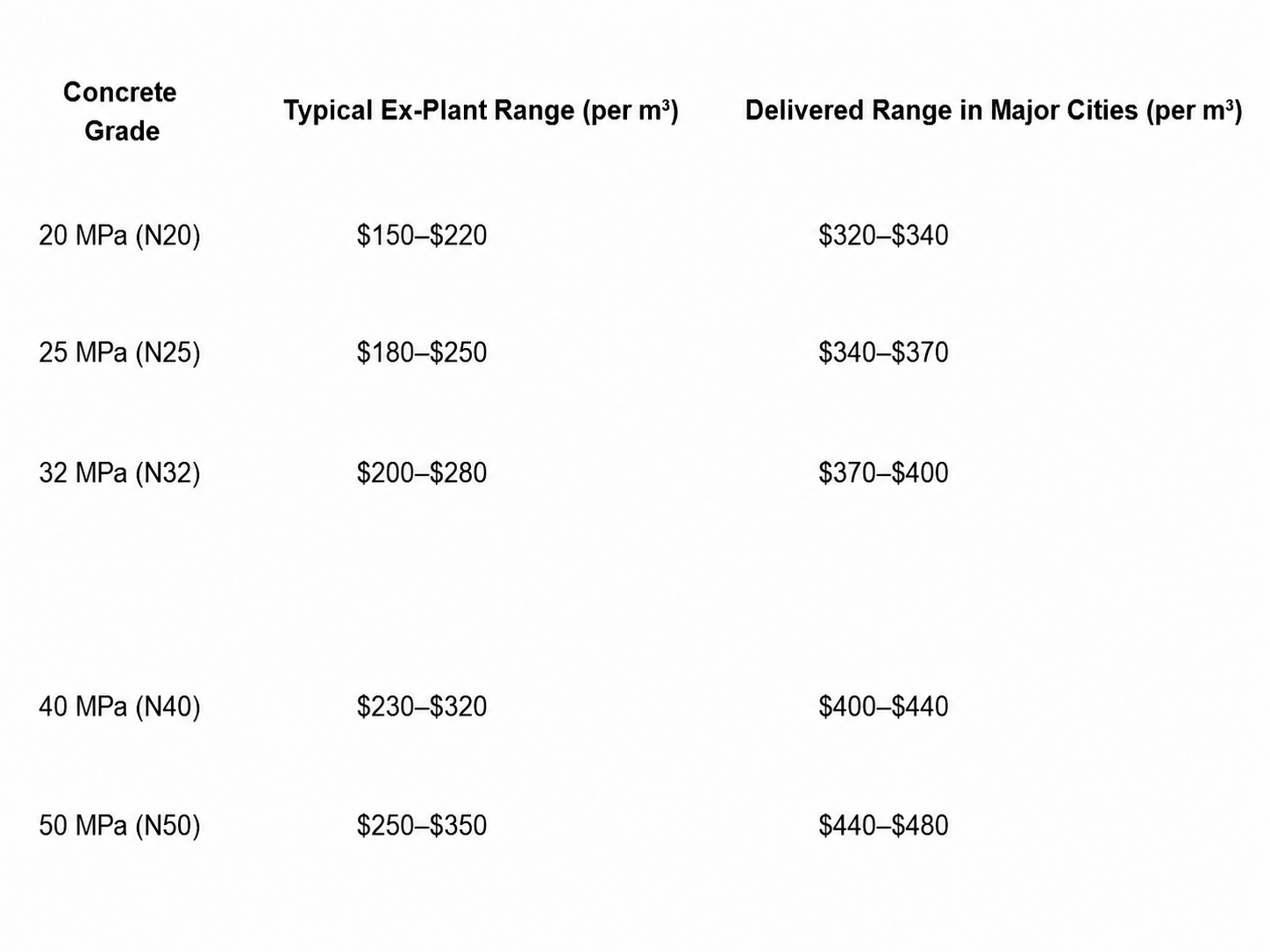
Concrete price per m3 Australia wide is one of the most searched numbers in this whole category, and honestly, one of the most inconsistent to quote, because "concrete cost" can mean the raw ex-plant rate or the fully delivered, pumped and placed rate. Here is how it breaks down:
Concrete grade pricing table layout
On top of the base rate, expect delivery fees of roughly $75 to $115 within a 20km radius, short load fees under 4m³, weekend surcharges, and fuel surcharges now being applied directly by major producers such as Holcim and Heidelberg Materials, which have added between $8.10 and $8.67 per cubic metre in 2026 alone. Concrete prices have climbed by around 5 percent a year on average since 2021 across the major capitals, and that trend has not broken yet.
Why Are Steel and Cement Rates Rising Across Australia Construction Material Prices
This is the question we get asked more than any other, so let's answer it properly rather than in one vague sentence.
What Affects Steel Prices in Australia
Iron ore and coking coal costs, which set the base cost of making steel in the first place
Import tariffs and anti-dumping duties, which have increased sharply through 2025 and into 2026 on steel from China, Malaysia, Thailand, Turkey and Vietnam
Freight and shipping disruption, including recent volatility linked to the Strait of Hormuz, which affects both fuel costs and container availability
Local infrastructure demand, with major projects such as Melbourne's Suburban Rail Loop and North East Link soaking up large volumes of structural steel
Currency movement, since a lower Australian dollar makes imported steel more expensive even when overseas prices are stable
Energy costs and the shift toward "green steel", which currently costs more to produce than conventional blast furnace steel
What Affects Cement Prices in Australia
Imported clinker and cement costs, which rose an estimated 15 percent in the most recent reporting period
Diesel and fuel prices, which spiked sharply in March 2026, rising 41 percent in a single month from around 181 to 256 cents per litre, a cost that flows straight into every delivery
Energy-intensive grinding and manufacturing, since cement production is one of the most energy hungry processes in construction materials
Producer fuel surcharges, now being applied directly on top of base pricing by major suppliers
Proposed carbon border adjustments, with a government review looking at a carbon tax on imports like cement and steel to prevent cheaper, higher emission imports undercutting local production
Put simply, both materials are being squeezed from the same direction: energy, freight, tariffs and a construction sector that has not slowed down demand enough to offset any of it.
Building Material Prices Australia by City: Sydney, Melbourne, Brisbane, Perth and Adelaide
Australia construction material prices are never uniform across the country, and steel and cement prices prove that clearly.
Steel prices Sydney and Melbourne tend to sit closest to the national average, since both cities have strong supplier competition and shorter freight distances from major distribution hubs. Steel prices Brisbane run similarly, though regional Queensland projects can see higher landed costs.
Steel prices Perth and Adelaide, on the other hand, usually carry a premium of around 10 to 20 percent above the eastern seaboard, largely due to geographic isolation and fewer competing suppliers.
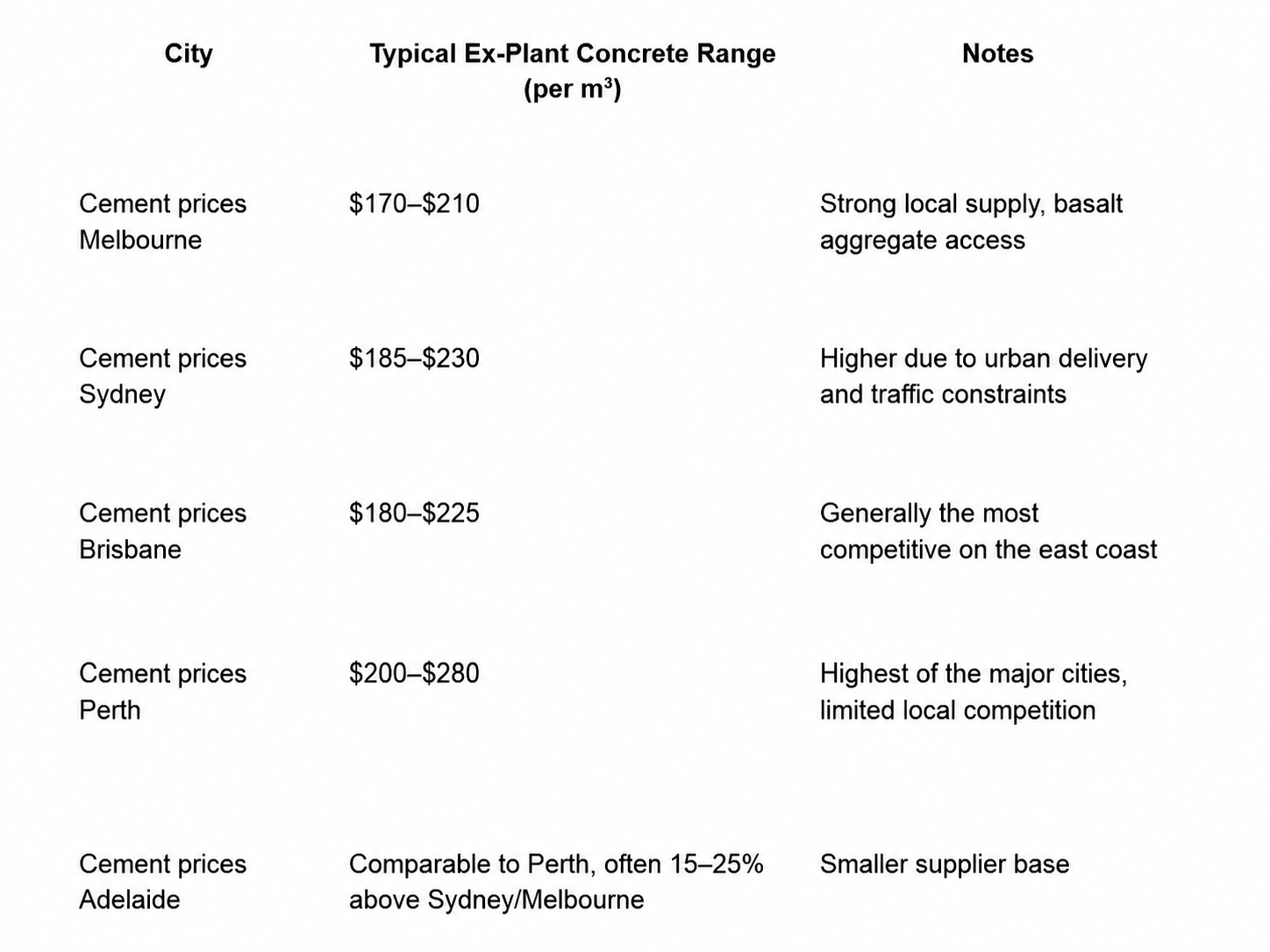
For cement and concrete, the pattern is much the same:
Cement price comparison across cities
If you are building in Sydney specifically, local government area matters more than most people realise. Burwood Council, City of Canada Bay, City of Ryde, City of Sydney, Cumberland City Council, Hunters Hill Council, Hornsby Shire Council, Inner West Council, North Sydney Council, Strathfield Council, Willoughby City Council, Woollahra Municipal Council, Ku-ring-gai Council and Lane Cove Council all sit within the greater Sydney supply network, but delivery zones, council approval timelines and access restrictions in denser inner-west and lower north shore suburbs can quietly add to the final landed cost of steel and concrete deliveries. It pays to ask your supplier directly whether your suburb sits inside their standard delivery radius before you lock in a quote.
Structural Steel Prices Australia and Rebar Prices Australia: Consequences for Builders and Homeowners
Rising Steel and Cement Rates are not just a line item change. They ripple through the entire build in ways that are easy to underestimate.
Fixed price contracts are getting harder to hold. Builders are increasingly adding escalation clauses to contracts because locking in a fixed steel or cement price 12 months out is genuinely risky right now.
House building material costs Australia wide are pushing project budgets up by several percentage points a year, even before labour and compliance costs are added.
Smaller builders and owner-builders feel it hardest. Large developers can often negotiate bulk pricing and lock in supply contracts, while a single home build does not have that leverage.
Renovation and extension projects are being delayed or scaled back, particularly ones involving structural steel beams, as homeowners wait to see whether prices settle.
Regional and remote projects face a compounding effect, since freight cost increases stack on top of already elevated base material prices.
The honest takeaway here is that construction cost inflation Australia wide is not a temporary blip caused by one single event. It is the result of several pressures landing at the same time, and most forecasts suggest at least some of that pressure will carry into 2027.
Steel Price Forecast Australia and Cement Price Forecast Australia: What's Ahead
Nobody can predict commodity markets with certainty, but the current signals point in a fairly consistent direction.
Steel price forecast Australia 2026 to 2027:
Most analysts expect steel prices to firm gradually rather than spike suddenly, assuming no major new trade disruption
Some forecasts suggest iron ore could fall toward US$83 per tonne by the end of 2026, which would ease some cost pressure on mills
Anti-dumping duties and import tariffs are likely to keep local structural steel and rebar prices supported even if global raw material costs soften
Expect general escalation in the range of 3 to 7 percent annually rather than a dramatic swing in either direction
Cement price forecast Australia 2026 to 2027:
The Australian cement market is projected to keep growing at close to 4.7 percent a year through 2030, supported by infrastructure and residential demand
Fuel and energy costs remain the biggest wildcard, particularly if diesel prices stay elevated
Proposed carbon border measures could add further cost to imported cement over the medium term
Concrete prices are likely to continue climbing at roughly the same 5 percent annual pace seen since 2021, barring a major shift in fuel or freight costs
If you are budgeting a project that will run through late 2026 or into 2027, building in a contingency of at least 5 to 8 percent for steel and cement related costs is a sensible, defensible position rather than an overly cautious one.
Different Perspectives on Australia Construction Material Prices
It is worth looking at this from more than one seat at the table, because the story changes depending on who you ask.
From the supplier's side, price increases are being framed as cost-driven rather than opportunistic, tied directly to fuel, energy and freight rather than demand spikes. Several major suppliers have been transparent about applying itemised fuel surcharges rather than simply raising base prices quietly.
From the builder and contractor's side, the frustration is less about the size of the increases and more about the unpredictability. A quote that is valid for 30 days can look very different from one that held for 90 days two years ago, which makes it harder to give clients confidence in a fixed budget.
From an economic policy perspective, the tariffs and anti-dumping duties placed on imported steel are designed to protect local manufacturing and jobs, including the long-term future of facilities like the Whyalla Steelworks. The trade-off is that local buyers absorb some of that protection through higher prices in the short to medium term.
From a homeowner's perspective, none of these explanations make the number on the invoice feel any smaller. That is a fair reaction, and it is exactly why getting multiple quotes, understanding grade requirements before you commit, and timing large material orders carefully all matter more now than they did five years ago.
There is a genuine counterargument worth acknowledging too: not every analyst agrees prices will keep climbing. If iron ore does fall as some forecasts suggest, and if freight disruption eases faster than expected, steel costs in particular could soften by late 2026. Cement is less likely to fall quickly given how much of its cost is tied to fixed energy and grinding expenses, but it is not impossible for growth to slow.
How and Where to Buy Steel and Cement in Australia
If you are actively sourcing materials rather than just researching, a few practical points will save you money.
Get at least three quotes for both steel suppliers Australia wide and cement suppliers Australia wide before committing, since pricing can vary more between suppliers in the same city than most people expect
Ask about bulk cement prices Australia suppliers offer for palletised or bulk bag orders, which are almost always cheaper per tonne than bagged product for anything beyond a small job
Confirm grade before you price rebar, since grade 40 versus grade 60 pricing gaps can quietly blow out a budget
Ask directly whether fuel surcharges are included in the quoted rate, since some suppliers list them separately and others fold them in
If you are hunting for the cheapest steel suppliers Australia wide, be cautious of prices that sit well below market average, since it can indicate compliance shortcuts or stock that has not passed proper Australian Standards testing
Time large pours outside peak season where possible, since spring and early autumn demand in NSW and VIC can tighten availability and push spot prices up by 5 to 10 percent
Steel and Cement Rates Buying Checklist
Use this as a quick reference before you commit to any supplier quote.
[ ] Confirmed exact steel grade required (structural section size, rebar grade 40 vs 60)
[ ] Confirmed concrete MPa strength required for the specific application
[ ] Requested at least three supplier quotes for both steel and cement
[ ] Asked whether fuel surcharges, delivery and short load fees are included
[ ] Checked delivery zone and suburb-level access restrictions with the supplier
[ ] Compared ex-plant pricing against fully delivered and placed pricing
[ ] Built in a 5–8% contingency for material cost escalation
[ ] Checked current import duty and tariff status if considering imported steel
[ ] Locked in supply timing ahead of peak spring or early autumn pouring season
[ ] Reviewed contract for price escalation clauses before signing
Frequently Asked Questions
-
As of 2026, structural steel runs from around $1,900 to $2,300+ per tonne, rebar ranges from $1,000 to $1,800 per tonne by grade, and concrete ranges from roughly $150 to $490 per cubic metre depending on strength and whether it is delivered.
-
Steel prices are rising due to increased import tariffs and anti-dumping duties, higher freight and shipping costs, strong infrastructure demand, and rising energy costs tied to steel production.
-
Cement costs have risen due to a 15 percent increase in imported cement costs, higher local grinding costs, rising fuel prices affecting delivery, and fuel surcharges applied directly by major producers in 2026.
-
Iron ore and coal costs, import duties, freight rates, currency movement and local construction demand are the main factors affecting steel prices in Australia.
-
Energy costs, imported clinker prices, transport and diesel costs, and producer surcharges are the biggest factors affecting cement prices in Australia.
-
Structural steel typically costs between $1,900 and $2,300 per tonne at the lower end of the market, with higher pricing for complex fabrication, coatings or imported sections.
-
Ex-plant concrete typically costs $150 to $350 per m3 depending on strength grade, while fully delivered and placed concrete in major cities can range from $320 to $490 per m3.
-
Most forecasts expect prices to firm gradually rather than fall sharply, though a drop in iron ore prices could ease some steel cost pressure by late 2026. Cement is less likely to fall quickly due to fixed energy costs.
-
Yes. Perth and Adelaide typically carry a 10 to 25 percent premium over Sydney, Melbourne and Brisbane due to freight distance and fewer local suppliers.
-
Compare quotes from at least three steel suppliers Australia wide and cement suppliers Australia wide, ask about bulk pricing, and confirm any low quote meets Australian Standards before committing.
Final Word
Steel and Cement Rates in Australia are being shaped by a mix of global commodity swings, local trade policy and everyday logistics costs that most of us never think about until a quote lands in our inbox. The most useful thing you can do right now is stop treating a quote as a fixed number and start treating it as a snapshot of a moving market. Get current pricing before you budget, understand exactly what grade or strength you actually need, and build in a sensible contingency. That single habit will save more money over the life of a project than almost any single negotiation tactic.
If you are planning a build or a large material order in the next few months, it is worth checking pricing again closer to the time, since even the ranges in this update can shift as the year progresses.
Sources referenced in this update include Altus Group's Q1 2026 Australian Construction Price Outlook, Cement Concrete & Aggregates Australia (CCAA), IndexBox Australia Cement and Steel Market Reports, supplier pricing from Melsteel, BGC Cement and BC Sands, and concrete pricing data from MixHub, Yellow Pages and industry cost guides current as of mid-2026.