
Solar Integration Explained: Smart Energy Solutions for Australian Homeowners
Introduction: Why Solar Integration is No Longer Optional for Australian Homes
Australia has a problem most countries would envy. We produce so much solar power that some states occasionally generate more than the entire grid can absorb. South Australia routinely powers itself entirely on rooftop solar during midday hours. And yet, the average Australian household is still paying electricity bills that have risen by nearly 10% year on year.
The disconnect comes down to one thing: most homeowners have solar panels but not true solar integration.
There is a real difference between bolting panels onto a roof and building a complete solar energy system that works in sync with how your household actually uses power. Solar integration is the process of connecting your solar panels, battery storage, smart inverter, and home appliances into a single, coordinated energy ecosystem. When it is done right, you stop being a passive electricity consumer and start running your home like a micro power station.
This guide is written for Australian homeowners, specifically those in Sydney's inner suburbs, the North Shore, the Inner West, and surrounding council areas, who are ready to move beyond entry-level solar and start treating energy as a proper household investment.
What Solar Integration Actually Means (And What It Does Not)
Most people think of solar as a single product. You buy panels, someone installs them, and you save money. That is solar panel installation. It is a starting point, not a destination.
Solar integration is a broader concept. It refers to the design and implementation of a residential solar system where every component is selected and configured to work together. That includes:
Solar panels (photovoltaic or PV)
An inverter (string, micro, or hybrid)
Solar battery storage
A monitoring system
Smart load management (appliance scheduling, EV charging, hot water diversion)
Grid connection settings and export limits
The goal of integrated solar solutions is not just to generate electricity. It is to maximise self-consumption of that electricity, minimise what you buy from the grid, and give you control over when and how you use energy.
Think of it this way. Without integration, your solar panels generate power during the day, most of which gets exported to the grid for a few cents per kilowatt-hour, while you buy electricity back at peak rates in the evening. With integration, that same solar energy charges your battery during the day, powers your dishwasher and washing machine at noon, and offsets your evening peak demand entirely.
The State of Solar Energy in Australia: 2026 Metrics
Before we get into the details of how solar integration works for your home, it is worth understanding the broader picture, because the numbers heading into 2026 are genuinely staggering.
Key statistics as of 2026:
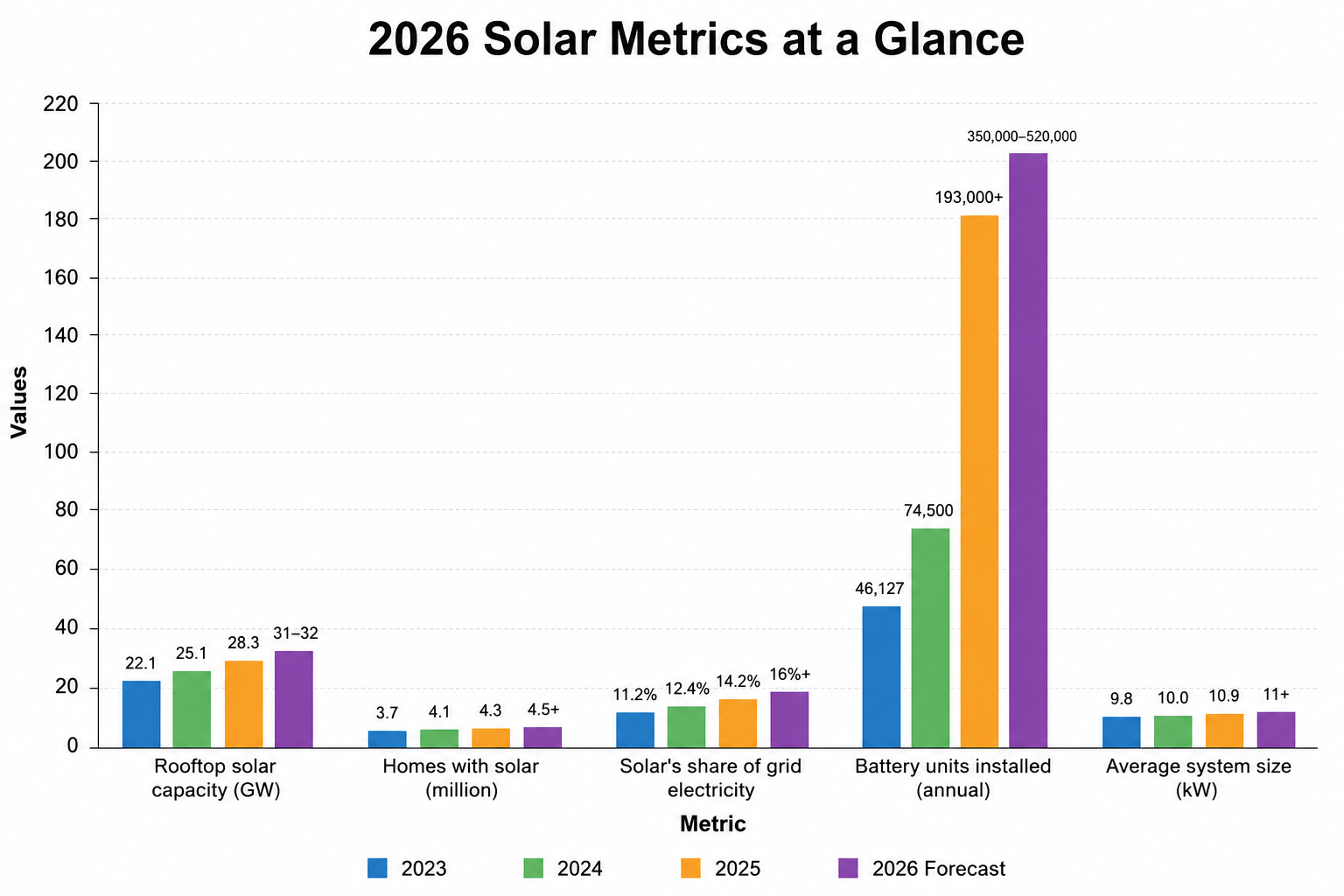
Over 4.3 million Australian households now have rooftop solar, making solar Australia's single largest power station
Rooftop solar capacity reached 28.3 GW by end of 2025, exceeding the entire coal-fired generation fleet (22.5 GW) for the first time
Rooftop solar now supplies 14.2% of Australia's electricity, up from 12.4% in 2024 and just 7.2% in 2020
Australia remains the world leader in per capita solar capacity at over 1.4 kW per person
NSW leads rooftop solar installed capacity at 8 GW, while Queensland leads in total number of systems at 1.16 million
In March 2026, Australia registered 341 MW of new small-scale solar in a single month, 16% above the same month in 2025
The CER forecasts rooftop solar installations will rebound to between 3 GW and 3.7 GW in 2026, after the 2025 slowdown caused by installer capacity shifting to battery work
The federal government has committed AUD 2.3 billion (later expanded to an estimated AUD 7.2 billion over 4 years) to the Cheaper Home Batteries Program
454,753 battery systems were installed across Australian homes by end of 2025, with the H2 2025 figure of 183,245 units equal to 99% of all batteries ever installed between 2020 and 2024 combined
The CER projects 350,000 to 520,000 residential battery installations in 2026 alone, representing 8 to 12 GWh of new storage capacity
In April 2026, Australia registered a record 442 MW of new small-scale rooftop solar, a 31% month-on-month surge and nearly double April 2025
The 2026 picture is one of acceleration, not consolidation. The battery revolution is reshaping what solar integration looks like for Australian homeowners. Roughly 3.7 million Australian homes already have solar panels but no battery storage. That is the biggest retrofit opportunity the domestic energy market has ever produced, and government policy is actively funding it.
2026 Solar Metrics at a Glance
2026 solar metrics overview.png
Sources: Clean Energy Council, Clean Energy Regulator, SunWiz, pv-magazine Australia. 2026 figures are CER forecasts as of February 2026.
This tells us something important. Australians are not just generating solar energy anymore. They are storing, managing, and deploying it at a scale that is reshaping the national grid. That is solar integration in action.
How Home Solar Integration Works: A Step-by-Step Overview
Understanding solar integration does not require an engineering degree. Here is a practical breakdown of how an integrated solar system actually functions in a Sydney home throughout a typical day.
Morning (6am to 9am)
Your battery, which charged overnight using time-of-use off-peak rates or residual solar from the previous evening, begins supplying power to your home. The solar panels start generating as the sun rises. By 8am in Parramatta or Balmain, a 10 kW system is already producing 3 to 4 kW of power, enough to run your morning routine without touching grid electricity.
Midday (10am to 3pm)
This is peak solar generation. Your panels may be producing 7 to 10 kW or more. Your smart energy management system routes this power in order of priority: household loads first (fridge, lights, devices), then battery charging, then hot water heating, and finally export to the grid. The goal is to use as much solar energy inside your home as possible before exporting any.
Afternoon and Evening (3pm to 9pm)
Solar generation tapers off. Your battery begins discharging to cover household demand. Under Ausgrid's time-of-use metering, the peak period runs from 2pm to 8pm, during which grid electricity can cost over 50 cents per kWh. A fully charged 10 to 13.5 kWh battery can carry most households through this window without drawing from the grid at all.
Night (9pm onwards)
Your home runs on whatever remains in the battery. If the battery is depleted, you draw from the grid at off-peak rates. A smart system will also check next-day weather forecasts and decide whether to top the battery up cheaply overnight or leave room for morning solar.
Benefits of Solar Integration for Residential Homes
Significant and Measurable Bill Reductions
This is the primary reason most homeowners consider solar integration, and the figures are compelling.
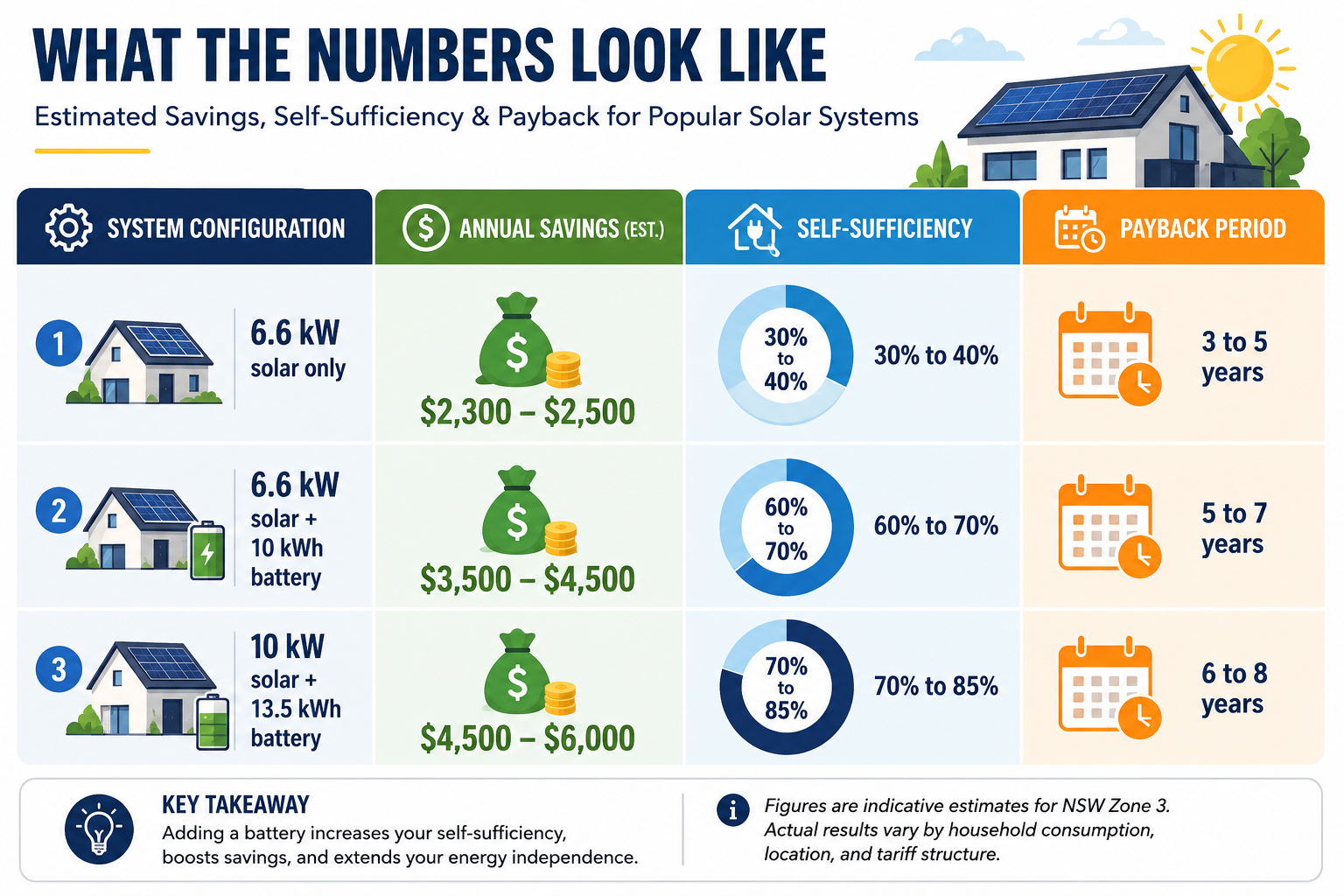
A standard 6.6 kW solar system in NSW can save between $2,300 and $2,500 annually on electricity bills. Add a 13.5 kWh battery and that figure nearly doubles, with households saving approximately $4,000 to $5,000 per year. A typical household with combined solar and battery integration can cover over 70% of its electricity needs through self-generated and stored solar power.
Under Ausgrid's time-of-day metering, which is now being rolled out across Sydney, homeowners save close to 52 cents for every kWh of solar power their system generates between 2pm and 8pm. That single number changes the financial case for battery storage dramatically.
Protection Against Rising Energy Prices
Australian electricity prices have been rising consistently. Homeowners in Burwood, Strathfield, Concord, and similar suburbs that rely heavily on daytime air conditioning are among the hardest hit. Solar integration insulates you from those increases by reducing how much grid electricity you consume.
When energy prices rise by 10%, your solar system keeps generating at zero fuel cost. Your savings effectively increase every time retail electricity prices go up.
Increased Property Value
Research consistently shows that solar-equipped homes attract a premium at sale. In NSW, homes with solar systems can sell for 3% to 4% more than comparable properties without solar. In high-demand suburbs like Hunters Hill, Lane Cove, and Mosman, where environmental credentials matter to buyers, a well-designed solar integration system can be a genuine point of differentiation.
Environmental Benefits
A 6.6 kW solar system in Sydney prevents approximately 8 to 10 tonnes of CO2 emissions every year. For households in the City of Sydney Council area, the Inner West, and Woollahra, where community sustainability targets are part of local policy, switching to clean energy solutions is both personally and collectively meaningful.
NSW has committed to cutting emissions by 70% by 2035 and reaching net zero by 2050. Residential solar integration is one of the fastest ways individual households can contribute to that goal.
Energy Independence and Resilience
Power outages are becoming more frequent as Australia's ageing coal infrastructure is wound down. A grid-connected solar system with battery backup can keep your essential appliances running during blackouts. For families in suburbs like Gladesville, Ryde, Chatswood, and Hornsby, where storms occasionally knock out grid supply, this resilience has real value beyond the financial.
Solar Integration with Battery Storage: The Game Changer
If panels alone are solar 1.0, then solar panel and battery integration is solar 2.0. And in 2025, the economics have finally made it accessible to most Australian households.
How Solar Battery Storage Works
A solar battery stores excess energy your panels generate during the day that would otherwise be exported to the grid. That stored energy is then available at night or during peak hours, when grid electricity is most expensive.
Most residential batteries are lithium-ion, with capacities ranging from 5 kWh (suitable for smaller apartments or townhouses) up to 20 kWh or more for larger family homes. Common systems in Australian homes include the Tesla Powerwall (13.5 kWh), BYD Battery-Box (various sizes), and Sonnen systems.
What the Numbers Look Like
Solar systems cost & savings overview
Figures are indicative estimates for NSW Zone 3. Actual results vary by household consumption, location, and tariff structure.
The Federal Battery Program: 2026 Update
The Cheaper Home Batteries Program launched in July 2025 with AUD 2.3 billion committed, later expanded to an estimated AUD 7.2 billion over four years. It provides approximately a 30% discount on the upfront cost of eligible battery installations, delivered through an expansion of the STC framework. From May 2026, the program moved to updated STC settings and battery-size tiering, but the core mechanism remains: a CEC-accredited installation qualifies the household for a meaningful upfront cost reduction.
The impact has been historic. In the six months after launch, over 183,000 battery units were installed nationally. A 35% surge in battery installations was recorded in March 2026 alone as homeowners accelerated decisions ahead of the May program update.
Combined with NSW's VPP incentive, eligible households can stack multiple forms of support. The timing is critical. STC rebates on solar panels decrease annually and expire in 2030. Installing in 2026 still captures meaningful incentive value before the next scheduled reduction.
Grid-Connected Solar Systems: Understanding How You Interact with the Grid
Most residential solar in Australia is grid-connected rather than fully off-grid. This is the right choice for the vast majority of Sydney homeowners, and understanding how it works helps you get the most from your system.
How a Grid-Connected Solar System Works
Your solar panels generate DC electricity, which your inverter converts to AC power used by your home. When generation exceeds demand, excess power flows out to the grid and you receive a feed-in tariff (FiT) credit. When demand exceeds generation (at night or on cloudy days), you draw from the grid and pay the applicable retail rate.
With battery storage integrated, this dynamic changes significantly. Excess solar charges the battery first. You only export to the grid after the battery is full. And in the evening, you discharge the battery before drawing from the grid.
Feed-in Tariffs in NSW
Feed-in tariffs in NSW are set by individual retailers rather than the government. Current rates range from 0 to 22 cents per kWh depending on the retailer and tariff structure. Under time-of-use metering, the value of solar energy you generate during peak hours is significantly higher than the simple FiT, because it offsets electricity you would otherwise buy at 50+ cents per kWh.
This is why self-consumption is now more valuable than grid export. Smart solar integration systems are designed around maximising the energy you use from your own panels and battery, not around maximising what you export.
Virtual Power Plants (VPPs)
NSW is actively promoting VPP participation, where homes with battery storage share capacity with the grid during high-demand events. Participants receive additional incentive payments. Several providers operate VPPs across Sydney, including in suburbs like Auburn, Merrylands, Granville (Cumberland City Council), Leichhardt, Marrickville (Inner West Council), and Neutral Bay (North Sydney Council).
If you join a VPP, your battery is occasionally dispatched to support the grid, usually during extreme heat events when demand peaks. In return, you receive payments that can further improve your system's payback period.
Solar Integration Across Sydney's Councils and Suburbs
One of the most common questions is whether solar integration makes sense for your specific suburb. The answer almost always depends on three factors: your roof orientation, your daily energy consumption pattern, and whether your property is freestanding or a unit.
Burwood Council and Surrounds
Suburbs including Burwood, Croydon, and Strathfield (partially) have a high proportion of established brick homes on moderate-sized blocks. These properties typically have good north-facing roof space and are well-suited to 6.6 kW to 10 kW systems. Households in Burwood with high daytime cooling loads during summer are strong candidates for solar integration with battery storage.
City of Canada Bay
Rhodes, Concord, Drummoyne, Five Dock, and Abbotsford are predominantly residential suburbs with a mix of older homes and newer townhouse developments. Residents here tend to have above-average household incomes and are among the early adopters of solar energy management technologies, including smart inverters and home energy monitoring. The proximity to the Parramatta River and established tree canopy means shading assessments are particularly important here.
City of Ryde
Ryde, Meadowbank, Putney, Gladesville, West Ryde, Eastwood, and Ermington are among the most active solar postcodes in NSW. Families here tend to have larger homes with high electricity consumption. Solar integration with a 10 kW or larger system and battery storage can achieve over 70% self-sufficiency. The City of Ryde Council has also committed to its own sustainability targets, which creates community support for renewable energy solutions.
City of Sydney Council
Suburbs including Surry Hills, Newtown, Glebe, Pyrmont, Waterloo, Zetland, and Alexandria contain a large proportion of apartments and terraces, which changes the solar equation. The Solar for Apartment Residents (SoAR) grant is specifically designed for these properties, covering up to 50% of shared rooftop solar installation costs (up to $150,000 per project) for multi-unit dwellings with 3 to 55 residential lots.
Cumberland City Council
Parramatta, Auburn, Merrylands, Granville, Guildford, Wentworthville, and Pembarton are areas where electricity bills tend to be higher due to larger family sizes and year-round air conditioning use. The financial case for solar integration is particularly strong here. Households in Auburn and Merrylands could see payback periods as short as 4 to 5 years on a well-designed solar battery system, especially given access to multiple federal and state rebates.
Hunters Hill Council
Hunters Hill, Woolwich, and Longueville are among Sydney's most affluent and leafy suburbs. Properties here tend to have excellent roof space but sometimes significant tree shading. Custom solar design is more important here than in open suburban areas. Residents in Hunters Hill are also more likely to be candidates for premium solar products such as all-black panels, building-integrated photovoltaics, and high-end battery systems.
Hornsby Shire Council
Hornsby, Waitara, Thornleigh, Pennant Hills, West Pennant Hills, Beecroft, Cherrybrook, and Galston are largely suburban, with many large-block freestanding homes. This is ideal solar territory. Properties here with larger roof areas can accommodate 10 kW to 15 kW systems, which generate sufficient surplus to charge large batteries, run pool pumps, and even support EV charging. The Hornsby area also benefits from slightly lower levels of urban haze than inner suburbs.
Inner West Council
Balmain, Leichhardt, Rozelle, Annandale, Dulwich Hill, Marrickville, Tempe, Sydenham, and Petersham have a mixed housing stock of Edwardian and Victorian terraces alongside newer apartment blocks. Terrace houses on narrow north-south streets sometimes face shading challenges, but many properties can still achieve meaningful solar generation with micro-inverter systems or optimisers. Inner West homeowners have been among the most engaged with the VPP programs in NSW.
North Sydney Council
Kirribilli, Cremorne, Neutral Bay, Crows Nest, and St Leonards are predominantly unit-heavy, with some prestige freestanding homes. For unit owners, the SoAR grant and strata solar programs are the primary pathway. For freestanding homeowners, the steep block profiles typical of the North Shore mean east-west solar configurations sometimes outperform north-facing alternatives.
Strathfield Council
Strathfield, Homebush, and Homebush West are dense, established suburbs where solar adoption is growing quickly. Chinese and Korean-Australian communities in Strathfield have shown particularly strong interest in home energy systems as part of broader home technology upgrades. Smart solar integration systems with app-based monitoring are especially popular in this demographic.
Willoughby City Council
Chatswood, Artarmon, Willoughby, Naremburn, and Northbridge are high-income, high-consumption suburbs where the value of solar integration is substantial. Chatswood in particular has a high density of dual-income households with significant daytime cooling and evening load profiles. A 10 kW solar system with a 13.5 kWh battery can cover a large proportion of a Chatswood family's annual electricity bill.
Woollahra Municipal Council
Double Bay, Paddington, Woollahra, Rose Bay, and Edgecliff include some of Sydney's most expensive real estate. Property values here are extremely sensitive to home improvement quality, and professionally designed solar integration systems with premium components add measurably to resale value. Heritage overlay restrictions apply in some streets, which may require consultation with Woollahra Council before installation.
Ku-ring-gai Council
Gordon, Killara, Pymble, Turramurra, St Ives, and Lindfield are classic North Shore suburb with large blocks, mature trees, and significant household energy consumption. Households in these areas often have pools, large homes, and multiple occupants, creating high year-round demand that solar integration can effectively address. The main challenge in Ku-ring-gai is tree shading from established canopy. East-west panel layouts or micro-inverter systems can manage this well.
Lane Cove Council
Lane Cove, Longueville, Linley Point, and Northwood are small, well-resourced suburbs where environmental awareness is high. Lane Cove Council has its own sustainability strategy, and many residents here are motivated by both financial and environmental considerations. Average system sizes in Lane Cove tend to be larger than the state average, reflecting higher disposable income and a willingness to invest in premium integrated solar solutions.
Common Mistakes Australian Homeowners Make with Solar
Buying Panels Without Thinking About Battery Compatibility
Many households installed 5 kW or 6.6 kW systems five to seven years ago with string inverters that are not compatible with modern battery systems. Retrofitting a battery to an older system often requires an inverter upgrade, which adds cost. If you are planning solar now, install a hybrid inverter from day one so battery addition is seamless.
Undersizing the System
The most common mistake installers see is homeowners requesting a smaller system than they need because the upfront cost feels high. With STCs reducing the cost by 25 to 30% and interest-free loans available under NSW's Home Energy Saver program (up to $15,000), the case for going larger is strong. An undersized system leaves money on the table for years.
Ignoring Time-of-Use Tariffs
The shift to time-of-use metering across the Ausgrid network fundamentally changes which energy behaviours are rewarded. Homeowners who are still on flat-rate tariffs may not be getting the full benefit from their solar systems. Switching to a TOU tariff that rewards solar self-consumption during peak hours is one of the easiest ways to improve returns.
Choosing the Cheapest Installer
Solar panel installation quality varies enormously. A poorly installed system may generate less power than designed, have warranty complications, or create safety risks. Always choose a Clean Energy Council (CEC) accredited installer. In NSW, all systems must be installed by CEC-accredited professionals to qualify for STCs and other rebates.
Not Checking Shading Properly
A solar panel that is shaded for even part of the day loses a disproportionate amount of output. Before signing any contract, ask your installer to conduct a proper shade analysis using tools like SolarEdge's Designer or Aurora Solar. In tree-heavy suburbs like Pymble, West Pennant Hills, or Willoughby, this step is non-negotiable.
The Financial Case: What Does Solar Integration Actually Cost and Return?
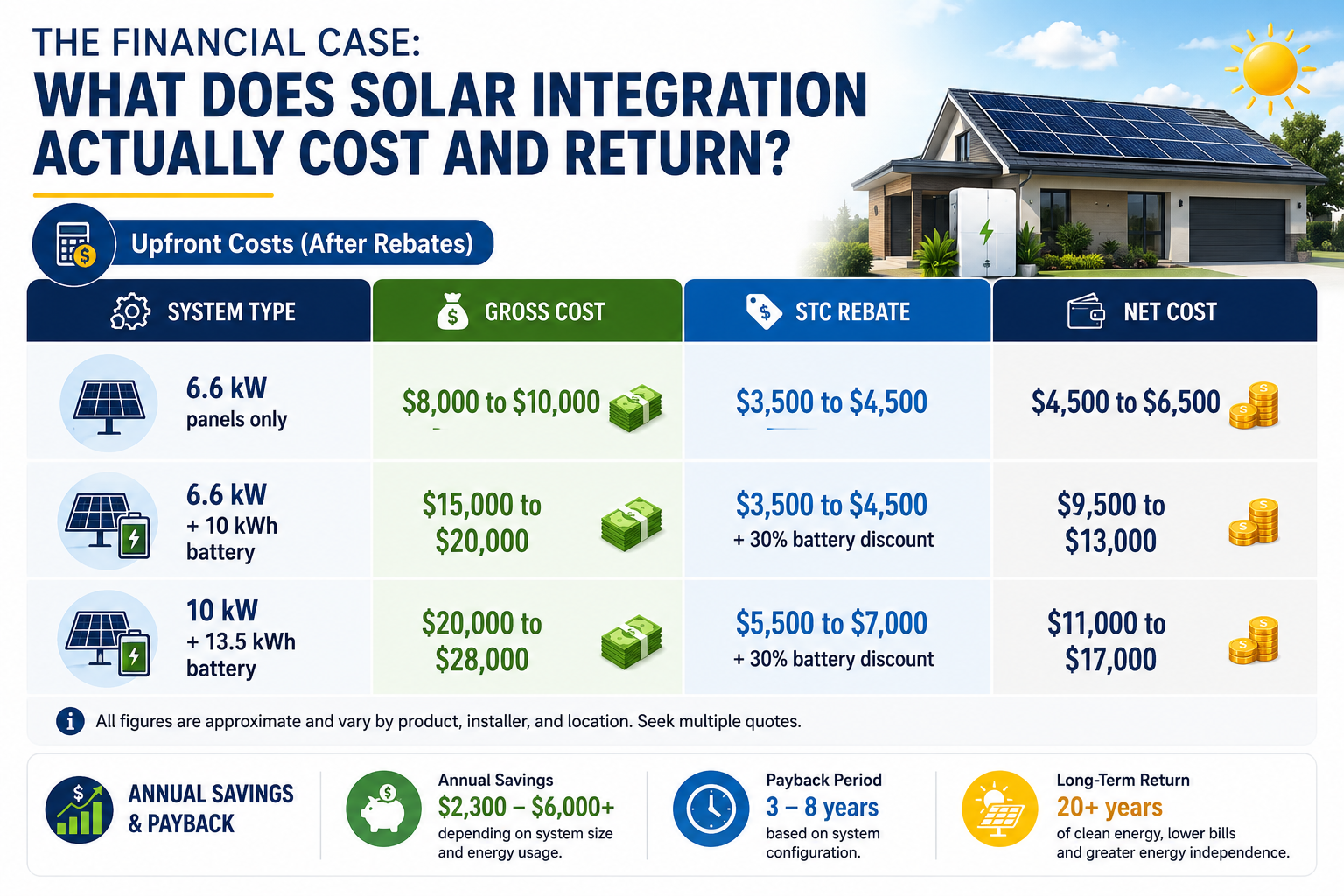
Upfront Costs (After Rebates)
Solar cost and return breakdown
All figures are approximate and vary by product, installer, and location. Seek multiple quotes.
Annual Savings and Payback
At current electricity prices and under time-of-use metering in Sydney, a well-configured 10 kW solar system with a 13.5 kWh battery delivering 75% self-sufficiency generates:
Annual savings of $4,500 to $6,000 on electricity
Feed-in tariff income of $200 to $600 depending on the retailer
Potential VPP income of $200 to $500 per year
That puts payback periods at 6 to 8 years for a premium system, and 4 to 5 years for a mid-range setup. With a 25-year panel warranty and 10-year battery warranty, the net lifetime return on a well-chosen solar integration system is substantial.
NSW Home Energy Saver Program (Current as of 2025)
The NSW Government's $557 million Home Energy Saver program offers:
Zero-interest loans of up to $15,000 for rooftop solar, batteries, insulation, and efficient appliances
Upfront discounts for eligible households
Access for renters (with landlord consent)
This removes the barrier of upfront cost entirely for many families. A $15,000 interest-free loan covering a solar battery installation, repaid through electricity bill savings, creates a day-one positive cashflow scenario.
Smart Solar Integration Systems: What Technology Looks Like in 2025
Modern solar integration for energy-efficient homes goes well beyond panels and a battery. Here is what a fully integrated system looks like today.
Hybrid Inverters
A hybrid inverter manages energy flows between your solar panels, battery, home loads, and the grid simultaneously. Top models from brands like Sungrow, Fronius, SolarEdge, and Enphase include built-in monitoring portals and can be upgraded over the air as software improves.
Smart Energy Management Platforms
Platforms like Tesla's Powerwall app, Reposit Power, or Amber Electric's smart control system allow you to schedule appliances, set battery charge targets, and automate energy decisions based on weather forecasts and electricity spot prices. Some platforms even automate dispatch into VPPs without any manual input.
Solar Hot Water Diversion
A hot water diverter (also called a solar diverter or solar controller) redirects excess solar energy that would otherwise be exported into your electric hot water system. For households in Parramatta, Epping, or Carlingford that still use electric storage hot water systems, this is one of the cheapest ways to increase self-consumption.
EV Charging Integration
With EV sales in Australia rising 38% in 2025 and representing 13.1% of new car sales, home EV charger integration is becoming a standard part of solar system design. A smart EV charger that charges only during solar generation hours can reduce household fuel costs to near zero.
What Happens If You Do Not Switch: The Consequences of Waiting
This is a conversation worth having directly. Many homeowners acknowledge they should investigate solar integration but keep deferring the decision. Here is what that costs in 2026.
The STC rebate is shrinking every year. The value available in 2026 is lower than it was in 2025, and the programme ends entirely in 2030. Every year you wait, you leave money on the table before you even start saving.
Electricity prices are not falling. NSW network charges and retail electricity rates have trended upward consistently. A household currently paying $3,000 per year in electricity bills will pay more next year, not less.
The battery retrofit window is open right now. With 3.7 million Australian homes already having solar but no battery, the CER is forecasting 350,000 to 520,000 new battery installations in 2026 alone. Installer demand is surging. Waiting risks longer lead times and potentially reduced availability of the federal 30% battery discount as program terms are reviewed.
April 2026 set a new record. Australia installed 442 MW of new rooftop solar in a single month, 31% above March and nearly double April 2025. This level of market activity means the best installers are increasingly booked out. Early movers get the best quality installs, the best products, and the best prices before demand peaks.
Collective savings are already $6 billion annually. Households with solar are collectively saving $6 billion in electricity costs every year. Every month without solar is a month of funding that outcome for others rather than for yourself.
Different Perspectives on Solar Integration
The Financial Pragmatist
"I want to know the numbers. Show me the payback period." For this homeowner, the case is clear. A 6-year payback on a system with a 25-year panel life is a 16-year profit window, producing returns well above any savings account or term deposit. The risk profile is also low: sunlight is not subject to market volatility.
The Environmentally Motivated Homeowner
"I want to do my part." A 10 kW solar system prevents roughly 12 to 15 tonnes of CO2 per year. Over 25 years, that is the equivalent of planting several hundred trees or taking a car off the road permanently. For families in the Inner West, Ku-ring-gai, or Lane Cove where environmental values are strong community norms, this motivation is entirely valid alongside the financial one.
The Sceptic
"I've heard people who installed cheap systems that didn't deliver." This is a legitimate concern. The Australian market has seen its share of unscrupulous solar installers and low-quality imported panels. The answer is not to avoid solar, but to research carefully: check CEC accreditation, read installer reviews, get three quotes, and ask specifically about brand quality and warranty terms.
The Renter or Apartment Owner
"Does any of this apply to me?" More than most people realise. NSW's SoAR grant funds shared rooftop solar on apartment buildings. Some energy retailers offer community solar products or virtual net metering that allows renters to access renewable energy. And the NSW Home Energy Saver program explicitly includes renters for certain upgrades with landlord consent.
FAQs
-
Solar integration is the process of connecting solar panels, battery storage, an inverter, and smart energy management into a coordinated home energy system. It goes beyond simply installing panels, ensuring that generated solar energy is maximised through intelligent storage, scheduling, and grid interaction.
-
Solar integration reduces electricity bills by generating free electricity during daylight hours, storing surplus energy in a battery for use at night, and automatically shifting energy-intensive appliances to times when solar generation is at its peak. In NSW, households with integrated solar and battery systems save between $3,500 and $6,000 per year on average.
-
Yes, for the majority of Australian homeowners. Australia has the highest per capita solar capacity in the world, excellent sunlight conditions, generous federal and state rebates, and rising electricity prices that increase the financial return year on year. The typical payback period for a solar integration system with battery storage is 5 to 8 years, with a system lifespan of 25 years.
-
NSW homeowners can access Small-scale Technology Certificates (STCs) that reduce upfront costs by 25 to 30%, the federal Cheaper Home Batteries Program (30% off battery installations from July 2025), VPP incentives for battery-equipped homes, and interest-free loans of up to $15,000 through the Home Energy Saver program.
-
A grid-connected solar system is one where your home's solar panels are linked to the public electricity network. During the day, your solar generates power for your home. Surplus is exported to the grid for a feed-in credit. At night or on cloudy days, you draw from the grid. When a battery is added, grid dependency is significantly reduced.
-
Most Sydney homes are suited to systems between 6.6 kW and 13 kW, depending on household size and electricity consumption. A single-person household in a terrace typically needs a 3 to 5 kW system. A family of four in a freestanding home in Ryde, Burwood, or Hornsby will generally benefit from a 10 kW or larger system.
-
Yes. The NSW Solar for Apartment Residents (SoAR) grant covers up to 50% of shared rooftop solar installation costs for apartment buildings with 3 to 55 units. Applications are open to owners corporations through the NSW Government's energy programs.
-
A solar battery stores excess electricity generated by your solar panels during the day. That stored energy is then used at night or during peak electricity price periods, reducing what you buy from the grid. Modern batteries like the Tesla Powerwall hold 13.5 kWh, enough to power a typical family home through the evening and overnight.
-
A Virtual Power Plant is a network of home battery systems that are connected and managed collectively to support the electricity grid. When demand spikes, the VPP discharges energy from all connected batteries simultaneously. In NSW, households participating in VPPs receive financial incentives and can also receive feed-in payments beyond the standard tariff.
-
For most freestanding homes in Sydney, solar panel installation takes one to two days. More complex systems involving battery storage, switchboard upgrades, or three-phase power connections may take two to three days. Connection to the grid and activation of your system typically takes a further one to two weeks, depending on your network operator.
Final Thoughts: Solar Integration Is Not the Future. It Is Now.
The conversation about solar integration for Australian homes has moved well beyond "should I do it." The question now is "how do I do it well." With over 4 million systems already installed, Australia has become the world's most solar-saturated nation. The infrastructure is mature, the products are proven, and the incentives have never been better aligned.
For homeowners across Burwood, Ryde, the City of Sydney, Cumberland, Hunters Hill, the Inner West, North Sydney, Strathfield, Willoughby, Woollahra, Ku-ring-gai, Lane Cove, and Hornsby, solar integration is not a luxury or an experiment. It is a financial decision with calculable returns, a lifestyle choice with real comfort benefits, and a contribution to the community energy system that every neighbourhood needs.
The only mistake is waiting.
Information current as of June 2026. Statistics sourced from the Clean Energy Council, Clean Energy Regulator, SunWiz, pv-magazine Australia, and the federal DCCEEW. Rebate programs and tariff rates are subject to change. Always seek quotes from CEC-accredited installers and verify current incentive details through the NSW Government's energy portal at energy.nsw.gov.au.